Your First 90 Days of GEO: A Week-by-Week Checklist
A first 90 days of GEO runs as a 13-week, four-stage cycle, not a publishing calendar. The full table, deliverables as acceptance units, and an honest record of what we did not finish.
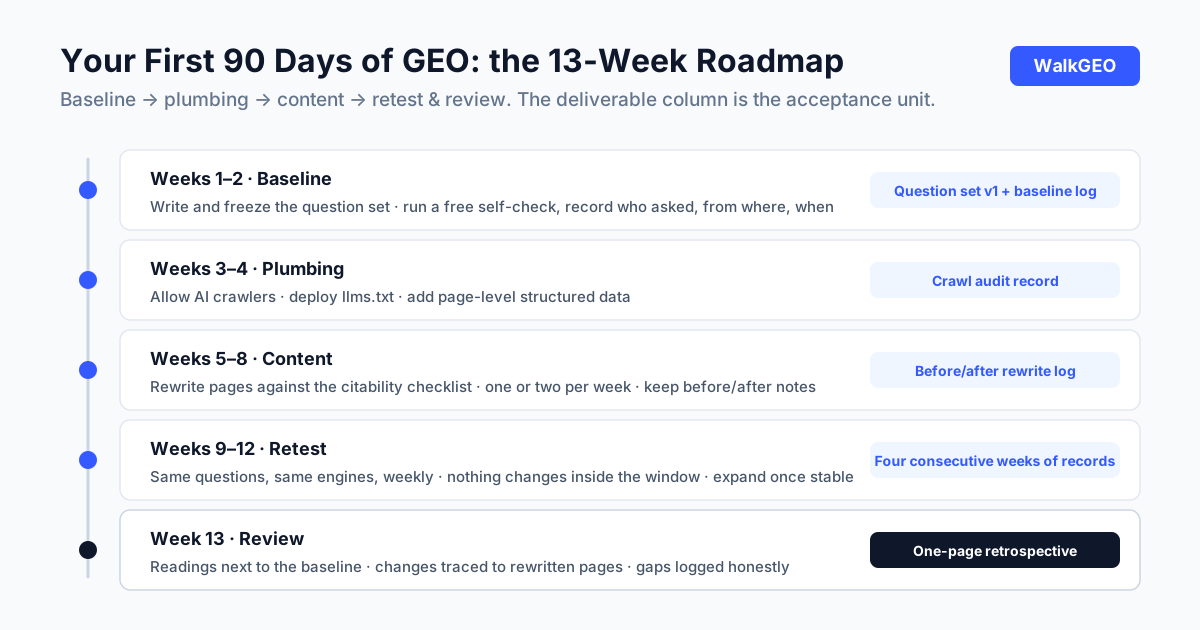
Your first 90 days of GEO is not a publishing calendar. It is one lap of a four-stage cycle: establish the baseline, fix the plumbing, rewrite content, retest and review. The full 13-week table is below, followed by notes on how to fill each row, what each deliverable looks like, and which step gets skipped most often. Follow it as written and by week 13 you will hold a complete record that answers three questions: what was done, whether anything changed, and what the next lap should be.
The 13-week overview
| Weeks | Stage | Core actions | Deliverable | Owner |
|---|---|---|---|---|
| 1–2 | Baseline | Write the question set, run a free self-check, record first readings | Question set v1, baseline log | Marketing |
| 3–4 | Plumbing | Allow AI crawlers, deploy llms.txt, add structured data | Crawl audit record | Engineering |
| 5–8 | Content | Rewrite pages against a citability checklist, one or two per week | Before/after rewrite log | Content |
| 9–12 | Retest | Same questions, same engines, weekly readings; expand once stable | Four consecutive weeks of retest records | Marketing |
| 13 | Review | Compare against baseline, decide the next cycle's focus | One-page retrospective | Everyone |
Read the table with three things in mind. The deliverable column is the acceptance unit, not effort: if two weeks pass and the question set is not frozen, the stage is not done, and there is nothing to argue about. The owner column exists for teams that divide work; working alone, read the whole column as yourself and keep every deliverable. And the table schedules actions, never outcomes. Any row promising "visibility at X% by week 12" digs your own acceptance trap in advance.
Weeks 1–2: nail down the question set and the baseline
The question set is the ruler every later reading gets measured against. Write 15 to 30 sentences your buyers would actually ask, balanced by journey stage and whether they name your brand by name; the design method and the freezing discipline are laid out in our prompt set guide. Baseline readings come out the same week: ask the questions manually, screenshot the answers, and record who asked, from which interface, on which date. The manual methods are listed in free AI visibility checks. That one line of provenance is worth more than the number itself.
When we set our own blog plan on October 29, the first thing written down was the clustered list of questions to cover; the first article went out the next day straight from that list. A rough list on paper beats a perfect one in your head, because every following week checks its readings against it.
Done looks like this: question set v1 frozen for four weeks, and a baseline log with one row per question.
Weeks 3–4: let the AI crawlers in
Technical access work, and every task in it verifies in under an hour. Walk through your robots.txt against the mainstream AI crawler list; the classic failure is a CDN or firewall blocking AI user agents by default, and the full self-check lives in the robots.txt audit. Deploy llms.txt alongside your site documentation; the format and our own deployment are covered in the llms.txt guide. Add structured data for page-level facts; the four mark-up types are compared in the Schema primer.
Leave an audit record behind: allow/block status per crawler, the live URL of llms.txt, and which page types carry which mark-up. Two weeks later, when someone asks what engineering actually did, this record is the answer.
Weeks 5–8: rewrite content at one or two pages a week
Pick targets by priority: pages AI has cited but that now hold outdated facts, pages matching high-intent questions, product fact pages. Run each through the six-item citability check: conclusions first, paragraphs that stand alone, sourced facts, visible update dates. One or two pages a week is deliberately slow. Rewriting is page-level work, and rushing it drifts back toward bulk spam; where that path leads is documented in the programmatic GEO piece.
Keep a before-and-after note per page: which paragraphs changed, which facts were added, what sources back them. During retesting this habit saves you: when a number moves, you map it to a specific page instead of guessing at a curve.

Weeks 9–12: retest on the same questions, expand only when stable
Retesting has one rule: same questions, same engines, same recording method. Ask the full set weekly, log readings into one table, and fix the definition of every metric, including what counts as a valid sample, following the metric definitions in our metrics explainer. Four weeks make one observation window, and inside the window you change nothing, no matter how tempting.
Expansion comes after the readings stabilize. If engine coverage is thin, add engines using the portfolio logic in multi-engine monitoring. If question coverage is thin, add questions justified by retest data rather than hunches. Data signals may cut in line: on November 9, the top query in our Search Console dashboard became a new article the same day it appeared. What never cuts in line is the recording method; break that and four weeks of comparable readings go with it.
Week 13: review, then decide the next lap
Week 13 does one thing: put retest readings side by side with the baseline. If the change sits inside the noise band, write "no change" plainly; if something moved, trace it to the pages rewritten in weeks 5–8 and state the causal chain. Then decide the next cycle: keep rewriting, expand engines, or shift budget to off-site presence in the same voice. Every one of those decisions should cite records you already hold.
Our own 90 days did not score full marks either. Six backlog topics remain unscheduled, and a title experiment on two engine articles has to wait for four full weeks of data before we settle the wording. All of it sits in the "unfinished" section of our retrospective note. A schedule with honest gaps beats a green scoreboard; the gaps tell you where the next lap actually starts.
Common ways this plan breaks
Compressing 90 days into "publish a hundred pages at once". Output outruns quality, bulk low-grade content gets treated as noise by the ecosystem, and the mechanics plus the exit are covered under bulk spam in the black-hat red flags.
Buying a full-service package in week one. Without a baseline you have no grip to push back when a vendor claims a 50% lift; measure one round yourself first, then talk procurement. The whole negotiation path, from baseline to exit clauses, is in the contract ten-clause piece.
Judging success on hourly readings. AI answers wobble by nature; at daily granularity everything looks like noise. How long GEO takes runs the math: weekly retests, four weeks minimum, before trend separates from jitter.
Common questions
Is 90 days actually enough to see GEO results?
It is enough to finish one full cycle, but the word "results" only has meaning against your own baseline: in week 13 you put the retest readings next to your week-1 records, and what moved, moved. Anything promising numbers without your baseline deserves suspicion about how it plans to deliver.
I'm doing this alone. What about the "owner" column?
Read the whole column as you. The owner column exists to stop finger-pointing on teams; what actually prevents rework is the deliverable column, because a frozen question set, a saved crawl audit, and consecutive retest records do not depend on headcount. If you work solo, add one thing: put each week's actions on your calendar and let the calendar, not memory, carry the schedule.
Can I change my monitoring question set mid-cycle?
Wait until the observation window closes. The moment questions change, readings before and after stop being comparable and the sampling budget already spent goes to waste. Week 13 is the right place to revise; write the reason into your retrospective note. Keep both versions around so the next cycle can be read against the old one.
I've done SEO for two years. Can I skip the first four weeks?
No, but you can compress them. Allowing AI crawlers, deploying llms.txt, and adding structured data sit outside classic SEO, and your established site may be blocking some crawlers by default. The question set and the baseline are entirely new; keyword rankings will not help you there. Your two years pay off in weeks 5–8, where you already know your own pages and can rewrite them faster than anyone starting cold.
There is no hidden technique in a GEO 90 days; every action is listed above, and what remains is putting them on a calendar and honoring the weeks. Two things are doable today: copy the overview table into your project tool, and write your first ten monitoring questions; by this time next week they should be frozen as v1. Once retesting starts, the weekly close-out routine picks up where the weekly table ends, and when sampling needs a tool's hands, pricing shows what that hand-off looks like. Most of the WalkGEO blog itself is running on this weekly table; the articles you are reading came out of its weeks 5–8.
Done reading? Run the same audit on your own site
Sign up, then let the agent scan every page and hand you a prioritized fix list. Your first audit is free.
Run a free site audit