Retrofitting Thousands of Old Pages for AI Search: A Prioritization Guide
Thousands of old pages cannot all be rewritten. Score them by traffic value, AI relevance and fix cost, then split mechanical cleanups from human judgments.
With tens of thousands of old pages, the first instinct is to rewrite the whole site. That path does not work. Effort gets spread across every URL, and the usual result is a small edit everywhere and a finished page nowhere. What works is ranking: pick the small set worth doing properly, make those pages extractable and checkable, then move to the next batch on a schedule.
The priority scorecard
A retrofit means updating published pages in batches by value and risk, not rewriting the whole site. Here is the table first; each cell is explained below. Score each row 1, 3 or 5, and fill the evidence column with a link or a screenshot location. If you cannot produce evidence, score low.
| Dimension | Question to answer | 1 point | 3 points | 5 points | Where the evidence lives |
|---|---|---|---|---|---|
| Traffic value | Does the page still receive real questions? | No visits, no internal links | Occasional visits | Steady high-intent queries | Site analytics, GSC query report |
| AI relevance | Would someone ask this verbatim? | Pure brand promotion | Broad category terms | A specific question answered directly | Sales notes, support tickets, answer samples |
| Fix cost | How much work to make facts checkable? | New interviews, full rewrite | Add sources and structure | Dates, terms and links only | Page-by-page inventory |
| Error risk | Could stale facts be repeated as truth? | No factual claims | Outdated but minor | A key fact is wrong and cited | Answer samples, user reports |
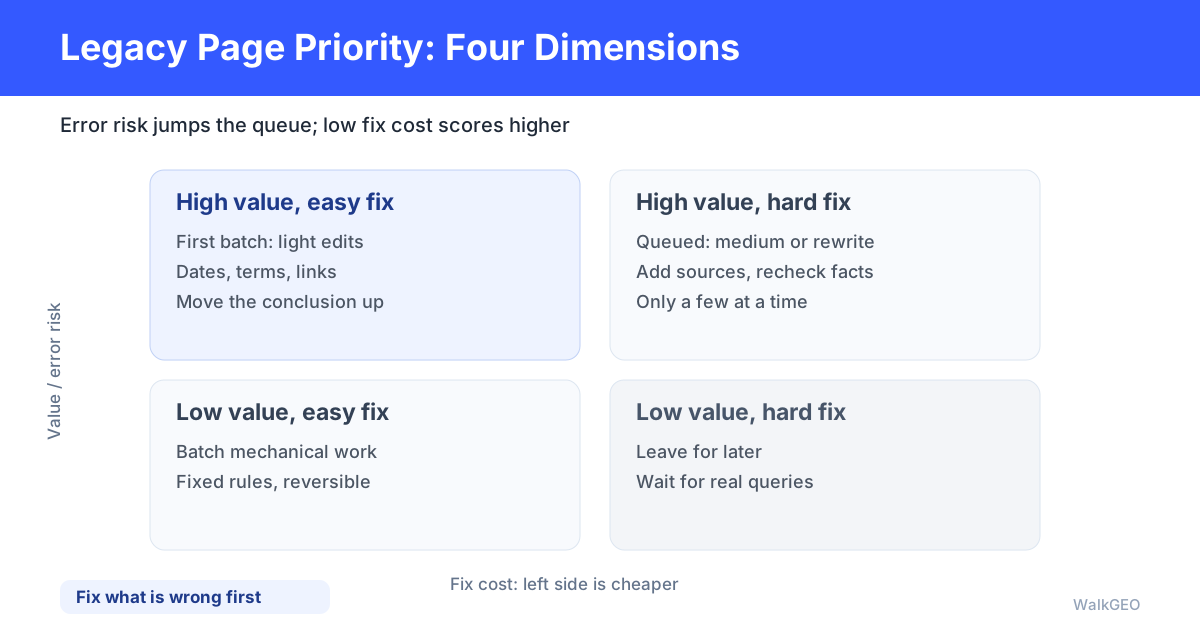
The total is not precise science. Its job is to force the judgement into writing. Cost runs in reverse: the easier the fix, the higher the score, because the same effort clears more pages. Error risk gets its own row because one class of page actively outputs wrong facts and cannot be queued like ordinary underperformers.
Traffic value: do not manage old pages like a homepage
The common mistake is treating visits as the only signal. Low traffic does not mean low value: some pages are the only usable answer to a long-tail question, used a few times a day by exactly the right reader. Other pages get plenty of visits from navigation, hold attention for seconds and contribute nothing to an answer engine.
Look at two things: whether real queries still land on the page, and whether other pages link to it. Queries mean external demand still exists. Internal links mean the site still treats it as an entry point. A page with neither can wait, unless error risk pulls it forward.
AI relevance: the words people actually use
This dimension sets the direction of the fix. Put the page title next to the user's sentence. A title like "Product advantages at a glance" does not match "which one suits a small team". Adding paragraphs rarely bridges that gap. A title that already says "how a small team should choose a GEO tool" only needs a clean answer structure to be extractable.
Where do the original sentences come from? Call notes, support tickets, public Q&A communities that repeat the same phrasing, and the question set you already sample in answer engines. Do not invent user language from internal vocabulary. In citeable content we covered leading with the answer and keeping paragraphs self-contained. Retrofitting is the reverse of that process: find the question first, then check whether the page contains a standalone answer.
Some pages will never score well here: dated news timelines and event recaps with no conclusion. They can stay as archives. Do not expect a few line edits to turn them into frequently extracted material.
Fix cost and error risk: one is about effort, the other about urgency
Cost orders the queue. Error risk jumps the queue.
Low-cost pages need mechanical work: unify terms, add a check date, repair links, make the author record visible. None of that requires a new factual judgement, so templates and scripts fit. High-cost pages need fresh interviews, new numbers or a rewritten argument. There are only so many of those in a day.
Error risk ignores the total score. If an answer engine is repeating a specification you got wrong three years ago and the page is still public and crawlable, fixing it outranks any high-scoring page. That is damage control, not a forecast. The 90-day roadmap puts "fix what is wrong" before "add more", for exactly this reason.
Three levels of action
After scoring, assign a level so a small job does not become an engineering project.
- Light: change the date, unify names, attach an author, repair links, move the conclusion into the first paragraph. A dozen a day is realistic; review only mechanical checks.
- Medium: add sources, replace vague claims with checkable statements, split long paragraphs into extractable units. Each paragraph needs human judgement; a few a day is a good pace.
- Full rewrite: the facts are wrong or the structure cannot carry the question. Write to the standard of a new article, keep the old URL and redirect it. Do not let external sources point at a page that disappeared.
Choosing the wrong level wastes effort. A rewrite for a page that only needed a date spends people on nothing. A date change on a page with a wrong fact simply refreshes the error. The test is simple: does the page contain an assertion nobody can verify? If so, medium is the floor.
The line between batch work and human work
Two failure modes matter in large retrofits: never starting, and changing too much too uniformly. The boundary can be stated plainly. Anything with a fixed rule gets batched. Anything requiring judgement stays with a person.
Batchable: writing a common check date, replacing an old domain in links, applying one author record to pages missing one, swapping anchor text through a mapping table. Each result can be verified one by one and rolled back.
Not batchable: generating opinions, inventing cases, inserting keywords from a template, spinning one article into ten similar pages. That is the bulk low-quality pattern in black-hat self-check. It solves no factual problem and adds noise that engines must filter. Before adding a rule that writes text automatically, ask who would notice when the rule is wrong. If nobody would, do not automate it.
One correction we had to make
We have an article about measuring AI visibility. It went live in late October and got a substantive update in early November. The reason was not a factual error. It was that the page did not contain the sentences people actually asked.
The first batch of real GSC queries arrived: eight English phrasings about measuring brand presence in AI search. Our title used different words. The draft read smoothly in internal vocabulary, but neither the title nor the FAQ carried the user's sentence. The update was deliberately small. We kept date at 10/27, moved updated to 11/03, added those phrasings into an H2 and the FAQ, and left the statistical section untouched.
The lesson: the most common gap in old-page updates is not stale facts. It is a mismatch between the language of the page and the language of the question. A few words separate them, and answer engines will not do the synonym work for you. It also reminded us not to equate a good update with a big one. Sometimes a few dozen changed characters are the whole job.
What does that mean for you? When auditing old pages, pull the real queries alongside what the page says and align them line by line. The mismatches are the first places to edit.
Re-testing after a retrofit
Traffic alone is too slow. After changing a page, send its related fixed questions to the same engines and record three things: whether the page appears, whether facts are repeated correctly and whether the source link changed. These show direction within days; traffic takes longer.
Use the same fields as AI citation tracking and never swap the question set. If several weeks bring no change, check whether the questions were wrong before adding more edits. Volume cannot fix a structural mismatch.
Common questions
Can every old page really be updated?
No. Spreading a small team across every URL leaves every page slightly touched and none properly fixed. A workable approach is to score and rank, make the first small batch genuinely solid, then move down the list on a fixed cadence. Pages outside the first batch are not abandoned; they are waiting for evidence that puts them higher.
Which legacy pages deserve attention first?
Three kinds: pages still answering a specific high-intent question, pages cited by AI but clearly out of date, and pages whose wrong facts are being repeated in answers. The third group is the most urgent because it is not merely missing exposure; it is actively publishing an error on your behalf. Homepages and pure brochure pages usually belong to none of the three.
How is bulk cleanup different from bulk filler?
Look at whether the action has a fixed rule. Adding check dates, standardising terms, repairing links and attaching an author record are mechanical and scriptable. Generating opinions, inventing cases and stuffing keywords have no rule to check against; they just copy low quality many times. The first group cleans facts. The second manufactures noise.
How do I know a retrofit worked?
Re-test with a fixed question set rather than watching traffic alone. Ask the same questions to the same engines before and after, and record whether your page appears, whether facts are repeated correctly and whether the cited source changed. Traffic lags; changes in answers arrive sooner. If several weeks show nothing, re-check the questions and the page before increasing volume.
Old content is not a liability. Unranked old content is. The move today: export a page list, score each row on the four dimensions above, and pull out everything whose error risk is high. Fix those first, then work the queue a small batch at a time on the weekly routine. Scope and pricing are on product and pricing. WalkGEO kept the original publish date on that measurement article, moved the update date and added the missing user phrasings; the structure stayed as it was, so you can open it and compare.
Done reading? Run the same audit on your own site
Sign up, then let the agent scan every page and hand you a prioritized fix list. Your first audit is free.
Run a free site audit