How to write content that AI actually cites
AI extracts fragments, not articles, so citability is fragment-level work. Six checks with good and bad examples each, plus the lesson from when our own construction checker flagged us.
AI pulls fragments from your page, not the page itself: an eighty-word definition, a five-row table, one question with one plain answer. So being cited is never an article-level event; it is fragment-level work. Your page needs a few paragraphs that can be lifted out and dropped straight into an answer. You do not need intuition to check this; six items, each with a good example and a bad one. The table first, then each item.
| # | Check | Pass standard |
|---|---|---|
| 1 | Conclusion first | Each section's first sentence states the conclusion, no warm-up |
| 2 | Self-contained paragraphs | Lift any paragraph out; it reads without context |
| 3 | Factual density | Key parameters, numbers, or conditions present |
| 4 | Verifiable sources | Numbers and claims carry origins; links resolve |
| 5 | Visible update date | The page shows its last substantive revision |
| 6 | FAQs in user wording | Questions written as real queries; answers delivered straight |
Item 1: conclusion first
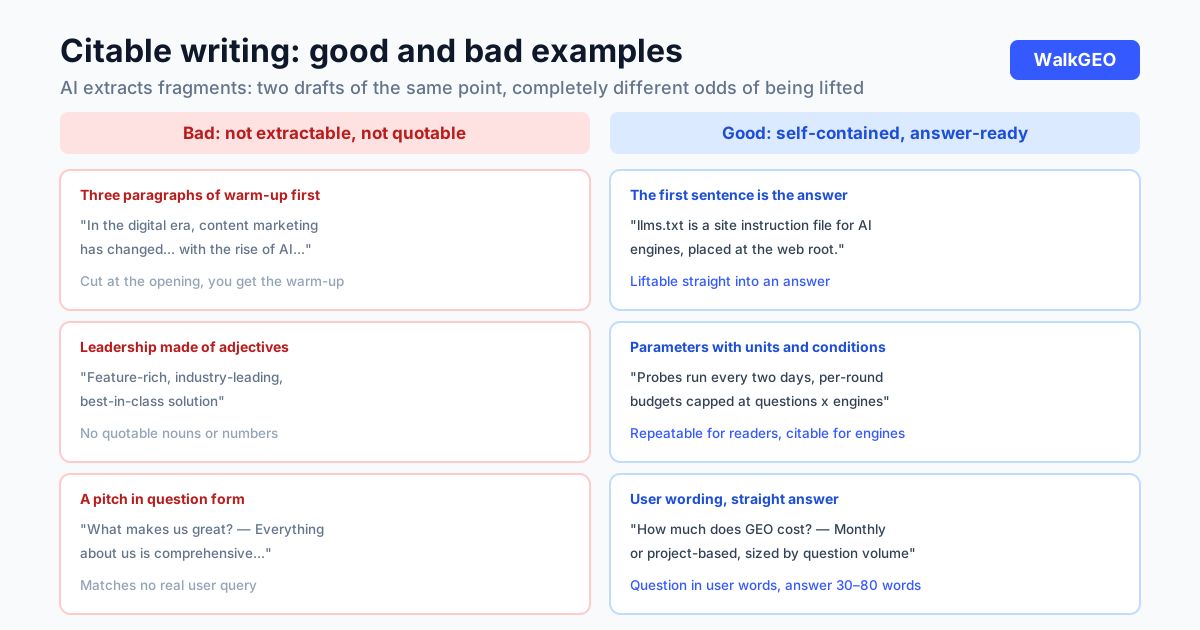
Bad: three paragraphs of background before the answer appears in paragraph four. Good: the first sentence is the answer itself, "llms.txt is a site instruction file for AI engines, placed at the web root." Engines cut fragments from openings; skimming readers read openings too; one change serves both. The inverted pyramid is not a newsroom custom, it is the first law of extractability.
Check: cover everything after the first sentence; can it still answer the section heading alone?
Item 2: self-contained paragraphs
Bad: paragraphs opening with "as mentioned above" or "in other words", crippled outside their context. Good: every paragraph carries its own subject and a complete claim, ready for an engine to lift while assembling an answer. A cheap test: paste the paragraph alone into a chat window and ask a colleague what it says. An answer means it passes; a blank look means add the subject and the qualifiers.
Check: sample three paragraphs and run the paste test; all three must stand alone.
Item 3: factual density
Bad: "feature-rich with industry-leading performance", adjectives carry no information and an engine cannot cite one. Good: "probes run every two days, with per-round budgets capped at questions times engines", concrete enough to repeat and to cite. Specificity has a side effect: it forces vague promises into checkable statements, harder to write and worth every word.
Numbers deserve their own care. Digits with units, conditions, and time windows are citable; "every two days" beats "frequently", "verified November 2026" beats "recently". Five extra keystrokes while writing, a higher chance of being chosen later.
Check: strike every adjective; count what information the nouns and numbers still carry.
Item 4: verifiable sources
Bad: industry data with no origin, or citation of a citation of a citation, the source unreachable. Good: every figure carries a source and a year, external links point at official documentation or a publicly checkable primary page. This connects directly to how engines choose sources: they look for whoever is most checkable, and your own citation practice is the business card you present. Restrict external links to two per article, official documents first.
Retranslation deserves restraint. Secondhand retellings drift as they pass hands, so walk industry figures back to a source anyone can open: official docs, the paper itself, a checkable media page. Data with no findable origin is better unused; one unsourced number contaminates the credibility of the whole page, and engines hold grudges just like readers.
Check: does every percentage sit next to a source and year, clicked open before it shipped?
Item 5: visible update date
Bad: no way to tell when the page was written, three-year-old pricing in today's packaging. Good: substantive revisions update the annotation, publish date and revision date kept separate. Engines handle recency conservatively, preferring clearly dated older material over vague fresh material; showing the date turns freshness into evidence instead of a guess the engine has to make.
Check: does one explicit date exist on the page, updated when the content was?
Item 6: FAQs in the user's wording
Bad: FAQs written as "what makes us great", a sales pitch in question form. Good: questions in the user's actual phrasing, "how much does GEO cost", "AI has my company info wrong, how do I fix it", with answers of 30 to 80 words delivered straight. On our site, every article's FAQ entries flow into the page's FAQPage structured data, so the question wording decides whether it matches a real user query. Where the question phrasing comes from, support logs, on-site search, live forum posts, earlier articles cover in detail.
Check: read each question aloud; would you type it into a search box yourself?
Where structure ends
Six items done, one judgment remains: structure is for machines, judgment is for people, and a page needs both. An article of nothing but bullets is easy for engines to dismantle and unreadable as an argument; no shares, no return visits, no long-term value. Lists carry steps, parameters, and checklists; paragraphs carry reasoning and tradeoffs; FAQs carry questions and answers, each form to its own shelf. A workable ratio: argument paragraphs hold at least half the body, lists handle conclusions and check items.
The time our own checker flagged us
The lesson happened in this house. After 28 articles we audited our own library, and the result was ugly: every article had grown into the same template, an average of 23 dashes per piece, closing formulas reused across articles, FAQ answers opening with the same two characters like they came off one press. Fragmentation for engines had drifted into formula for engines. The fix turned template-smell into an executable check: a construction-fingerprint script counting dashes, flagging signature words, screening closing formulas; the baseline run found 105 violations across 28 articles. Now every article passes the script before it ships, and over-quota means rewrite.
The meaning for you sits at the boundary: fragmentation is not pulverization. What you extract are self-contained fragments, not judgment-free crumbs; structure lets engines lift your conclusions, and argument lets readers trust them. Do both and citation and trust arrive together. As for relapse, our quotas are not editorial whims but script-enforced counts: the machine screens construction first, a human reads for judgment second, and each layer minds its own.
Frequently asked questions
Does AI really prefer to extract FAQ sections?
Extraction does not recognize section types, only self-contained fragments. FAQs get picked often because a question and a plain answer form a complete unit by themselves: the question is the user's own wording, the answer reads fine with no context. Apply the same discipline to body paragraphs and it works the same. Answers of 30 to 80 words, delivered directly, with length variation, not stamped from one mold.
Do more headings and lists mean more citations?
No. Structure serves extraction; judgment serves the reader; a page needs both. An article that is nothing but bullet lists is easy for engines to tear apart and unreadable as an argument, so nobody shares it and the material loses long-term value. Match the form to the content: steps and parameters in lists, reasoning and tradeoffs in paragraphs.
Where do I start when refreshing an old article?
Item one, and walk the list in order. First check whether each section's opening sentence stands alone, then whether facts carry sources and dates. We have refreshed our own articles, embedding real queries from Search Console into titles and FAQs, with every revision applied to both language versions in sync. Revisions land in the updated field; the publish date stays.
How long until a rewrite shows up in citations?
Engineering fixes take effect at the next crawl; material fixes wait for the engine to re-retrieve and re-check, days to weeks at best, usually read on a four-week observation window. The test is not a feeling of improvement, it is the week-over-week movement of mention and citation rates on a frozen question set. Our timeline article covers the full schedule.
Run the six checks after drafting, then ask the last question: would a reader share this, and could an engine use the lifted paragraph as-is? Both yes, and the paragraph is done. The six checks are also daily life on WalkGEO's own content line: the machine blocks construction first, a human blocks judgment second; if you want a standing review cadence for your own pages, the weekly routine is copy-ready. For the mechanics behind the six checks, how AI picks sources explains why engines choose the way they do; to verify the effect of a rewrite, the paths live in free AI visibility check and the citation tracking guide; and what is GEO is the starting point for the whole practice.
Done reading? Run the same audit on your own site
Sign up, then let the agent scan every page and hand you a prioritized fix list. Your first audit is free.
Run a free site audit