How long does GEO take? A weekly operating rhythm
No single number answers 'how long does GEO take' — but each class of action has a checkable clock: gate fixes verify same-day, indexing runs days to weeks, citations show across weekly re-tests.
"How long does GEO take" is the question everyone asks and no honest practitioner answers with a number — because there isn't one. What exists instead is a checkable clock per class of action: some things finish and verify the same day, some move at the engine's re-crawl pace, and some only show direction across weeks of disciplined re-testing. Treat "results" as one blob and you'll wait blindly. Split it into gates, indexing, and citations, and every class has a completion standard you can actually verify. This article gives you that timetable, plus two real same-day closes from our own site.
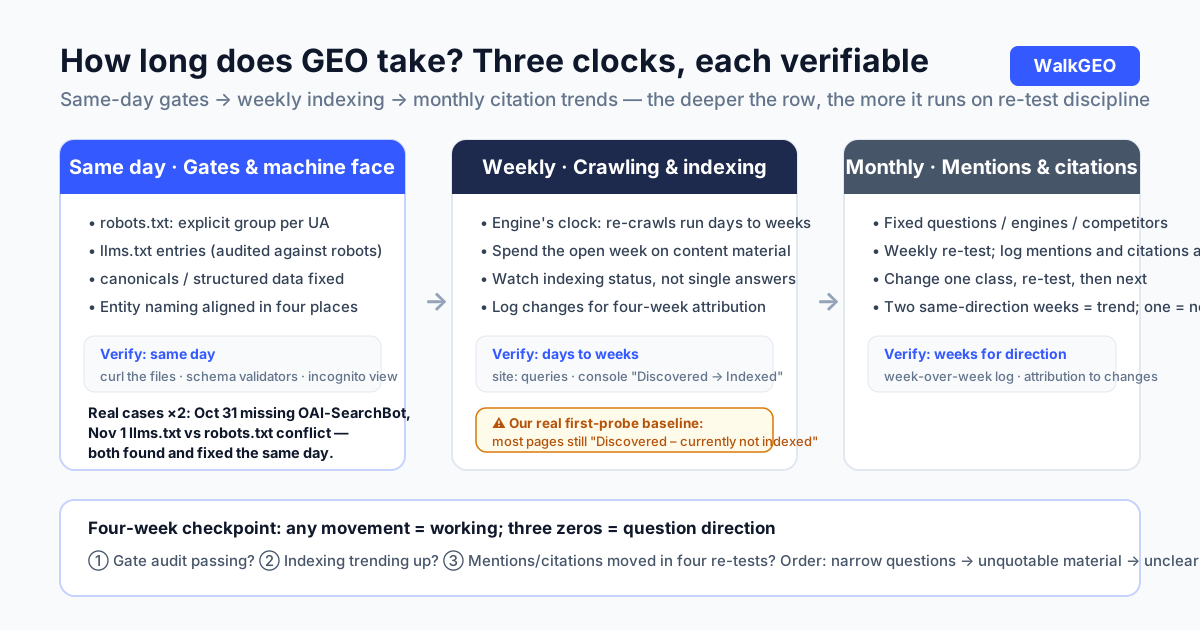
Split "results" into three checkable classes
| Action class | Typical work | Clock | How to verify |
|---|---|---|---|
| Gates & machine face | robots.txt rules, llms.txt entries, structured data, canonicals | Same day, same-day verify | curl the files, schema validators, crawler-view tools |
| Crawling & indexing | New pages discovered, entering the search index | Days to weeks | site: queries, search console status changes |
| Mentions & citations | AI answers start naming you, citing your pages | Weekly re-tests, watch the trend | Fixed question set, week-over-week comparison |
The first row is entirely yours. The second runs on the engine's re-crawl schedule. The third stacks material quality and question-set fit on top. The further down the table, the less you can directly intervene and the more you can only observe on a weekly cadence. The reason "how long" has no single answer is that askers usually blend all three rows: the gates were fixed today, but citations are still waiting for the engine's next crawl. That's not "no results" — that's "not your row yet."
Same day: close every gate
Class-one actions share one property: same-day closure. Change something, verify it immediately with a command, and no third party is involved. Opening robots.txt to AI crawlers, adding llms.txt entries, fixing canonicals and structured data, correcting entity naming inconsistencies — all of it belongs here.
Two real examples from our own site, both completed discovery-to-fix-to-shipped in one day:
October 31. While writing our robots.txt audit guide, we checked our own file UA by UA and found we were missing OAI-SearchBot — the crawler behind ChatGPT's search retrieval had no explicit entry and was living on the wildcard default. We added the explicit group that day and shipped it with the build. The full story is in that article's case section.
November 1. A better example. During a site audit for our pricing page migration, we found a self-contradiction: llms.txt was recommending /app/pricing to AI engines while robots.txt's Disallow: /app/ blocked the entire path — two machine-face files telling engines opposite things. Any retrieval-based engine would trip on this: the guide says come in, the gate says stay out. Same day, we moved the pricing page to an indexable path, turned the old path into a 301, and restored consistency between the two files. The insidious part is that neither file "errors" on its own — the contradiction only shows when you read them against each other. That's exactly why audit checklists pair the machine-face files together.
The completion standard is concrete: curl pulls the changed files, status codes are right, key pages read without login. What closes in a day shouldn't be stretched into a week of engineering.
Weekly: crawling happens, watch indexing
Class two runs on the engine's clock. You've opened the gates and fixed the structure — the next crawl of your site might come tomorrow or in two weeks, depending on your site's weight and update frequency. You can't rush it, but three things decide whether the wait is wasted:
- Give the week to content. When the crawler comes, there should be something new to take — quotable definition sentences, numbers with sources, structured question-answer pairs. The material standard lives in how AI picks sources.
- Watch indexing status, not single answers. The search console shift from "Discovered – currently not indexed" to "Indexed" runs in days to weeks. When we ran our first probe, most of our own pages were still stuck in the earlier state — indexing in progress is normal, not a red flag.
- Log every change. What changed, which day, why — one line each. In four weeks, your attribution work depends on this log.
The discipline here is not verifying effects daily. Engine re-crawls are weekly-scale events; searching your own brand in an AI every few hours produces pure noise — mentioned today, gone tomorrow is usually retrieval jitter, not your change.
Monthly: mention and citation trends
Class three is what people actually mean by "results": AI answers naming you, citing your pages. The observation cycle here is naturally a multiple of weeks, because it stacks two cadences — engine re-crawls (days to weeks) and corpus/retrieval refreshes (longer). Your job is to make the observation solid:
- Fix the question set. Three things stay constant — questions, engines, competitor list — or weeks aren't comparable. The framework setup is in how to measure your brand's AI visibility.
- Re-test weekly; log mention rate and citation rate separately. Mentions: does the answer name you? Citations: does it link you?
- Change one class at a time. Gates this week, content next week — never both, or the re-test attributes nothing and four weeks later you hold a pile of mixed variables.
A simple trend rule: two consecutive weeks in the same direction is a trend; a single week's swing is noise. This re-testing discipline isn't about precision — it's immunity to "I asked three times today and it didn't mention me" self-scares.
When to doubt the direction
A timetable needs an exit condition. Set a four-week checkpoint with three checks:
- Is the gate audit fully passing (class one closed)?
- Is search indexing trending up (class two moving)?
- Across four weekly re-tests, did mentions or citations move at all (class three signaling)?
Any movement means it's working — keep the weekly rhythm. Three zeros mean it's time to question direction, in this order: is the question set too narrow (only brand queries, while users ask category queries); is the material worth citing (pure self-promotion has no definition sentence or sourced number an AI could lift); is the entity still unclear (company and product names disagree across your site, articles, and structured data). Check your own questions and material before doubting the method — most "did everything, nothing happened" cases stall in the first two.
| Symptom | Likely cause | Fix |
|---|---|---|
| Four weeks, still "Discovered – not indexed" | Weak crawl signals | Check sitemap and internal links; route links to new pages |
| Indexing up, mentions at zero | Question set and material mismatched | Widen the question set from brand to category and scenario queries |
| Mentioned sometimes, gone other times | Single-week noise read as trend | Two same-direction weeks before judging; widen the question set |
| Mentioned, but the info is wrong | Entity inconsistency | Audit names and facts across the site for consistency |
FAQ
How long does GEO actually take to show results?
Split it by action, not by a blanket promise. Gate work (robots.txt, llms.txt, structured data) finishes and verifies the same day. Indexing moves at the engine's re-crawl pace — days to weeks. Mention and citation trends need weekly re-tests against a fixed question set, and usually take several weeks to show direction. Any "guaranteed in N days" pitch fails this test: every step of showing results runs on the engine's crawl and refresh cadence, not on you or your vendor.
Can I get cited by AI the same day I make changes?
Gates verify the same day; citations don't happen that day. Real-time retrieval engines (ChatGPT search, Perplexity) cite through a fetch → retrieve → cite chain. You control the first step's same-day completion; the next two run on the engine's clock. What you should do today is curl the files to confirm the gates are open and pages are readable — then move to a weekly rhythm instead of watching single answers.
How do I know GEO isn't working at all?
Set a four-week checkpoint with three checks: gate audit fully passing, search indexing trending up, and four weekly re-tests of the fixed question set. Any movement means it's working; three zeros mean it's time to question direction — in this order: is your question set too narrow, is your material self-promotional with nothing worth quoting, and is your entity still unclear about who you are. Check your own questions and material before doubting the method.
Why can't I change many things in the same week?
Re-testing earns its value through attribution: when this week's mention rate moves, you need to know which change did it. Edit robots and ten articles in the same week and the movement belongs to nothing — your next edit is a blind flight. Change one class of things, re-test, confirm, then move on. Slower, but every step counts.
How much time per week does GEO need?
One-time gate and machine-face fixes run in hours — done is done. In steady state, one weekly re-test plus one content action fits inside two hours: run the question set, log mentions and citations, attribute last week's change, schedule next week's. GEO is a cadence job, not a hours-piling job.
The real answer to "how long does GEO take" isn't in any vendor's promise — it's in your own weekly log: gates closed the same day, indexing watched weekly, citations judged monthly. We ran this rhythm on ourselves first; the two same-day cases above are the receipts. WalkGEO packages the question set, re-testing, and attribution into a weekly routine; start from pricing for the full picture, or read how to measure your brand's AI visibility to set up the measurement framework first.
Done reading? Run the same audit on your own site
Sign up, then let the agent scan every page and hand you a prioritized fix list. Your first audit is free.
Run a free site audit