Black-hat GEO: red flags to catch before it hurts your brand
Spotting black-hat GEO takes no technical background, only behavior patterns: bulk spam, fake listicles, staged screenshots, guaranteed slots. Nine defensive questions with a check each.
The March 2026 CCTV 315 gala exposed a GEO gray-market chain: bulk-publishing articles to feed large models, pushing a specified product into AI recommendations. To verify it, a reporter invented a product that does not exist, ran it through the pipeline, and walked away with recommendations from multiple engines. A couple of weeks later, a follow-up test relayed by Phoenix added the second blow: four mainstream models were asked the same question about the gala, only one answered correctly, one declared the gala "has not taken place", another handed over verification links that would not open, citing commentary articles later detected as heavily AI-generated and themselves wrong. Wrong information citing wrong information; the loop closed itself.
Together these two facts say two things: black-hat GEO has scaled to gala coverage, and the AI ecosystem's immunity to it lags far behind. Your job is not to study the techniques; it is to recognize behavior patterns and verify evidence. Nine questions follow, each with a check, all from the defensive side.
What does black-hat GEO actually mean?
Any technique that manipulates AI answers outside legitimate frameworks. GEO itself is legitimate: writing facts clearly, keeping the site reachable, making material checkable, all positive moves in our content that AI cites guide. The boundary sits on the word manipulation: content stops describing facts and starts manufacturing the appearance of citability, fake lists, fake cases, fake reviews, deployed at scale to bend the statistical distribution toward one brand. The chain the gala exposed is the extreme form: the product did not exist, and the recommendation was produced anyway.
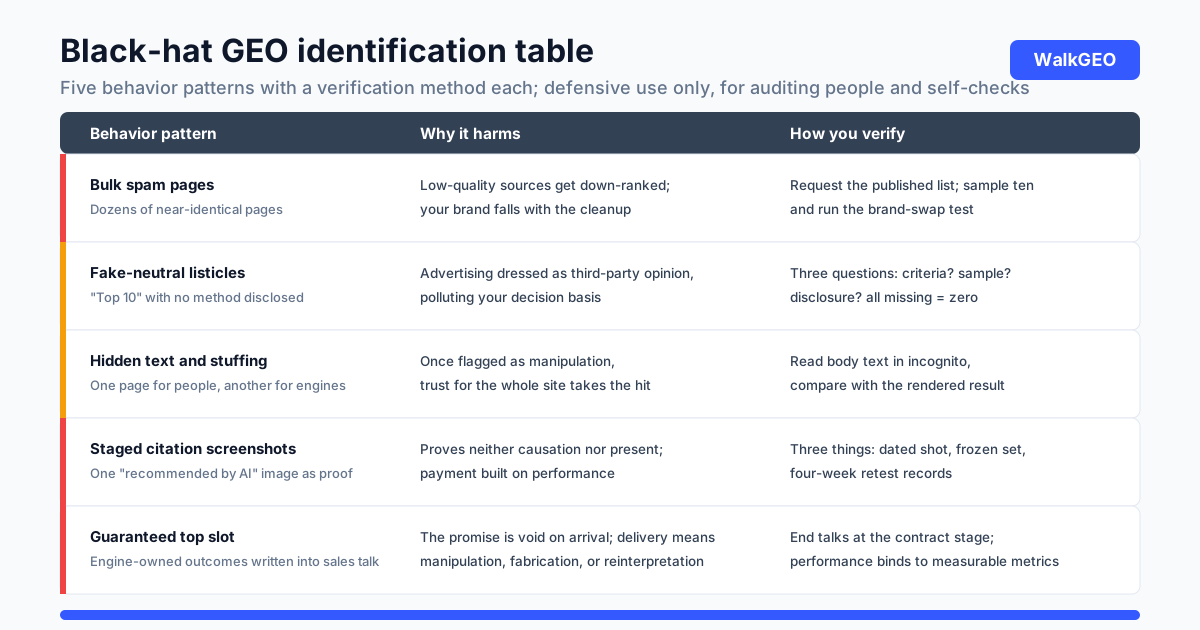
Recognize the family by four faces:
- Volume: dozens of near-identical low-quality pages pushed at once;
- Disguise: hidden text, keyword stuffing, expired domains borrowed for their history;
- Fabrication: invented cases and client names, fake reviews, staged screenshots of AI recommendations;
- Packaging: subjective scores dressed to two decimal places, "guaranteed top slot" written into sales scripts.
This list exists so you can audit people, not so you can operate; the boundary matters enough to state twice.
One quick test sorts any action: describe it to your competitor and notice whether you blush. Writing a definition sentence does not blush; buying a list slot does. A blushing action stays off your plan even when it works, for reasons the seventh question unpacks.
How do I spot bulk spam pages at a glance?
Three features together: dozens of near-identical pages on adjacent topics appearing at once, template-shaped down to the rhythm; boilerplate density so high that swapping the brand name makes the text fit any company; messy venues, real outlets mixed with content farms and abandoned sites. The check: ask the vendor for the full published-content list with links, sample ten at random, run the brand-swap test once, audit venue quality, and look at publish dates too, dozens of pages going live in one day is its own testimony. Volume aims to shift the statistical distribution, and engines eventually down-rank those sources; the harder the push, the faster the reckoning. In our own review pipeline, sameness is a hard block: a construction-fingerprint script counts dashes and repeated sentence shapes per article, and anything over quota gets rewritten. A vendor delivering a hundred "original" articles should be able to answer what their equivalent check looks like; no answer means no check.
How do I tell whether a "top 10" listicle is paid placement?
Three checks: is the selection criteria stated, who was sampled, is there a disclosure of interests. Missing all three, the list's credibility is zero. People who genuinely review products are not afraid to disclose their method; whoever hides it needs the neutrality costume. Your own judgment applies: a list that never says how it was judged has no business deciding for you.
A positive reference helps. Our own listicle rules sit in the open: ranking by category rather than position, a "verify first" item per entry, and the interest disclosure for our own entries printed in the body. Legitimate lists survive these standards; fake ones do not. All of it is laid out in our GEO tools roundup.
Can I trust a vendor's screenshot of "our client recommended by AI"?
A screenshot proves only that the answer looked that way at that moment; it proves neither causation nor the present. Three things make it evidence: a dated screenshot, a frozen question set, and retest records running four weeks or longer. A single image and a complete record are different grades of proof, and payment decisions belong to the second grade only. While verifying, ask one more question: which question set, which counting rules, do refusals count in the denominator. Three fumbled answers and the screenshot is stage property. Watch the variants too: a video instead of an image, a one-time demo instead of a record; the grade of evidence does not change. What counts is reproducible records, not performance.
A vendor promises a guaranteed top slot. Why is this a hard no?
AI answers are generated by the engines; no third party can guarantee a position, so the promise is void the moment it is made. Whoever writes "guaranteed top slot" into a pitch has three delivery paths left: manipulation, fabrication, or reinterpreting the terms after the money arrives. All three take your brand down with them; end the conversation at the contract stage. What the contract should contain and how performance clauses are designed is laid out along the procurement flow in our ten-clause GEO contract article; put the prohibited-conduct clause in while you are at it.
Could my own site be tampered with? How do I check?
Yes, from two directions: content planted on your site that does not belong there, or fake material spread off-site under your name. For the first, check version history, account permissions, and any instruction-like text unrelated to your topic; for the second, periodically ask several engines "what company is XX" and compare the introduction against facts, fixing evidence through the platform's channels the moment something looks off. The bottom line under both is one: entity information consistent everywhere, because the inconsistent spot is the gap others exploit. Both responses stay on verification and appeals, never retaliation. Wrong information has a separate correction path, expanded in our article on fixing what AI gets wrong about your company, which complements the checks here.
I found a competitor using these tactics. What can I do?
Boundary first: you can document, report, and harden; you cannot retaliate in kind. Three steps:
- Fix the evidence: screenshot of the answer, date, engine name, cited sources, captured in one pass; fragmented screenshots halve their force in an appeal;
- Use official channels: engines and publishing platforms all run reporting paths for manipulated content; submit through the platform's rules with dates noted, re-checking that the entry point still exists before each filing;
- Harden yourself: a slot your competitor could take means your material layer still has gaps; filling them beats feuding.
Two do-nots deserve equal space. Do not fight in public; mutual mudslinging manufactures new topics that the engines happily index, both sides included. Do not hire retaliation; fighting black with black puts your brand on the same cleanup list, and the seventh question's rebound logic applies to you in full. A vendor who proposes such actions has given you the reason to replace them; the prohibited-conduct clause in our contract article exists precisely for that moment.
Why is black-hat visibility borrowed, never owned?
A low-quality source's first day and first year in the AI ecosystem are different things. Retrieval and ranking keep tightening quality standards, and fake-neutral lists, spam pages, and their kin enter answers short-term and sit first in line for cleanup long-term. Worse, it reverses on you: your brand attached to a garbage source that gets cleaned, your visibility falls with it, and disentangling the brand from bad neighbors costs extra effort. The post-gala test demonstrated the loop's wrong shape: AI-generated commentary cited by the next layer of AI, error compounding into error. The loop runs positively too, well-sourced, checkable material cited again and again, compounding slowly. The legitimate path is slow, and the slow part is the moat: nobody doing a fast squeeze can copy your four weeks of retest records, your entity consistency across the web, or the material quality engines have verified repeatedly. Each takes time, and time is exactly the cost the shortcut never pays.
What should the budget buy instead?
Three accumulable things. First, get the fact pages right on your own site: definition sentences, parameters, FAQs, the anchor every engine checks against, all covered by the six checks in our writing guide. This needs no vendor; an internal afternoon starts it, and what it builds serves every engine at once. Second, retest weekly: frozen question set, per-engine records, a four-week window; only talk tools once self-testing hits its ceiling. Your own readings are your leverage in any vendor negotiation; without them, improvement is whatever the vendor says it is. Third, off-site placement in the same voice: Zhihu, WeChat official accounts, and other venues carrying wording identical to your site, each one an extra evidence point for entity checks.
Our own content pipeline runs the internal version of these three: the construction-fingerprint script blocks template smell, source verification blocks unsourced numbers, and human review comes last. What gets blocked is worthless; the habit of blocking is the asset. Use the same lens on vendors: a shop with no quality gates calling itself a legitimate GEO practice is a grain dealer with an uncalibrated scale calling itself honest.
Back to the invented product
Remember the product that never existed, recommended by multiple engines anyway? The next time any AI answer serves up a too-perfect recommendation, including one that happens to recommend us, run it through the nine questions. Evidence you can verify, trust; evidence you cannot, noise, however well phrased. Your brand's position in AI answers is worth trading real records, half an hour a week, and not worth gambling on a shortcut that made gala television. The first step this week: build the frozen question set, run one free self-check to confirm engines can read your site. WalkGEO's free check methods and the weekly routine are ready to copy, and pricing has the entry. Recognition is defense's first layer, records its second; with both layers thick, black hat keeps its distance, and time always sides with the records.
Done reading? Run the same audit on your own site
Sign up, then let the agent scan every page and hand you a prioritized fix list. Your first audit is free.
Run a free site audit