Buying GEO services: ten things your contract must spell out
GEO disputes come down to acceptance, not price. Ten contract clauses, from deliverables to data ownership, plus our own boundary disclosure, including what we cannot promise.
A contract that says only "optimization services" leaves you nothing to hold on delivery day. Disputes over GEO services rarely come down to price; they come down to three unanswered questions: what exactly gets delivered, by what standard it is judged, and what happens when it fails. Those answers can only be nailed into the contract, because GEO services are intangible: what you buy is not a page or a piece of code but a question library, sampling records, content revision, and a weekly reading practice, all paper assets, nearly impossible to establish after the fact. This article lays ten clauses along the procurement flow, a summary table first, then the three stages that decide quality, and finally our own boundary disclosure, including what we cannot promise.
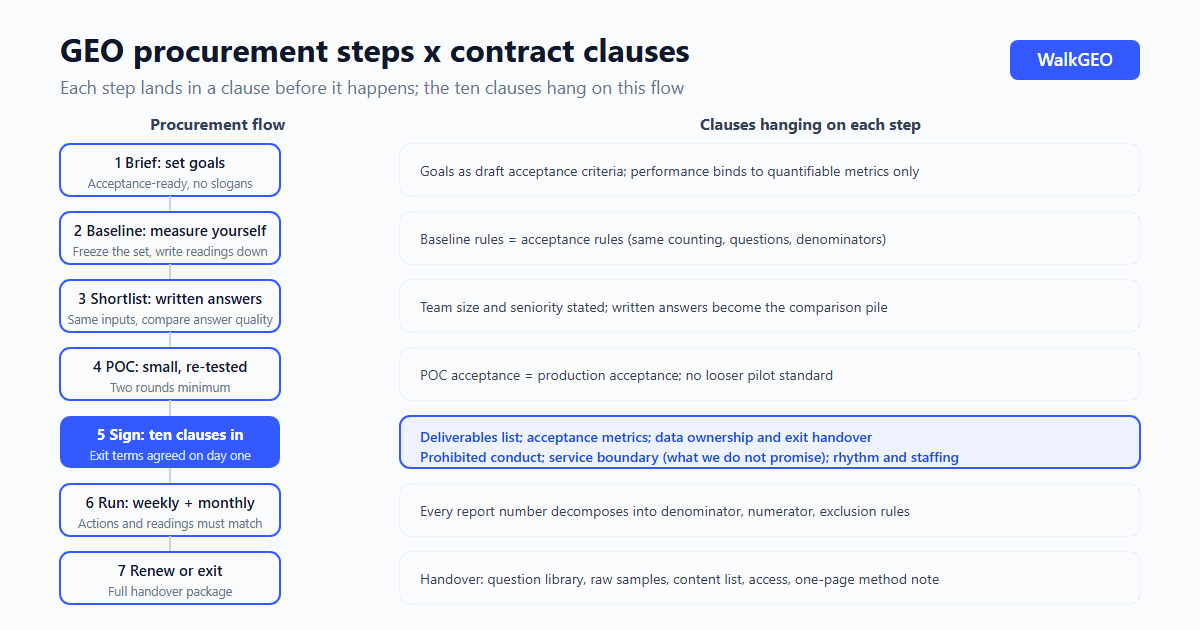
The ten clauses
| # | Clause | Must state |
|---|---|---|
| 1 | Deliverables | Question library, baseline report, sampling records, content and recommendations, monthly reports, exit handover package |
| 2 | Acceptance metrics | Counting rules plus sample size plus period plus exclusion rules, all four |
| 3 | Question set discipline | Freeze period, legitimate reasons to add questions, breakpoint marks for any change |
| 4 | Data ownership | Question library, sampling records, historical readings belong to the buyer; full transfer on exit |
| 5 | Prohibited conduct | No bulk spam pages, hidden text, fake reviews; breach carries liability |
| 6 | POC design | Small scope, re-tested, judged by the same acceptance standard |
| 7 | Payment structure | The boundary between fixed and performance; performance binds only to front-end quantifiable metrics |
| 8 | Service boundary | The vendor writes down what it does not promise |
| 9 | Governance rhythm | Weekly meetings watch actions, monthly reports watch readings, each with a fixed agenda |
| 10 | Staffing and change | Who executes, advance notice on personnel changes, handover on transition |
The table is the skeleton; six details across three stages decide whether the contract actually works.
Before signing: baseline and POC decide everything
What happens before the signature determines the contract's entire value. The procurement order matters first: set goals and baseline, then look for vendors, then discuss price. People who reverse the order derive their goals from a vendor's proposal deck, and no matter how detailed the contract, the acceptance ruler was handed to them by the other side. Before shortlisting, send a written requirements list and make vendors answer your questions in writing: what method, whether raw data is shared, who writes content, which compliance red lines they accept, how many people on the team, how the price is composed. Written answers go into the comparison pile; what you compare is the quality of answers to identical inputs, not the typography of proposals.
The baseline comes first among the artifacts: without pre-contract readings of your visibility and citation rates, a vendor's later claim of fifty percent improvement has no counter-evidence and no verification. What the baseline measures, on which question set, under which counting rules, all three must match the acceptance criteria exactly; two sets of rules cannot be compared. Our article on measuring your baseline before buying any GEO service gives the full procedure, and that procedure is itself contract-attachment material.
The POC comes second. Small scope means few questions and few engines. Re-tested means the same measurement runs at least two rounds; single-round readings enter no conclusion. Control awareness means no other major changes land during the window, otherwise neither rise nor fall can be attributed. Write the POC's acceptance standard into the contract, identical to the production standard, leaving no door open for "a looser standard during the pilot". When the POC ends, reconcile against the same record sheet: which metrics moved, which did not, how the unmoved ones are explained. That reconciliation is the decision basis for renewal or replacement, not a feeling.
During delivery: deliverables and acceptance are the heart
The deliverables list states what you will receive: the question library, per-round sampling records, content revisions with recommendations, monthly reports, and the handover package at exit. The acceptance criteria state how to judge what arrived: counting rules, sample size, period, exclusion rules; a metric is acceptable only when all four are present. The two places vendors most often blur: reports full of percentages with no denominator, and sampling records reduced to conclusions with the raw answers withheld. Put both into the contract: every number in a monthly report must decompose, and raw records ship with the report.
The governance rhythm lives in the same section. Weekly meetings watch actions: which pages changed, which content shipped, which rules moved. Monthly reports watch readings: mention and citation rates week over week, plus a column for this period's changes. When actions and readings disagree, either the actions were ineffective or the readings are wrong, and both deserve an immediate question. Put "reports bad news" into the expectation for reports: a monthly report that lists risks and errors separately is credible; one where everything is good deserves distance from the renewal.
Clause ten, staffing and change, is a during-delivery guard too: GEO services run on people, and the judgment about question sets and citation slots accumulates in the executor's head. Two contract lines suffice: key personnel changes require advance notice, and the outgoing person stays reachable through handover. Without them, a mid-term replacement is a second procurement, with tuition paid twice.
After: data ownership and exit decide whether you have a way out
Data ownership is the most ignored clause and the most expensive at incident time. The question library is a first-hand asset you paid for; sampling records are your historical baseline. The contract must state they belong to the buyer, transfer completely at exit, and arrive in usable formats. Without it, your history sits in the vendor's hands when renewal comes, and switching providers means starting from zero.
Exit terms get negotiated on signing day, not on the day things fall apart. List the handover package yourself: the question library with version history, all raw sampling data, the content revision list with publication locations, account and permission transfers, and a one-page method note. The last item is most often forgotten and most valuable, because the person taking over needs to know why the process runs this way. The prohibited-conduct clause belongs in the same conversation: bulk spam pages, hidden text, and fake reviews go into the contract with liability for breach. The clause protects not against the vendor but against your brand being carried into their methods; the identification table in our black-hat GEO article can serve as an appendix directly.
Self-assessment: what we ourselves cannot promise
Auditing ourselves by the same table. WalkGEO is a tool plus service for monitoring and content production: probes cover nine platforms on a two-day scheduled rhythm, every number in our reporting decomposes into denominator, numerator, and exclusion rules, and content production passes both a machine check and a human read. That is what we can promise, and it is all documented on our site.
What we cannot promise is written more plainly. First, we do not promise a magnitude of improvement in mention or citation rates, and we do not promise a timeline: AI answers belong to the engines, and the four-week window is a reading rhythm, not an effect guarantee. Second, our probe list does not currently include Kimi; if your customers use it heavily, our readings do not cover that path, which is a product fact, not a talking point. Third, engine citation policies move quickly; when official documentation lags, our verification records carry the same time-boundary, and a change may surface first in your own testing rather than in our report. Fourth, we do not engage in off-site black or gray tactics; when a competitor occupies slots maliciously, we help you locate and document it, we do not retaliate for you.
The point of this disclosure is not our sincerity; it is a template. Take the same four questions to any vendor: what do you measure, what do you not measure, what can you not promise, how do you report bad news. A vendor who answers all four plainly is worth negotiating with; one who stalls is not worth signing, no matter how thick the contract, because what protects you was never the number of clauses but whether the person writing them dares to say the ugly parts first.
Frequently asked questions
Can I sign a performance-based GEO contract?
Yes, but performance clauses may bind only to front-end quantifiable metrics: week-over-week movement of mention and citation rates, re-tested on a frozen question set under written counting rules. Never accept "guaranteed AI recommendation" or "guaranteed top slot": AI answers belong to the engines, nobody can guarantee them, and whoever writes that into a contract plans to deliver it some other way.
Which numbers in a monthly report deserve suspicion?
Numbers that are too tidy. A full column of zeros or hundreds, two decimal places of precision, percentages with no denominator stated: treat them as statistical questions first, market questions second. A competent report lets you decompose every figure into denominator, numerator, and exclusion rules; anything that fails decomposition is prose.
What if the vendor refuses data ownership clauses?
Walking away is a legitimate option. The question library, sampling records, and historical readings are assets you paid for; the contract must state they belong to you, transfer completely on exit, and arrive in usable formats. Ambiguous ownership means your baseline sits in the vendor's hands, and renewal negotiations start without leverage.
What contract length makes sense?
Work backward from GEO's rhythm: one four-week observation window, two to three windows to see a trend, so three to six months is the reasonable range. Contracts over a year need exit clauses and stage acceptance, with a formal contractual check at every window's end rather than the first reconciliation at expiry.
Before the ten clauses go into your contract, do two things: run one baseline on your own question set, and walk the vendor through the four-question template. For budget ranges, the pros and cons of pricing models, and the traps, our GEO pricing article follows the industry logic, and the no-effect-promises red line applies on both sides of the table. After signing, the operating rhythm lives in the weekly routine, and expectation management in how long GEO takes. The contract is the one thing you hold in your hand; write it thick and the expectations thin, and the engagement stands.
Done reading? Run the same audit on your own site
Sign up, then let the agent scan every page and hand you a prioritized fix list. Your first audit is free.
Run a free site audit