GEO in Regulated Industries: Healthcare, Finance, Education
In regulated industries, GEO aims at being retold accurately, not loudly. What the law bans, how to rewrite claims, which risk questions to pre-answer, and how limits stay attached to conclusions.
"The most trusted clinic in the city. One screening covers every major disease." "Results guaranteed in three months, full refund otherwise." Two sentences of common ad copy in regulated industries. In the search era they already violate advertising law; in the AI era there is a second layer: the engine learns your wording and retells it, and what the retelling drops first is exactly the limiting conditions. In regulated industries, the goal of GEO is never to be recommended loudly; it is to be retold accurately. Four checklists, run in order.
Checklist one: what the law explicitly bans
| Industry | Explicitly banned wording | Provision |
|---|---|---|
| Healthcare, drugs, medical devices | Assertions or guarantees of efficacy or safety; stating cure or effectiveness rates; comparisons with other products' efficacy; using spokespersons as endorsements | Advertising Law, Art. 16 |
| Education and training | Explicit or implied guarantees about admissions, passing exams, earning certificates, or training outcomes; invoking exam bodies or question setters; endorsements by professionals or beneficiaries | Advertising Law, Art. 24 |
| All industries | Absolute terms such as "national-level", "highest-level", "best", and equivalents | Advertising Law, Art. 9(3) |
The provisions follow the 2021 amendment; we checked the text word by word on November 16, 2026, and the full public text is here. Check point: provisions get amended, re-verify against the linked text before you rely on them, and log the checking date.
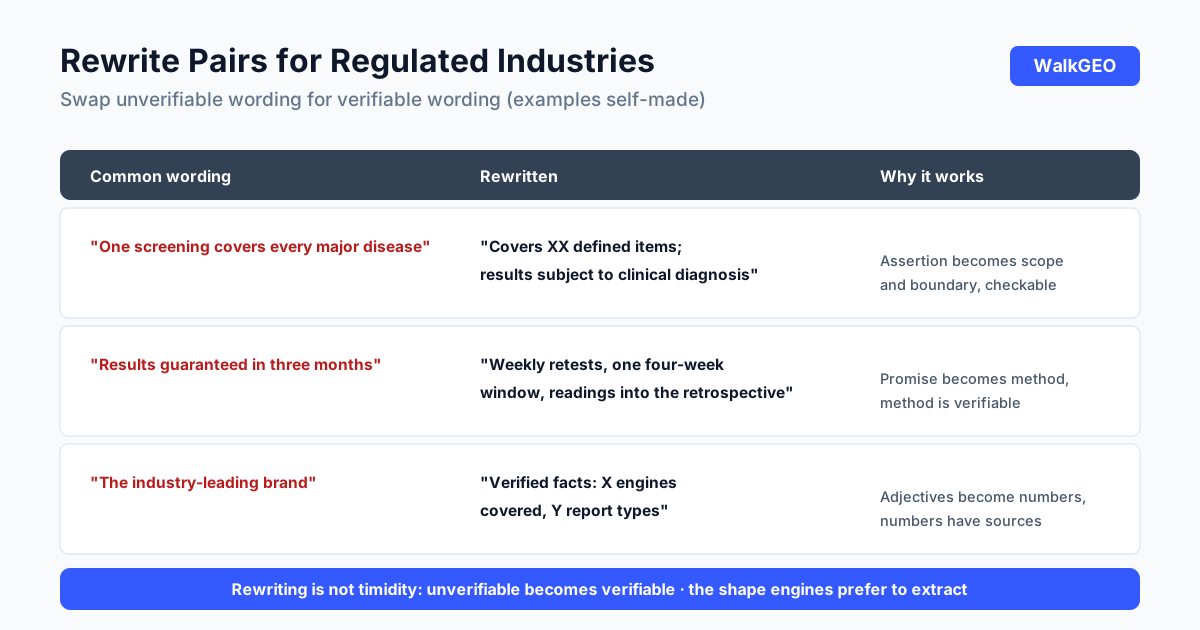
Checklist two: how to rewrite the wording (examples all self-made)
| Common wording | Rewritten | Why it works |
|---|---|---|
| "One screening covers every major disease" | "Covers XX defined items; results are subject to clinical diagnosis" | Assertion becomes scope and boundary, both checkable |
| "Results guaranteed in three months" | "Weekly retests, one four-week window, readings into the retrospective" | Promise becomes method, method is verifiable |
| "The industry-leading brand" | "Verified facts: X engines covered, Y report types" | Adjectives become numbers, numbers have sources |
Check point: rewriting is not timidity; it swaps unverifiable sentences for verifiable ones, which is also the shape engines prefer to extract. Writing details in our citability piece.
Checklist three: the risk-question library, pre-answered
In regulated industries users ask not "which is best" but "where are the traps". Pre-build pages for these: who should not use your product (non-applicable scenarios); common risks and side effects, with responses; costs beyond the fee (time, cooperation, follow-up actions); qualifications and boundaries of validity (regions, conditions); the complaint and refund path when something goes wrong.
One page per question, answers stated flat, matching the approach in the correction piece: what the engine retells comes from those flat paragraphs. Check point: move the question library into your prompt set and retest retelling quality weekly.
Checklist four: keep the limits attached to the conclusions
Summaries drop qualifiers first. Four writing rules. Put the limit in the same sentence as the conclusion: "covers XX defined items" sits right next to the screening claim, not a paragraph away. Parenthesize next to the claim: applicable regions and populations ride beside the conclusion in brackets. Never bury conditions in the footer: the end-of-page disclaimer is the first thing a summary crops; key boundaries go early. Don't stack: three qualifiers in one sentence makes engines skip the sentence entirely; one per sentence holds.
Check point: after rewriting, ask engines about the page and see whether the limits survive; the method follows the portfolio logic in multi-engine monitoring.
Our own intercept rules, and this article's verification record
Our review line genuinely intercepts a few things: promise-shaped wording ("guarantee", "ensure" followed by an outcome) gets rewritten into method or boundary; percentages without sources stay out of body text; absolute terms never appear in our self-description; market-forecast dollar figures are not cited regardless of origin. What gets stopped is not glamorous; the habit is what's valuable. Our production line's two gates were described in the black-hat checklist; this piece adds the regulated-wording gate.
Writing this article, we ran a full verification: Articles 9, 16, and 24 of the Advertising Law checked word by word against the 2021 amendment text, dated November 16, 2026. One incidental finding: the absolute-terms provision has sat in Article 9 since the 1994 version, wording unchanged. We cite no third-party paraphrase and link only the publicly checkable text, which is the same discipline applied. The boundary, as always: nothing here is compliance advice for any industry; follow your regulator and your legal counsel for specifics.

Common questions
Do these rules apply to AI-written content too?
Yes, and liability does not move. Advertising law governs what gets published, not who wrote it; AI involvement carries a separate labeling duty, handled in our AIGC labeling piece. A non-compliant sentence does not become exempt because AI drafted it; the publishing entity carries the responsibility.
I'm not in healthcare, finance, or education. Does this still matter?
Yes. The ban on absolute claims covers every industry; Article 9 has no sector exemption, and the risk-question library and limit-attachment writing rules hold everywhere. Regulated industries differ only in harder enforcement and real penalties, not in the rules themselves.
What evidence is there that AI summaries drop the limits?
The most direct test is in your hands: take your own page, ask several engines, and see whether the limiting language survives the retelling. Every industry can run this test, and the result is visible to you. We cite no third-party percentage; retelling varies by engine and question, so your own retest record beats any universal number.
Who should do the compliance review?
Two gates. Wording self-check belongs to operations: walk checklist one line by line and keep the change log. Final compliance review belongs to legal or industry counsel, especially for healthcare and finance wording. Both pass before publishing, in that order.
GEO in regulated industries does not chase the loudest recommendation; it chases retelling without distortion, with the limits intact and the boundaries visible. What starts today is checklist three: list the five risk questions your industry hears most, and build one flat-answer page per question. Once retesting runs, sampling and checks fold into the weekly routine; the tooling side of content work sits on pricing. WalkGEO's own four checklists are already in its publishing flow; the article you just read is the first one published under them.
Done reading? Run the same audit on your own site
Sign up, then let the agent scan every page and hand you a prioritized fix list. Your first audit is free.
Run a free site audit