Which AI engines should I track? Setting up the portfolio, not the favorite
AI engine tracking starts from your market, not engine fame. An eight-engine reference table, the four-engine domestic default, three overseas additions, and what to cut first when budget tightens.
Ask the same customer question across five engines and you will get five different answers: different sources, different brands named, some answers carrying citations, others just prose. That is not engines misbehaving; it is structure. Each one sits on a different retrieval ecosystem, with different citation habits and a different user base. So "which engines should I track" has two layers: start where your customers ask, and accept that no single engine's reading tells you your overall position in AI until coverage is in place. This article gives an eight-engine reference table, a four-engine domestic default, the judgment for adding three overseas, and the order in which to cut when budget tightens.
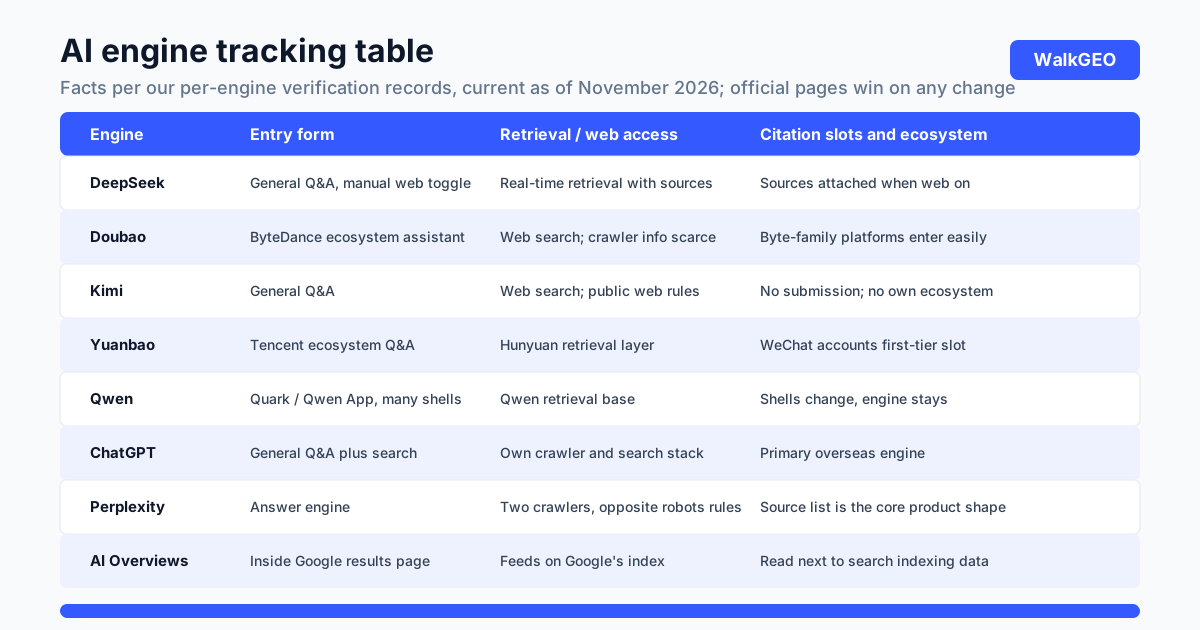
Eight engines, one table
Evidence boundary first: the facts below come from the verification records of our per-engine articles, current as of November 2026; when an official policy moves, the official page wins. Each row's linked article carries the itemized sources and verification dates.
| Engine | Entry form | Retrieval / web access | Citation slots and source ecosystem | Details |
|---|---|---|---|---|
| DeepSeek | General Q&A, manual web toggle | Real-time retrieval with source list | Sources attached when web is on; no ecosystem tilt | Getting cited by DeepSeek |
| Doubao | ByteDance ecosystem assistant | Web search; crawler info scarce | Byte-family content platforms enter its retrieval easily | Doubao GEO |
| Kimi | General Q&A | Web search | Public web rules; no submission channel | Getting cited by Kimi |
| Yuanbao | Tencent ecosystem Q&A | Hunyuan retrieval layer | WeChat official accounts are its first-tier citation slot | Yuanbao recommendation slot |
| Qwen | Quark / Qwen App, multiple shells | Qwen retrieval base | Entry shells change, the engine stays; open-source spread | Getting cited by Qwen |
| ChatGPT | General Q&A plus search | Own crawler and search stack | The primary overseas engine; English-language corpus | Getting cited by ChatGPT |
| Perplexity | Answer engine | Two crawlers: index crawler obeys robots, live fetcher does not | The source list is the product's core shape | Perplexity optimization |
| AI Overviews | Inside Google results | Google's index as the base | Inherits search indexing; no separate submission | AI Overviews guide |
Read the table three ways. Entry form decides where you go to test, in-app, on the web, or inside a results page. Retrieval mode decides how the access check runs, which crawler to allow through robots. Citation slots decide where material goes, official accounts, Byte-family platforms, or your own site as the body of evidence.
Why one question returns five answers
The divergence is not random; the structure sits inside each retrieval ecosystem. Doubao leans on ByteDance platforms, so articles and video distribute into its retrieval easily. Yuanbao treats WeChat official accounts as the first-tier citation slot, where your own site is not the fastest entrance. Qwen's entries changed shells three times in a year while the retrieval base stayed put, so material done once serves every shell. Perplexity runs two channels with opposite rules, an indexed path that obeys robots and a live path that fetches on the spot and does not. Put those differences into one question and five distinct answers are almost guaranteed.
For your operations this compresses to one line: cross-engine differences have to come from your own same-question sampling; never infer engine B from engine A. The method is cheap: take your core twenty questions, run one round per engine, and log three things per answer, mentioned or not, which source, what answer form. After one round, the clustering shows itself, which engines agree and which walk their own path. High-overlap engines get grouped and served by one set of material; independent ones get their own. We ran this grouping logic in the Yuanbao and Qwen articles.
One trap inside the divergence deserves its own paragraph: persistent citations and live citations must not be counted together. The same engine may cite you today and not two weeks later, in either direction, because indexed citations decay slowly while live-retrieval citations move with the crawl rhythm. Blended into one number, neither rise nor fall can be explained. Perplexity's two crawlers put this on the table: the indexed path obeys robots into its index, the live path fetches pages on the spot without robots. We count the two separately, and the reading rules are split the same way in our citation tracking guide. At minimum, log whether an answer's source is an attached search result or pure generation; four weeks later, that column saves the most confusion.
Start with four domestic engines
If your customers are in mainland China, the default group is DeepSeek, Doubao, Qwen, and Yuanbao. Why these four: each has its own retrieval ecosystem, which is the reason to test them separately; each is a mainstream Q&A form, which is the reason testing them is practical; and their citation habits differ enough to cross-check one another. Kimi is worth testing but sits in our second batch: it runs on public web rules with no independent ecosystem slot, so its material work overlaps heavily with the four; add it once the first four run smoothly. The reasoning is in the engine-list section of our Kimi article.
Three operating points: one shared question set across the four, because identical wording is what makes comparison possible. Separate record sheets, because citation slots differ and blended logs cannot be attributed. One web-search state per the engine's own documentation, because DeepSeek with web off is testing its training corpus, and the same holds for Doubao; check the toggle before each round. The full reading framework lives in how to measure AI visibility.
Add one column beyond the four basics: this week's changes. Which page you edited, which article shipped, which robots rule moved, one line each. When the curve moves in week four, attribution lives entirely in this column; without it, a rise has nobody to thank and a drop has nothing to fix. The column costs a dozen words a week, and its absence costs the whole sheet.
Coordinate placement across the four as one portfolio: Yuanbao's official accounts and Doubao's Byte-family platforms are the fast lanes inside their own ecosystems, while your site is the body every engine shares. Material built once, definitions, parameters, FAQ, with identical wording on site and in the ecosystems. If the two sides disagree, the engines' cross-checking tears both down.
The three to add for overseas
If you sell overseas, add ChatGPT, Perplexity, and Google AI Overviews. The mapping is direct: ChatGPT is the largest general entry in overseas markets; Perplexity's users arrive with explicit research intent and its answers attach source lists, the form closest to a traditional citation; AI Overviews lives inside Google's results page and feeds on your SEO base, so read its numbers next to your search-indexing data, not apart from them.
Language follows the market: an English market gets an English question set, worded the way local customers actually ask, not translated from Chinese. Two rules for the bilingual stage: freeze the Chinese and English sets separately, each with its own baseline; and treat hreflang and the technical base as its own topic, which the multilingual series will take up. Grok is worth a note here: it sits in our selectable catalog but not the default group, a fit for overseas businesses whose audience overlaps heavily with the X platform; most businesses can ignore it.
The smallest plan is a multiplication
Plan size is one multiplication: questions per round times engines times frequency. Our product sets the per-round budget cap exactly on this product, because cost rises linearly along it. Three starting tiers:
| Tier | Questions | Engine group | Frequency |
|---|---|---|---|
| Minimum viable | 15–20 | four domestic | weekly |
| Standard | 25–30 | four domestic plus one overseas | every two days |
| Full coverage | 30+ | four domestic plus three overseas | every two days |
Start at the bottom tier and survive one observation window before stepping up. Engines are the most expensive term in the multiplication: adding one raises cost across every question, while the reading gain depends on whether it has an independent retrieval ecosystem. Get four engines' four-week curves first; discuss the fifth after.
Stepping up follows events, not moods: entering a new market, launching a flagship product, a new competitor class, any one of the three justifies adding questions first and a tier second. Nothing changed, nothing moves; save the budget for continuity. Stepping down works the same way: a market exits, a product line ends, the matching question groups and engines retire with it. The list follows the business, not inertia.
When budget tightens, cut frequency, not coverage
There is a right and a wrong way to cut. Wrong: cut engines. Coverage breaks, nobody watches that week's answer distribution, and a competitor taking your slot in a paused engine surfaces two weeks late. Right: cut frequency. Moving an engine from every-two-days to weekly keeps coverage, drops resolution one notch, and the trend still reads, with turning points surfacing a few days later.
Order it: first cut frequency, then cut questions, keeping the decision-stage questions and dropping awareness-stage ones, then freeze part of the engine list, keeping the domestic group and pausing overseas, and only then consider a full stop. Cut the other way around and you save little while losing the most.
A full stop is the worst tier. If you must, leave a minimal record: one manual round of ten core questions per month, answers archived. A few minutes a month preserves the continuity of history, so that when monitoring resumes, the baseline still exists instead of another four weeks from zero. Monitoring can pause; continuity cannot. Four months of missing curve reduces everything before it to archive material.
How we set our own default group
Our product offers nine selectable platforms: ChatGPT, Gemini, Claude, DeepSeek, Doubao, Qwen, Yuanbao, Grok, and Perplexity. Defaults follow region: a China-region brand gets DeepSeek, Doubao, Qwen, and Yuanbao; other regions get ChatGPT, Gemini, and Claude. The three criteria from above set the defaults: where customers ask, whether there is an independent retrieval ecosystem, whether readings stay stable. Kimi is not in the default list for the reasons above, and it is not in the selectable list either, not an oversight but a decision to stabilize the defaults first. You can change the group per brand and market in settings.
The value to you is not the list itself but the ordering that produced it: market before engines, ecosystem before fame, stability before completeness. Follow that order and your own eight-engine list will likely converge with ours; ignore it and the list follows the news, and the baseline never stands.
Frequently asked questions
Is tracking more engines always better?
No. Cost rises as questions times engines, while readings get scattered rather than sharper. Coverage follows customers: mainland customers first get the four domestic engines; overseas business adds the three international ones. The test is not which engine is famous, it is where your customers actually ask.
Should a newly launched engine join the list right away?
Do not chase launches. Check three things: does it have its own retrieval ecosystem, have your customers started asking it, can it produce stable readings. Add when two of the three hold, via a candidate list, and confirm after a full observation window. Chasing news keeps your list moving and your baseline standing on sand.
Do all engines share one question set?
One set of questions, separate records. Shared wording is what makes cross-engine comparison possible; separate logs are what make attribution possible. Each engine has its own citation slots and source ecosystem; blended into one sheet, difference and noise cannot be pulled apart. Merge into an overview table only after the per-engine sheets exist.
Can I track just one engine?
Fine for starting, wrong for staying. A single-engine result does not generalize: retrieval ecosystems, citation habits, and user bases all differ, so one engine's number says nothing about your overall position in AI. Track two from the first week. It doubles the cost and changes the nature of the conclusion, from "what one assistant says" to "what the market says".
The first step this week: write down the twenty questions customers ask most, run one round each across the four domestic engines, and log three cells per answer, mentioned or not, which source, what answer form. Two hours buys you a distribution map that anchors every later configuration. To skip the manual round, WalkGEO ships the nine-platform catalog with regional defaults and scheduled probes every two days; the weekly routine is copy-ready and pricing has the entry.
Done reading? Run the same audit on your own site
Sign up, then let the agent scan every page and hand you a prioritized fix list. Your first audit is free.
Run a free site audit