The Company Fact Base: The Foundation of GEO Content
Unquotable content is rarely a writing problem; the facts have no master copy. Five vaults, ownership with trigger updates, the one-question-one-page-one-evidence flow, our rework-born discipline.
A familiar bind: marketing is tasked with producing quotable content, writes two pieces, and discovers there is nothing to write. Product parameters: engineering returns three versions. Customer cases: sales says authorization is pending. Pricing: sales ops says the contract governs. Two months pass, no articles ship, and the teams have fought two rounds over whose wording is right. This is not a writing problem; the facts have no single master copy. The fix is a company fact base: five vaults, explicit fields, claimed owners, trigger-based updates. The structure, upfront:
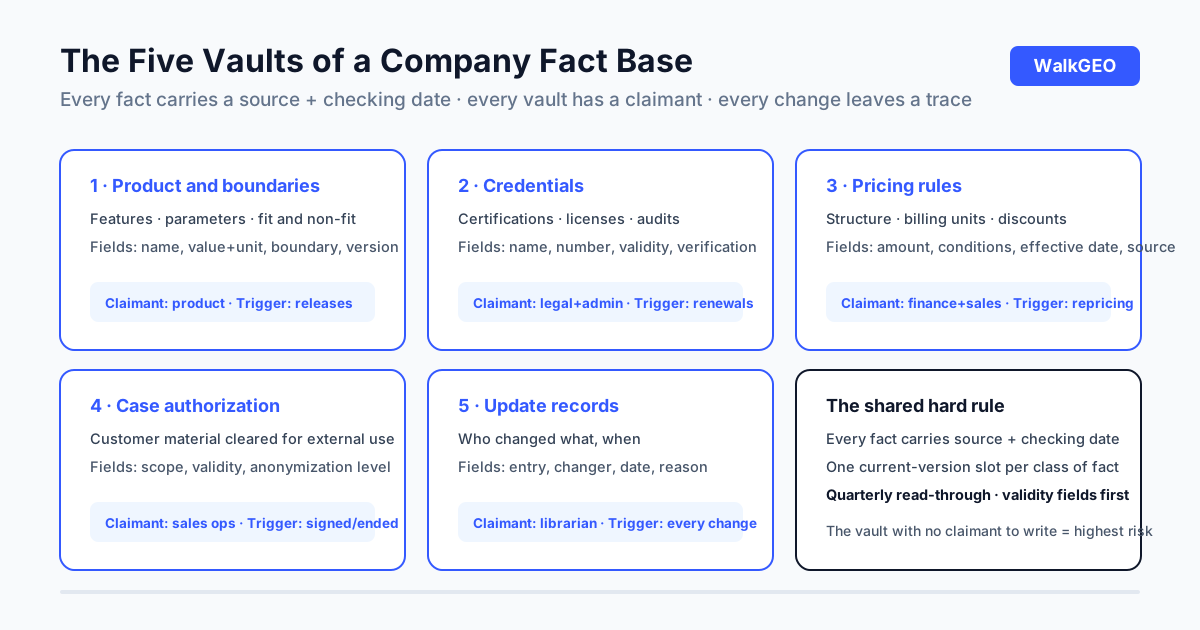
Five vaults and what each stores
| Vault | Stores | Key fields |
|---|---|---|
| Product and boundaries | Feature list, parameters, fit and non-fit scenarios | Name, value + unit, boundary sentence, version |
| Credentials | Certifications, licenses, audit conclusions | Certificate name, number, validity, verification method |
| Pricing rules | Pricing structure, billing units, discount rules | Amount, conditions, effective date, source |
| Case authorization | Customer material cleared for external use | Scope of use, validity, anonymization level |
| Update records | Who changed what, when | Entry, changer, date, reason |
One hard rule crosses all five: every fact carries a source and a checking date. Facts without sources do not enter the base, the same red line the content line enforces; a dirty master copy ruins everything downstream.
Who maintains it, and when it updates
The maintenance structure has two layers: the librarian owns structure and discipline (format unity, trigger follow-up, quarterly read-through), and each vault is claimed by the team closest to the facts: product facts to product, credentials to legal or admin, pricing to finance or sales ops, cases to sales, records to the librarian. The most dangerous vault is the unclaimed one; errors live in fields everyone assumes someone else is watching. Updates run on triggers, not calendars: a product iteration triggers the product vault, a certificate renewal triggers credentials, a price change triggers pricing rules, a signed or ended engagement triggers cases. Beyond triggers, the whole base gets one quarterly read-through focused on validity-type fields.
From the fact base to pages: the workflow
One question, one page, one evidence. Content production starts from a specific question (the kind users actually ask) and ends at a page, where every key fact points back to an entry in the base. The flow turns writing from creation into citation: the author no longer verifies facts per article but pulls sourced entries, and the source and date ride along into the page automatically. Three steps run as specified: questions enter the question set per the prompt-set guide, pages are organized per the citability check, and the evidence chain points back into the base. Verification work collapses from per-article checking to maintaining the master copy itself, which is exactly why citable content can be produced continuously. The step most often skipped is the back-link: the page ships without its source links. Short-term nothing breaks; once the base updates an entry, the unlinked pages become stale versions floating across the web, and that is a high-frequency path to AI misstating your information. The back-link is not pedantry; it is the mechanism that lets the whole site update with the master copy.
Compliance items: authorization and the public scope
The case vault carries the highest compliance sensitivity. Negotiate three items in writing: scope of use (named or anonymized, which details), validity (ends with the engagement or long-term), and removal rights. Clean entry requires all three. The pricing vault's boundary separates the public price from the contract price: external pages carry only the public price; contract terms and discount authority stay out of the public base. The credentials vault lives on timeliness: once renewed, the old certificate is void, and the base and the pages must swap versions together. The usual boundary stands: specific legal and contractual wording follows counsel.
The lesson: how our single source came to be
One of our own rework stories. Early in the production line, brand and product basics lived in three places: one wording in the plan documents, one hard-coded in page code, one more in article frontmatter. The first incident was the byline: changing one author name touched four locations, and four people each claimed one before the list was complete; that retrospective created the rule of listing every affected surface before any change. The second incident was summary length: the same rule scattered across two documents, versions disagreeing, bounced three times in one month by the build script. The two reworks produced the current discipline: brand names, bylines, prices, metric definitions, each class of fact converges to exactly one current-version slot, and every other location references rather than copies. What you can check: this blog's fact layer has one master copy; a change lands once and propagates site-wide, with build checks watching consistency so people do not have to. The lesson compressed to one line: a fact base is not documents moved into a folder; it is one current-version slot per class of fact, with everything else a reference.
A minimal viable start
You do not need all five vaults on day one. Start with two: product-and-boundaries and pricing rules, the two vaults covering the highest-frequency scenarios where AI misstates company information. One spreadsheet carries the start: one row per fact, five columns (name, current value, source, checking date, claimant), and two weeks is enough to converge the most dangerous facts. The other three vaults follow business complexity, while the trigger-based update mechanism runs from day one. The signal for extending is also simple: when the same fact starts appearing on two pages and requires human effort to stay in sync, it belongs in the base; facts whose consistency depends on people will eventually drift into competing versions.
Common questions
Fact base versus brand kit?
Kit is a collection, fact base is the single master. Three disciplines: source and date on every fact, one owner per entry, traceable changes. Kits hold five versions of a parameter; the base holds one current version, because version drift is where AI misstatements begin.
Who maintains it?
One librarian plus vault claimants: product to product, credentials to legal or admin, pricing to finance or sales ops, cases to sales, records to the librarian. The unclaimed vault is the dangerous one.
How do we negotiate case authorization?
Three items in writing: scope, validity, removal rights. Without named authorization, the substitute layers (anonymized, self-use, aggregate) have reserved slots in the base, with the authorization status column marking "substitute" versus "named", never mixed.
How does it connect to production?
One question, one page, one evidence: questions into the set, pages per the six-item check, facts pointing back to entries. Writing becomes citation; verification collapses to maintaining the master copy.
Five vaults, two disciplines, one workflow: the foundation is laid. Today's move: copy the five-vault table into your collaboration tool and write the claimant's role on each vault. The vault with no name to write is your highest-risk vault. With the master copy in place, page-side work follows the checklist in your website as a source, entity governance for terms and names lives in entity consistency, and AI-involved content carries its own labeling duty per our AIGC piece. When weekly production needs tooling, pricing and the weekly routine are the hand-off points. WalkGEO's own master copy came out of the rework above; your first version may be rougher, but the single-source rule is not optional. And once the base settles, a second discovery follows: production speed rises, because the verification step has been lifted out of every piece of writing entirely.
Done reading? Run the same audit on your own site
Sign up, then let the agent scan every page and hand you a prioritized fix list. Your first audit is free.
Run a free site audit