How structured data helps AI cite you: Schema/JSON-LD basics
Structured data helps AI cite you by verification, not bonus points: who you are and what the page says, machine-readable. Four markup types, build-generated JSON-LD, three reconciliation traps.
How does structured data help AI cite you? Not as a bonus — as a verification. It turns who you are, what this page says, and which questions it answers into a machine-readable statement of account. When a generative engine picks sources it cross-checks entities and facts across the web; the more complete your statement, the cheaper that check, and the higher your citability. One iron rule above it all: markup must match the page's visible text, written plainly in Google's structured data guide. Four markup types in one table, the mechanism in one section, then our own build-generated JSON-LD and three ways the reconciliation fails.
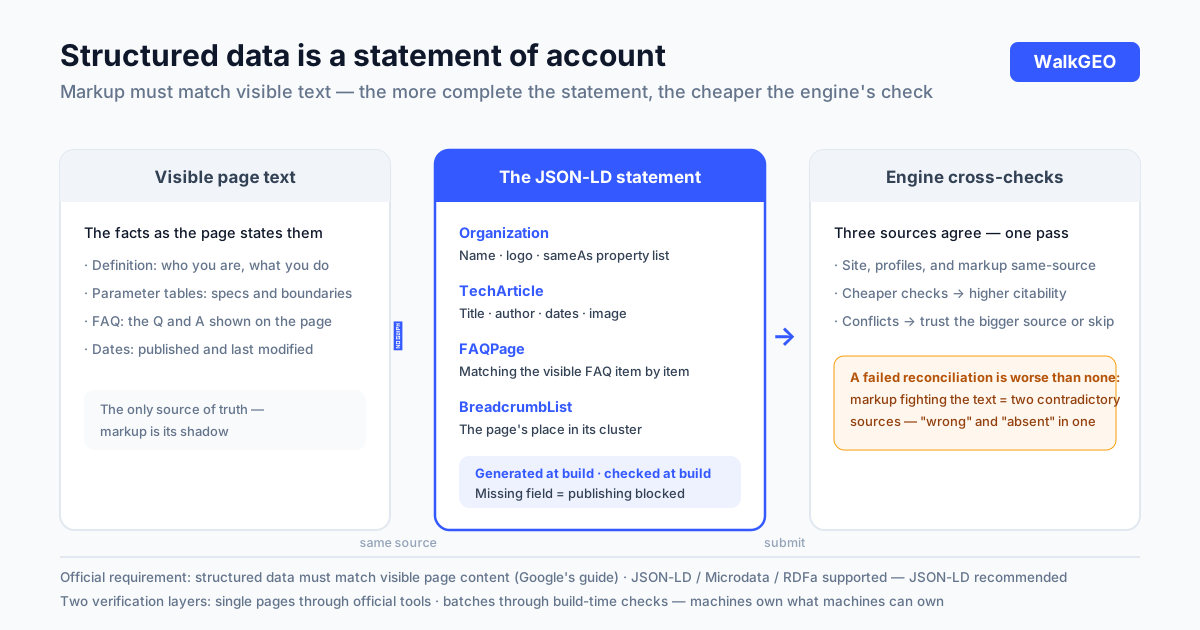
The four markup types, up front
| Markup type | What it carries | Why it matters for GEO | How to verify |
|---|---|---|---|
| Organization | Name, URL, logo, sameAs list of official properties | The main anchor for entity binding; same-name cuts depend on it | Ask the engine "who is X"; watch for misfiled entities |
| TechArticle / Article | Title, author, published and modified dates, image | Earns trust — facts have freshness, dates are the credential | QA tool checks date and image fields |
| FAQPage | Q&A pairs matching the visible FAQ, item by item | The machine-readable answer capsule; the most-liftable format | Compare to the text, word for word |
| BreadcrumbList | The page's position in site structure | Helps the engine place the page in its topic cluster | Breadcrumb navigation and markup agree |
The four share one trait: each saves the engine checking effort. Organization answers "who are you"; TechArticle answers "is this trustworthy"; FAQPage answers "can this page be lifted whole"; BreadcrumbList answers "which cluster does it belong to." All four in place, and a content page stops being "a URL" and becomes "a verifiable object."
A few lines on each type's soul field. Organization's is sameAs — every official property (site, socials, LinkedIn, encyclopedia entries) listed in one markup so engines can confirm "all these accounts speak for the same company"; the two chronic diseases, same-name cuts and legacy-name drift, mostly close with a complete sameAs, which is also an item on the entity-correction checklist. TechArticle's soul is the dates: datePublished speaks to seniority, dateModified to freshness — and when an engine judges whether a piece still holds, it reads the latter. Editing the text without updating the date field tells the engine "this hasn't been updated." FAQPage's soul is item-for-item identity: it is the answer capsule in machine-readable form — how to write capsules is in the DeepSeek piece; markup just hands over the same content again. BreadcrumbList's soul is belonging: clusters are expressed through internal links and breadcrumbs together, and a placed page gets cited in the right context.
Not a switch — a statement of account
Set the expectation first: writing markup doesn't buy citations. The official positioning has always been "help search engines understand the page"; citation is still decided by material quality and entity clarity — the same law as "indexed doesn't mean cited," one layer down. The real value lives in the check: when a model cross-verifies your entity across sources, structured data is the only answer sheet you get to fill in yourself. Site says A, a third-party profile says B, markup says C — the engine either trusts the bigger source or skips you; three same-source versions pass on the first check.
Why does the engine want this statement at all? Because its default work is cross-source comparison — the mechanism is unpacked in how AI picks sources: candidates corroborate each other, and when corroboration fails it would rather skip. What you experience as "expensive to verify" is, for the engine, compute. The more complete your markup, the shorter its verification path. Structured data saves the engine compute, and the saved compute comes back to you as citability — a trade, not a favor.
The failure mode lives in the same mechanism: a statement that doesn't reconcile is worse than none. Without markup, the engine reads the text itself; with conflicting markup, it holds two contradictory sources — "wrong" and "absent" are two faces of the same failed check.
Beside traditional SEO's use of Schema, the discipline is identical and the payoff shifted. In classic search, markup bought rich results — stars, breadcrumbs, FAQ boxes; a display-layer reward. In generative engines, it buys verification efficiency — a citation-layer reward. Different reward, same requirement: match the visible text. Teams that ran rich results have done the drills; at the GEO stage you don't relearn, you hand the same statement to a new grader. Teams that haven't: do it once, benefit twice.
Our JSON-LD is generated at build
First-hand mechanism, all checkable on the site. Every WalkGEO blog article generates its markup instead of hand-writing it — at build, three JSON-LD blocks come out automatically: TechArticle (datePublished and dateModified from one source, og:image on the image field), FAQPage (item-for-item with the visible FAQ), and BreadcrumbList (page placement). Generation is paired with enforcement: a missing required manifest field blocks the build outright — title, summary, date, image; miss one and nothing ships.
The mechanism buys two disciplines. First, FAQ consistency isn't supervised by humans: the visible FAQ is finalized first, then the markup is generated from the same data — "markup matches visible text" stops being a slogan and becomes a pipeline property. Second, humans only touch exceptions: the QA script checks the date fields and the image address (og:image must be an absolute PNG URL), and hands over only what fails.
What the script actually checks, laid open: TechArticle's datePublished and dateModified must equal the frontmatter publish date, isPartOf must point to the blog, FAQPage and BreadcrumbList must exist, og:image must be an absolute PNG — five checks, two of them about dates, because dates are the field most often wrong. The checks run on every build, so the cost of a mistake moves from "someday an engine notices" to "the build fails right now" — a completely different moment to fix.
One honest caveat: generation doesn't waive content responsibility. The build guarantees "markup same-source with text"; it cannot guarantee "the text deserves citing." A beautiful statement of account over an empty ledger still collects no citations. Write the citable text first; generate markup for it second.

How do you verify the markup is right?
Two layers, each owning a stretch. Single pages go through official tools: Rich Results Test or the Schema.org Validator — paste a URL or snippet, fix errors line by line, five minutes before any new page ships. The two tools divide the labor: the Validator judges syntax (is the markup written correctly), Rich Results Test judges eligibility (which rich results this markup qualifies for) — syntactically perfect can still be ineligible, because missing fields are missing eligibility; passing both is passing. Batch verification belongs to the build: required fields, legal date formats, absolute PNG image addresses as build gates that block publishing on failure. Page-by-page human review doesn't scale — machines own what machines can own, humans see only what the machine escalates.
When to re-verify is also settled: template redesigns, field renames, site migrations, moved date fields — any of these four, and the whole site's markup goes back through the tools. Re-verification goes on the change checklist; memory is not a process.
Three reconciliation failures
Markup written, text never was. The symptom: ten Q&A pairs in FAQPage, three visible on the page — the official requirement is agreement with visible content, so the extra seven aren't generosity, they're a broken reconciliation. The cause is usually "while we're at it": writing extra FAQs in markup disturbs no layout. Fix: markup generated from text data; nothing enters markup that isn't in the text. Want the engine to see one more FAQ? Write it into the page first.
Text edited, markup left behind. The symptom: product renamed, dates updated, prices adjusted — the visible page is all correct and the markup still carries the old values. This is the drift hotspot, because markup hides in the head where nobody looks, and redesign checklists rarely include it. Fix: same-source generation is the cure; where generation isn't possible, one line on the change checklist ("verify markup") executed on redesign day, plus a monthly spot-check of three random pages through the tool.
Using markup to state facts the text lacks. The symptom: wanting the engine to "know a bit more," you put parameters and dates into markup that the visible text never mentions. Worse than omission — you've submitted a statement that doesn't reconcile, the engine's check fails, and the failure is engine-side: your tools stay green because they check syntax, not semantic agreement with the text. Fix: markup is the text's shadow; the text is the only source of truth. To say more, write it in the text first, then let the markup follow.
Intake order for two kinds of sites
New sites and existing sites take different roads. New sites: build-generation from day one — the template holds the generation logic for the three blocks, the content team only touches frontmatter, and markup problems die at build time. Cheapest route; every day delayed is a day of hand-written debt. Existing sites: retrofit manually by value — homepage Organization first (the root of the entity), then the most-cited content page's TechArticle, then the FAQ page; each retrofitted page goes through the official tool before the next batch. The classic existing-site trap is copying templates — someone else's field names, date formats, and image paths migrate over; syntax all green, semantics all wrong, and the tool stays silent. Copy if you must, then replace every field with your own true values.
FAQ
Does adding Schema get me cited by AI?
No. Structured data is a verification item, not a switch: it turns your page's facts into a machine-readable statement that makes engine cross-checking cheaper — but citation is still decided by material quality and entity clarity. The official requirement cuts the same way: markup must match visible page content; writing tags without maintaining the text is submitting a statement that doesn't reconcile.
JSON-LD, Microdata, or RDFa — which one?
Google supports all three, and its documentation recommends JSON-LD: it lives in a script block independent of the page DOM, so markup never entangles with layout and maintenance stays cheap. This piece and our build both use JSON-LD. Pages already on Microdata don't need migrating — fix consistency first.
Must FAQPage markup match the page's visible FAQ exactly?
Yes. The official requirement is that structured data match visible content, and FAQ markup is where drift happens most — text edited, tags left behind, reconciliation broken. Our approach makes it a pipeline property: the page FAQ is finalized first, then the markup is generated from the same data, so both sides stay same-source forever.
Should old pages get structured data retrofitted?
Rank by page value, not page age. Mark the core four first: the homepage (Organization), the core product or service page, the most-cited content page, and the FAQ page. Aggregates and stale archives go last — markup is a maintenance promise, and retrofitting a page you'll never revisit is promising to maintain something you won't.
How do I verify my markup is correct?
Two layers: single pages through official tools (Rich Results Test or the Schema.org Validator), fixed error by error; batches through build-time checks — required fields, date formats, and absolute image addresses as build gates that block publishing on failure. Ours is the latter: JSON-LD is generated at build, the QA script checks dates and image addresses, and humans only touch what the tool flags.
The whole discipline compresses into one line: markup is the text's shadow, the text is the only source of truth, and generation plus checks keep the shadow from ever separating. Structured data promises no citations — it makes every engine check lean your way, a real positional edge in a cross-source world; and it's build-once, benefit-twice work, because classic search and generative engines read the same statement of account. WalkGEO's markup mechanism is publicly checkable, with the product and pricing page as the entry point; the targets markup serves — entity and material — are covered in fixing wrong AI brand info and how AI picks sources.
Done reading? Run the same audit on your own site
Sign up, then let the agent scan every page and hand you a prioritized fix list. Your first audit is free.
Run a free site audit