GEO for B2B: Long Sales Cycles in the AI Search Era
B2B buyers shortlist inside AI answers; your technical docs are the sales material. Five question types, five assets, tech-doc rewrite points, the verifiability boundary, and our own practice.
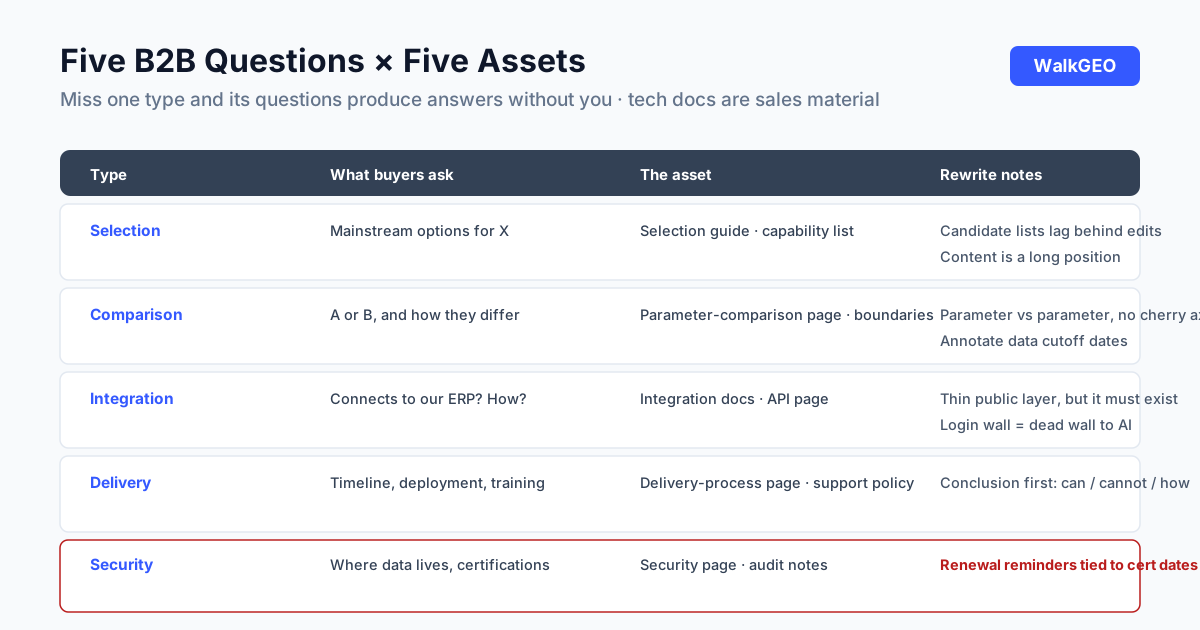
B2B purchase decisions run in months and quarters, with roles from engineer to procurement to management along the chain. The start of that chain is migrating: more research happens inside AI answers, how to list candidates, how two products compare, whether an integration can be done. For vendors this means one plain thing: your technical documents are the sales material, and they happen to live on your website. The assets to prepare, all five:
| Question type | What buyers ask | The asset that answers |
|---|---|---|
| Selection | What are the mainstream options for X | A selection-guide page, a capability list |
| Comparison | A or B, and how do they differ | A parameter-comparison page, fit boundaries |
| Integration | Can it connect to our system, how | Integration docs, an API page |
| Delivery | Timeline, deployment, training | A delivery-process page, support policy |
| Security | Where is data stored, what certifications | A security-and-compliance page |
Five questions, five assets; miss one and the matching questions produce answers without you. Type by type, below.
Selection and comparison: entering the candidate list comes first
For selection questions ("what are the mainstream options for X"), the engine lists candidates, and entry depends on how checkable your product facts are across the web: site parameters, third-party descriptions, mentions in industry content. One B2B-specific lag to note: candidate lists are not real-time, engine source updates trail behind, and last week's parameter edit will not appear tomorrow. That lag makes B2B content a long position rather than a short trade; weekly reading checks and quarterly content reviews are the rhythm that matches the channel. Comparison questions go further: the engine wants dimensional differences, which makes the parameter-comparison page one of the most valuable assets on a B2B site. Its boundary follows the same red line as vendor types: parameter against parameter, publicly checkable facts first, no disparagement. And do not pick only the axes you win; a comparison that flatters only itself gets flagged as promotion at cross-check and drops out of answers.
Integration and delivery: the rich vein of long-tail questions
"Can it connect to our ERP?" "Is private deployment supported?" "How long is implementation?" These questions are specific, low-frequency, and high-intent; the candidate pool is naturally small and parameter matching carries extreme weight. The assets behind them are technical documents: API references, integration guides, deployment notes, all public and crawlable. Many B2B teams lock technical docs behind a login wall on the grounds that they are "for customers". A login wall is a dead wall to AI sourcing. The fix is layering: overview and capability pages stay public, deep operations manuals stay in the customer area, and the public layer is thin but must exist. Layered openness pays a second, underrated dividend: pre-sales engineers answer noticeably fewer repeat questions, because buyers have already confirmed feasibility from the public layer. Publishing technical docs is not leakage; it is pre-sales capacity moved upstream.
The security page: B2B's hard currency of trust
Every enterprise evaluation sheet has a security line, and AI answers cite it too: where data is stored, what certifications hold, what audit support exists. Write those three as a standalone page, facts checkable and certifications verifiable, and it becomes the second most-cited asset on a B2B site after the comparison page. The update discipline matters more than the content: certification renewals and audit revisions can turn "checkable" into "mismatched" if stale, so tie a reminder to the certificate validity dates.
Rewriting technical documents: four points
Technical docs already carry high fact density; the rewrite is small if you hit four points. One specific question per page, titled in the engineer's own phrasing. Conclusion first: can, cannot, or how, before the details. Parameters and code samples carry version numbers, and documents move when versions move. Terminology unified site-wide; the same function never wears three names on three pages, the treatment from entity consistency applied to feature names. Acceptance runs through the six-item citability check, which goes fastest on technical docs precisely because they are already factual.
The boundary for claims: verifiability first
The classic B2B pit is capability inflation: "massive concurrency", "enterprise-grade security", phrases that survive no follow-up. Verifiability-first means numbers with conditions: "supports X concurrent sessions (benchmark conditions: X)", "certified under X (certificate number verifiable)". Where a number cannot be given, describe the applicable scenario instead of an adjective. The other half of the boundary matters equally: competitor parameters stay out unless publicly checkable with a dated source, and customer data stays out without written authorization.
Three B2B-specific misalignments
Three misalignments recur. One: consumer-grade content standards on B2B pages, emotional value up, parameter detail missing, failing both the engineer reader and the engine's cross-check. Two: GEO as a marketing-only task, while integration docs sit with engineering and the security page with compliance; the five assets need three departments' lists aligned before anyone moves. Three: expecting consumer-grade speed; decision chains run in quarters and reading changes reach inquiries in months, so grading by consumer pace means a wrong abandonment in month two. The fixes live in the sections above: parameters first, cross-department lists, grading by window.
Our own B2B content practice
WalkGEO is itself a B2B business: enterprise users, subscription billing, a decision chain seating both marketing and engineering. How we landed the actions here, checkable item by item. Of the five assets, selection and comparison are carried by the article matrix (this blog is organized by topic clusters, and answer material for selection questions lives in the selection, comparison, and metrics clusters). Integration and delivery map to the help center and the pricing page's structured explanations: prices served from dual sources with a live public endpoint, so "how is pricing computed" has a definitive page to cite. Security and compliance map to the site's legal and terms pages, where data and audit statements live as formal terms rather than blog slogans. The claims boundary lands in our line as a fact-checking discipline: every number passes a source gate before entering body text, and sourceless numbers do not ship, a line practice made public in our content line's intercepts. Everything is checkable on site: open the pricing page, the help center, any technical article, and four of the five assets stand in place, the exception noted next.
The missing case page, and its substitutes
Plain truth: no traditional customer-case page exists on our site. Not one unauthorized customer story has been published. The substitutes run three layers: anonymized (scenario and solution, identity removed), self-use (our own GEO work on this site as the case, which is every piece you are reading), and aggregate statistics without customer identification. The gap is discipline, not oversight: customer identity and business details do not go on site without written authorization. Build yours in the same order: the three substitute layers first, named cases when authorization arrives.
Common questions
Are B2B buyers really shortlisting in AI?
Direction clear, degree varies by industry: selection, comparison, and integration feasibility are AI's comfort zone, and usage is rising. No authoritative number exists and we will not invent one. Your check: run your selection questions across engines.
Who writes B2B GEO content?
Two-stage line: engineering supplies facts, marketing handles structure and citability. Marketing-only intros fail engineer readers and parameter cross-checks alike. Cross-proof before publishing.
Do case pages need customer authorization?
Named customers and business details: written authorization required. The three substitute layers, anonymized, self-use, aggregate, let you start; named cases when authorization lands.
How is B2B GEO measured?
The front-end: selection-question mentions and citations, tech-doc citation slots, brand-search movement. Inquiries stay observational; long chains distort attribution to the deal. Retest discipline matches general GEO.
Five assets built, and B2B GEO moves from "wanting to be recommended" to "surviving verification". Today's move: run the five-question table against your site, fill the missing type, and split one public layer out of your login-walled docs. Long-cycle attribution is expanded in the referrals piece, and the conversion-end coordination with paid channels is in the three-channel split. WalkGEO's four assets are checkable on site; your B2B site deserves the same audit.
Done reading? Run the same audit on your own site
Sign up, then let the agent scan every page and hand you a prioritized fix list. Your first audit is free.
Run a free site audit