GEO for Product Pages: Getting Your Products Recommended by AI
AI shopping assistants read structured facts and reviews, not copy. Four fact elements, Product Schema specifics, review trust logic, category boundaries, and our pricing-page rework.
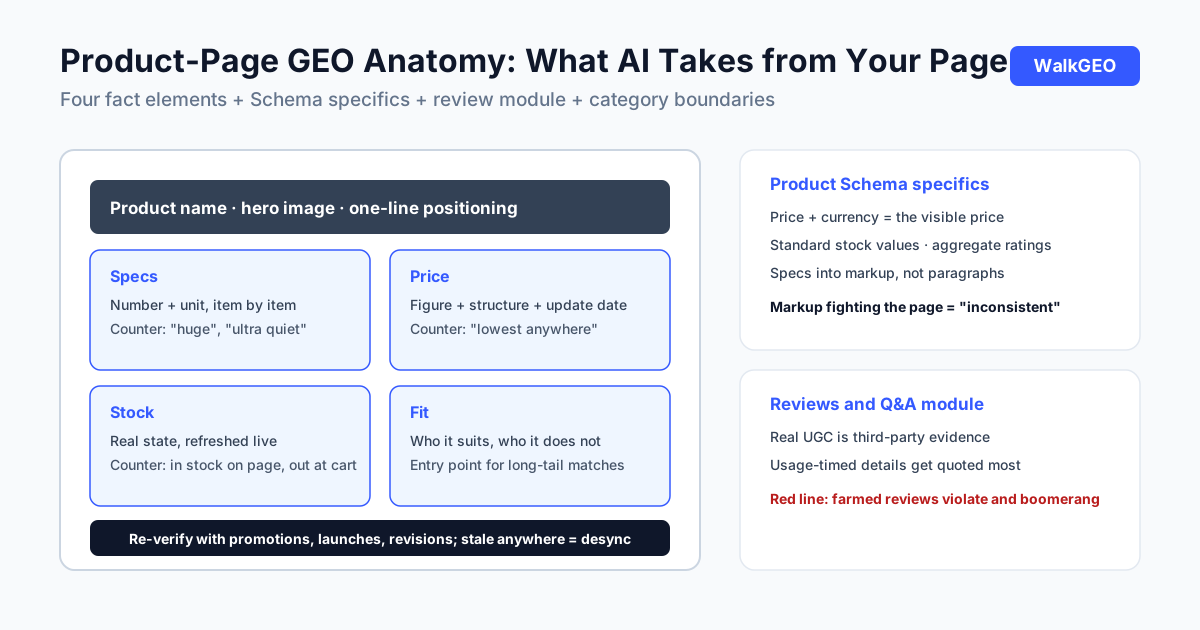
Watch a scene that happens more every week: someone asks an AI for "a quiet blender under five hundred for a small rental kitchen", and the answer lists three models with one-line reasons and sources. Where did those three come from? Not from any detail page's copy; words like "quiet" and "silky smooth" are unverifiable and incomparable across products. They came from structured facts: specs, reviews, prices. That scene decides this piece's whole position. GEO for product pages is arranging facts into a form machines can read, compare, and quote, not polishing the copy. Many teams' first reaction is to go smooth the words, which is exactly backwards: the more ornate the copy, the lower the share of checkable facts, and the less an answer has to draw on. On a product page, design and copy serve by making facts clearer, not by wrapping them thicker.
The four fact elements: specs, price, stock, fit
| Element | Hard requirement | Counter-example |
|---|---|---|
| Specs | Number plus unit, item by item | "huge capacity", "ultra quiet" |
| Price | Concrete figure plus structure, with update date | "great price", "lowest anywhere" |
| Stock | Real state, refreshed with the page | In stock on the page, out at checkout |
| Fit | Who it suits, who it does not | "perfect for everyone" |
Fit is the most commonly missing element and precisely the entry point for long-tail questions: "rental kitchen", "for elderly parents", "small counter space" find their matching evidence in fit descriptions. Stating who the product does not suit loses no real business and hands the answer a selection basis; AI recommending a product with stated boundaries is more confident than one claiming to fit everyone. The writing standard follows the citability checklist; product pages share the discipline with articles. One maintenance dimension gets missed too: the four elements are not write-once assets. Prices move with promotions, stock with sales, specs with revisions, and any stale item marks you "inconsistent" at cross-check time. Set a verification rhythm: price and stock with every promotion, specs with every new release, fit with every new scenario surfacing in user questions. The upkeep costs far less than rebuilding trust after one desync.
Product Schema: the product-page-specific items
The general logic of structured data lives in the Schema primer; product pages add only a few specifics. Walk them item by item: name, image, and description form the base; price and currency must match the visible price, because engines cross-check; stock states use standard values, never invented ones; ratings and reviews go through aggregate markup with the star average and count matching real data. Push specs into the markup item by item rather than into a paragraph; parameters inside markup can be compared item by item, parameters inside prose are quoted or skipped whole. Afterward, validate with the platform's rich-results tool, as described in the Schema piece. The most common failure is markup diverging from visible content: the page repriced, the markup kept the old figure, and the mismatch reads as "inconsistent". Better a few fewer marked fields than markup fighting the page.
Reviews and Q&A: the trust logic of real UGC
Reviews are the engine's primary evidence for how others see the product, inherently more credible than your copy because other people wrote them. The logic also explains a phenomenon: the same selling point, sitting in a hero banner, is advertising; sitting in a review with three months of usage behind it, it is evidence. Same information, different vehicle, different evidentiary grade. Operations should not disguise copy as reviews; it should give real usage experiences the chance to be written down and seen. That runs three layers deep: make honest reviews easy to leave, a modest post-purchase reminder being legitimate operations; keep the specific details visible, because "three months in" and "quieter than my last one" are exactly what engines quote; and never fabricate. The recognition details and consequences of fake reviews are itemized in the black-hat checklist, and product reviews carry an extra layer of platform rules; a store flagged for review farming loses more than ranking. AI-generated or polished review content carries its own labeling duty, handled in our AIGC labeling piece. The on-page Q&A module works the same way: real questions with real answers are direct source material for long-tail questions.
Category pages and comparison content: the boundaries
Category pages, the "how to choose a blender" kind, are the most-cited page type on ecommerce sites because they answer comparison questions directly. Two boundaries govern them. First, compare on dimensions the category already recognizes: noise, capacity, ease of cleaning, the axes buyers actually care about, not only the axes where you win; a comparison that only flatters itself gets identified at cross-check time as promotion rather than reference. Second, mention competitors only with publicly checkable facts, parameter against parameter, no disparagement, the same red line drawn in vendor types. Competitor specs change too; annotate the data cutoff date, which is both honesty and self-protection.
The three most common traps
- Vague specs: a page of adjectives without a single checkable number; the engine has nothing to compare and skips the page.
- Absolute claims: "lowest", "number one", "exclusive"; regulatory hot words, first dropped in retelling.
- Price and stock drift: one price on the page, another at checkout; one cross-check failure and the whole site's credibility takes the hit.
The shared thread is damage to checkability, which is the entire foundation of product-page GEO. The repairs live in the four elements: numeric, concrete, in sync.
How we reworked our own pricing page
A real page from our own site as the sample: /pricing. Strictly it is not a product page, but the discipline of arranging facts into checkable form is isomorphic, and every detail is verifiable by opening the page. What we landed there: prices and billing structure served as catalog statics, with a public endpoint refreshing live numbers on top, silently keeping the static values if the endpoint fails, so the price fact has two independent sources, and a crawler reaching either one gets the same number. Subscription and credit views coexist, each billing structure written separately, monthly, quarterly, and annual periods listed tier by tier, no "better value" fuzz, letting the numbers speak. The page carries its own FAQ block, questions in users' words, answers given flat. Nothing in this rework involved copy technique; all of it is the arrangement of facts: dual-sourced, tiered, checkable. The lesson it lends a product page is one sentence: every number you want AI to quote should be a clean, always-verifiable static fact on the page, not a modifier hiding in an image or a paragraph.
Common questions
Do AI shopping assistants actually read my product page?
Whenever an answer handles "recommend a few" or "which is best", the engine draws on product specs, review content, and comparison articles. Your product page is one of the candidate sources, and the only one you fully control. Whether it gets read is not up to you; whether it gets used depends on how well the facts are laid out, and that is the part you can work on.
My product has no sales or reviews yet. Will AI recommend it?
Cold-start products do start behind, because reviews are a major third-party signal. But pages with complete parameters, clear facts, and honest boundaries still enter comparison lists for long-tail questions; the more specific the question, the smaller the candidate pool and the higher the weight of parameter matching. The right cold-start move is filling the fact layer, never buying reviews: purchased reviews violate platform rules and boomerang once engines learn to detect them.
Does writing "lowest price anywhere" help?
It does not, and it carries risk. Absolute claims are high-risk words under advertising regulation, and AI retellings drop them first, keeping only checkable numbers. Write the concrete price, the pricing structure, and the update time; all three enter answers better than one "lowest". When engines compare two products, they use numbers, not your adjectives.
With ChatGPT Shopping launching, do I need a separate optimization for it?
No separate playbook needed. Shopping features read the same core product facts: name, specs, price, stock, source credibility, fully overlapping with general GEO's fact layer. Complete the Product markup and keep price and stock current with the page. Each platform's shopping rules follow its official documentation with a checking date noted; rules change, investment in the fact layer does not depreciate.
Four elements, Schema specifics, trust logic, boundaries, traps: this piece took product-page GEO down to the grid level. Today's move: pick your most important product page, copy the four-element table across it, fill the missing cells, then run the rich-results test. To verify citation changes, the retest method lives in how to track AI citations; fold weekly readings into the weekly routine, and the tooling boundary sits on pricing. WalkGEO's own pricing page arranges facts by this discipline; your product page deserves the same treatment.
Done reading? Run the same audit on your own site
Sign up, then let the agent scan every page and hand you a prioritized fix list. Your first audit is free.
Run a free site audit