Negative Claims About Your Brand in AI Answers: What to Do
Negative claims: real errors, stale facts, or unsupported content. Sort by type before acting. A six-column disposition sheet, zero counterattack moves, plus our dry-run record.
The two most common first reactions are both wrong. The first is counterattack: discovering AI misstated you, immediately digging up the competitor's flaws, hiring bots to flood praise, arguing anonymously in comment sections. The second is silencing: paying for takedowns, pulling strings, hoping the negative content quietly disappears. Both fail at the same place: neither touches the information itself. Counterattack manufactures new noise; silencing handles only the one item you can see, while the engine's next answer generation draws from the whole web as before. Worse, both leave traces, and the traces become source material themselves: the claim you fought does not vanish, but your own misstep gets archived. This piece teaches no counter-moves. It gives one disposition sheet and one typing flow, defense only.
The disposition sheet, template first
| Column | What goes in | Filling notes |
|---|---|---|
| Date | Found date and each retest date | Separate rows, never one column |
| Engine and question | Which engine, which question triggered it | Question verbatim, unchanged |
| Claim verbatim | What the AI said | Word for word, numbered screenshots |
| Type | Evidenced/unsupported × current/stale | One of four quadrants, chart below |
| Source | The page the answer cited | Trace to the origin before filling |
| Action and status | What was done, where it stands | One appended row per follow-up |
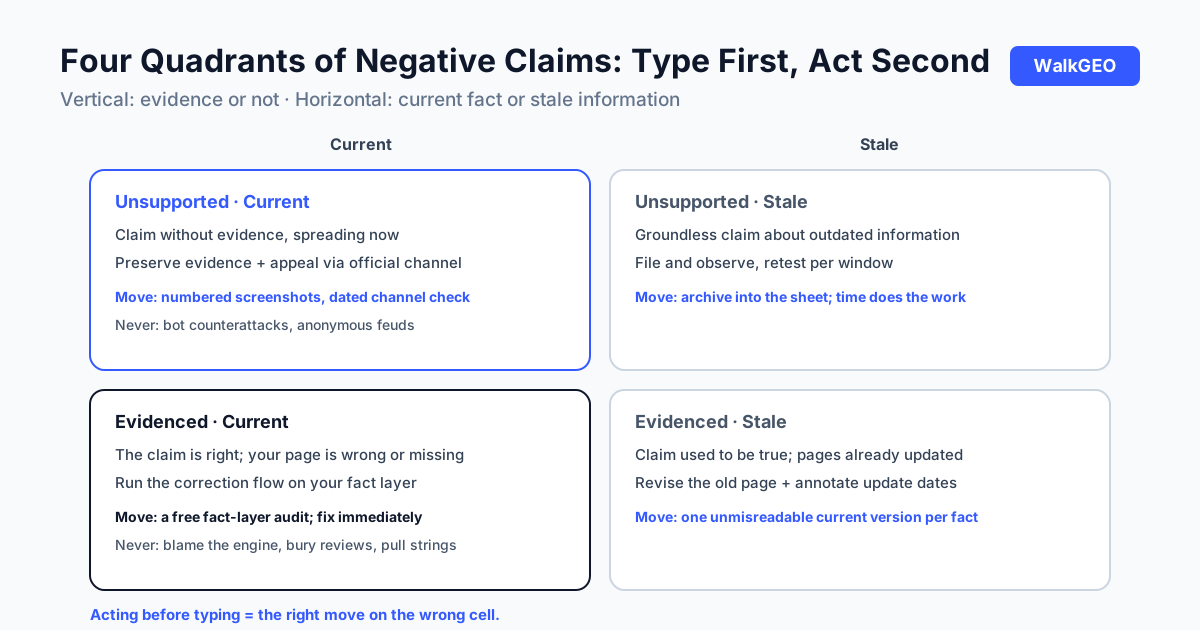
The quadrant is the core of typing. The horizontal axis is timeliness (current fact or stale information); the vertical axis is evidence (supported or not). Upper right, evidenced and current: not negativity but feedback, and your fact layer needs the fix. Upper left, unsupported and current: appeal with preserved evidence. Lower right, evidenced but stale: update your pages and annotations. Lower left, unsupported and stale: file and observe; most fade on their own. Once typed into the sheet, the path picks itself.
Step one: trace and locate
Draw the full information map before touching anything. Ask the fixed question on the major engines, note which engines and which answers carry the claim, and record the page each answer cited. The cited page is the claim's source, and disposition always happens at the source, never in the answer. Engine coverage follows the portfolio logic in multi-engine monitoring; the questions join your prompt set frozen with the rest. Check point: tracing covers at least the three to five engines your customers actually use; checking one engine alone misjudges the spread.
Typed disposition: three sources, three paths
Evidenced error, upper right: the engine is right and your page is wrong or missing. Run the correction flow, layered out in fixing what AI gets wrong. Of the three types this is the one least deserving of complaint: it is a free audit of where your fact layer has holes, with someone else paying the bill. Evidenced but stale, lower right: the claim used to be true, your pages have been updated, but the old content still floats and still gets cited. Disposition is update and annotation: revise the old page, add the update date, give every key fact one unmisreadable current version. Unsupported and current, upper left: disposition is evidence preservation plus platform appeal. Preservation means filling the sheet's first four columns with numbered screenshots; appeal goes through the official channel of the platform hosting the content, with the channel and rules taken from that platform's official pages and the checking date logged in the sheet. Unsupported and stale, lower left: file it, retest on the observation window, and let time do most of the work. Check point: each quadrant carries a different action, and acting before typing is how the right move lands on the wrong cell.
Positive fact assets: how dilution works
Dilution works by giving the next answer generation better material, not by out-numbering the negative. Here a side path needs sealing in advance: some people read "positive assets" as spraying soft articles, stuffing keywords, occupying search results, which is learning the manufacturing method of the upper-left quadrant. Positive assets take one form only: content genuinely related to your business, checkable in fact, hosted on ground you control. The action follows the type. If the rumor is "bad after-sales", write the after-sales policy, response times, and complaint path as complete pages; if it is "unstable quality", put the QC standards and warranty terms on the table. One clarifying fact page beats a hundred unrelated compliments. This is not review-farming; faked positivity becomes its own upper-left claim soon enough.
Monitoring: negative questions join the prompt set
Waiting until you see it is passive, and passivity costs twice: by discovery the claim may have spread across several engines, past the best window, and without routine monitoring you cannot tell a fresh claim from an old one. Pre-write the negative questions users may ask into the prompt set: "does X have pitfalls", "how is X's after-sales", "is X worth it", sharing the same sheet, the same window, and the same retest discipline as your brand questions, so reputation readings ride along for free. A new claim enters the sheet the day it is found. Only one step of disposition runs overnight: preserving the evidence. Everything else goes slow, by one dividing line: anything outward passes through typing first; anything repairing your own fact layer executes immediately, the one move that never needs deliberation.
Retrospective: the last cell of the loop
The sheet's final column is status, and status has exactly two endpoints: disposed (fact fixed, appeal closed, or the filed item aged out) and moved to monitoring (no action yet, in the prompt set under weekly observation). Each quarter, read the whole sheet top to bottom: did disposed items relapse, did monitored items escalate, and which quadrant appeared most. The busiest quadrant points at your weakest layer. Many upper-right items mean fact-layer maintenance debt; many upper-left items mean too few checkable facts, which is exactly the room unsupported content lives in. Half an hour per quarter, and the output is next quarter's defensive focus.
A dry run, honestly recorded
Plain truth: to date our sheet holds zero real negative claims against WalkGEO, but we ran the whole flow as a drill. The hypothetical claim was "the service's promised results never showed", starting from five-engine tracing, quadrant typing placing it upper left, unsupported and current, then evidence preservation and channel verification, every step producing the fields the sheet requires, one afternoon end to end. The drill's value shows up from the second column onward: the day a real claim appears, what you lack is not process knowledge but execution discipline under pressure, and discipline comes only from rehearsal. A checkable action: put this drill on the quarterly calendar, one hour, filed after each run.
Common questions
What is the right first response to a negative claim about you?
Record it; do not respond. Screenshot, then log the date, the engine, the triggering question, and the page the answer cited. Without this record every later step loses its footing: no typing, no appeal submission, no verification of any fix. Record first, judge second; that is cell one of the sheet.
How do I tell which type a negative claim is?
Cross two dimensions: does the claim have evidence, and does it match current facts. Evidenced and current means your fact layer needs fixing. Evidenced but stale means updates and annotations. Unsupported and current goes to evidence preservation and platform appeal. Unsupported and stale: file and observe. Never act before typing, because the right moves for different types contradict each other.
Can I ask an engine to delete an unsupported claim?
Engines have no public "delete this sentence" channel. Two layers work: the platform hosting the original content, appealed through its official channel with evidence, the channel taken from the platform's official pages with a checking date noted; and your own fact layer, made complete enough that the next answer generation draws on better material. Work both; whichever pays off first, you win.
How much positive content does it take to dilute a negative claim?
Dilution is not a volume contest. Engines draw on relevance and credibility, and one fact page that clears up the misunderstanding beats a hundred unrelated compliments. Follow the type: if the rumor is "bad after-sales", write the after-sales policy, response times, and complaint path as complete pages. Volume goes to time; relevance goes to content.
One flow, one price: rehearsal. Today's moves: copy the six-column sheet into your collaboration tool, and add three negative questions to the next version of your prompt set. Fold retesting into the weekly routine; monitored monitoring lives on pricing; the full correction path is in the correction piece, and the other side of "AI doesn't mention me" is in the mention-gap piece. WalkGEO's sheet is empty today, and we intend to keep it that way; the method is everything in this piece.
Done reading? Run the same audit on your own site
Sign up, then let the agent scan every page and hand you a prioritized fix list. Your first audit is free.
Run a free site audit