Founder Visibility Without Short Video: GEO for Expert IP
AI cites verifiable professional traces, not screen time. Signed articles, talks, Q&A and a checkable bio build an expert entity answers can describe consistently.
"Skip short video and nobody will know who you are" is only half true in answer engines. A model does not put you into an answer because you showed up on camera every day. It needs traces it can check, compare and cross-reference. Whether a founder gets recommended depends on how solid those traces are, not on screen time.
What happened when we switched from team bylines to a person
We went through this, and the process is simple enough to explain.
In late October, new posts on our site still carried the team name. From November, new posts switched to a personal byline: "Tim Li · Founder, WalkGEO". The author box explains that deployment and measurement walkthroughs come from first-hand work on our own site. We did not edit dozens of articles to make that change. We adjusted one author record, and the byline, the bio and the name and job title in structured data all moved together.
Why does that belong in a piece about founder IP? Because it shows the precondition people skip: the name has to stay stable before any association can form. If one batch of articles says team, another says an individual and a third uses initials, an engine doing cross-checks sees three objects instead of one person. A byline looks like a layout detail. To an answer engine it is the anchor for entity recognition.
The lesson is not "switch to personal bylines". It is "pick one form and keep it everywhere". Your field may be law, medicine, tax advice or independent software. The forms differ, the test does not: one name, one role, one short bio that can be checked, repeated across public material.
Four professional traces an engine can verify
A professional trace is public material that attaches a judgement to a specific person. With that defined, we can split traces into four types, each answering one question: who you are, what you did, how others describe it and where it can be checked.
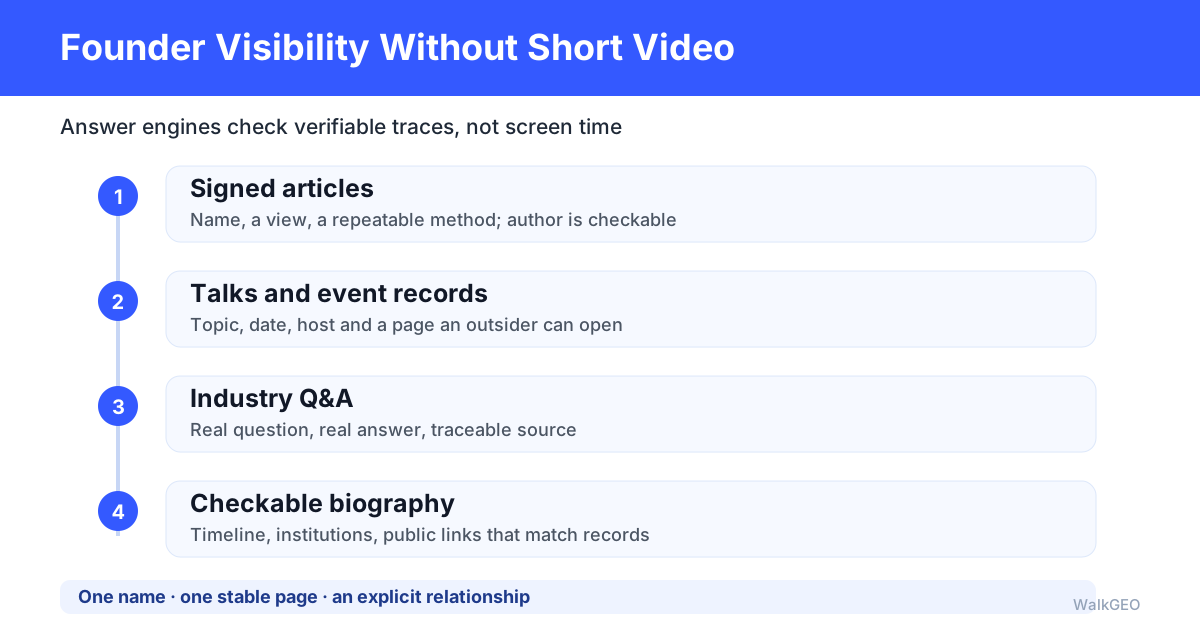
| Carrier | A qualifying version | What an outsider checks | A common failure |
|---|---|---|---|
| Signed article | Name, a view, a method someone can repeat | Who wrote it and whether methods stay consistent | Company voice only, no identifiable author |
| Talk or event record | Topic, date, host, an accessible page | Whether the event really happened | "Invited speaker" with no venue named |
| Industry Q&A | A real question, a real answer, a traceable source | Whether the answer came from the person | Generic filler copied between sites |
| Checkable biography | Timeline, institutions, public links | Whether it matches public records | A stack of titles nobody can confirm |
You do not need all four at once, but you need one to start from, and every new trace should point at the same name. A missing category is not a penalty; it is one less piece of cross-evidence available when someone tries to confirm you.
There is a lookalike that is not a trace at all: unsigned opinion roundups, mass-produced "expert says" pages, bought interview slots. They share one flaw: the words cannot be assigned to a specific person. Engines do not lack generic opinions. What they lack is a chain that attaches a claim to a subject.
Turning a name into a linked person
"Entity" sounds abstract. In practice it is three jobs: one name, one stable page, one explicit relationship.
One name means the byline, author page, public answers and event listings use the same spelling. A Chinese name stays Chinese; an English name stays English. Do not alternate within the same batch of material. We covered the brand version of this in entity consistency. A person follows the same rules with a different subject.
One stable page means a long-lived author or byline page that states the role, the area of responsibility and a few checkable works. It does not need to be elaborate. It needs to be crawlable and openable. Taking it down a day later undoes the association you just built.
One explicit relationship means saying, in both prose and structured data, who works for whom. Our article pages record the name and job title in a Person node and connect it to the company entity. That is the engineering version of "experience and expertise must be attributable" in E-E-A-T in practice. The person should lead back to the company, and the company should lead back to the person.
Content is not invented; it is tidied from work already done
This is where most people stall. They have done the work, but what they publish reads like a résumé. The missing step is a conversion: "I did X" becomes "I did X, judged it this way, got this result, and here is where it stops working".
A citeable piece says what happened, how a decision was made, what went wrong and where the boundary sits. If you migrated customer data once, the useful article is not "we are experienced". It is how fields were reconciled before the move, which step failed and what rule prevented a repeat. Such detail can be lifted straight into an answer. Nobody has to write an ad on your behalf.
Our own sequence is: keep raw notes from the project, split the durable questions into public answers, then expand the answers that hold up into a signed article. Every step uses something that actually happened. The order matches citeable content with the subject changed from company to person.
A quick test: cover your name on the article. If the remaining text reads the same with anybody's name, it is not a professional trace. Real traces stop making sense when you swap the person out.
Two lines not to cross
The first is inventing a résumé. Do not claim projects you did not run and titles you did not hold. Cross-checking keeps getting better, and a single mismatch in public records damages every later claim that person makes, not just one page. When AI is involved in drafting, mark it according to the boundaries in AIGC labeling instead of letting readers assume a verbatim record.
The second is buying endorsement. Purchased interviews, "industry leader" entries in paid listings and association titles with no clickable page are the same species as the fake neutral lists in black-hat self-check. They buy a business card, not an ability. They look busy this quarter and supply nothing checkable next year.
Keeping both lines is slower. That is fine. Expert IP compounds over years. One fabrication can erase years of accumulated trust.
Checking whether the association is working
Do not use follower counts, and do not declare victory after one mention. The practical test is a fixed question set reviewed weekly.
Use three kinds of question. The first asks about the field: who speaks publicly about this. The second asks about belonging: who founded this company. The third asks about reasoning: who has written a checkable method on a specific problem. They test, respectively, whether the name is known at all, whether the role is right and whether the reasons match published work.
Run the same set across the engines you use and record three things: whether the name appears, whether the role is correct and whether the stated reason matches something you published. One hit in one engine is not evidence. Watch the same questions week by week. When descriptions stabilise and reasons start to agree with each other, the association is forming. Build the sampling setup the way multi-engine monitoring describes; do not swap the question set midstream.
There is no hard KPI here. Being recommended is an external result shaped by engine updates, question mix and competing sources. Any promise of "do X and you will be recommended" is false. What you control is the number and consistency of traces, and that part can be audited one item at a time.
Common questions
Can a founder be mentioned by AI without appearing on video?
Yes, because answer engines look for verifiable professional traces rather than minutes on camera. A signed article with a method someone can repeat is stronger proof of expertise than a thirty-second clip. When several public sources point to the same name and the same descriptions, the model has something stable to cite. Video is one carrier, not the entry ticket.
Is founder IP the same thing as company brand?
No. A company brand answers what the company does. A founder IP answers who is responsible and why that person should be trusted. The two should link to each other without sharing a name: bylines, author pages and structured data should use one consistent person, with the employer stated explicitly. The person should lead back to the company and the company should lead back to the person.
What counts as a verifiable professional trace?
Four things are enough: signed articles, public event records, industry Q&A and a checkable biography. Each has the same test: an outsider can follow public information to confirm it. A resume that only exists in a sales deck does not count. An event list with a title and no page does not count. Leave a category empty rather than filling it with things nobody can verify.
How do I know whether the author entity is linked up?
Sample fixed questions such as who talks publicly about this field and who founded this company. Check whether answers contain the name, the right role and reasons that match published work. One hit in one engine is not evidence. Repeat the same set weekly and watch whether descriptions across engines converge. Stability, not a single mention, is the signal.
Whether a founder gets recommended has little to do with the camera and everything to do with the public, checkable things left behind. The move today: take one problem you personally solved and publish a signed answer about it, with a name and role you will keep using. Then watch how answers describe you, week by week. For the recording rhythm, follow the weekly routine; for scope and pricing, see product and pricing. WalkGEO keeps author information in a single record, so the byline, bio and structured data change together.
Done reading? Run the same audit on your own site
Sign up, then let the agent scan every page and hand you a prioritized fix list. Your first audit is free.
Run a free site audit