GEO on a Small Budget: The First Three Things to Do
Don't start GEO by buying a package. Three free things first: fix the fact pages, run a free self-check, open technical access. Three signals for when money is justified, plus our low-cost start.
The most expensive small-team mistake in GEO is not doing something wrong; it is buying the wrong thing at the wrong time: an annual package signed while the baseline is unmeasured, the fact pages unedited, and the crawlers still blocked. Three free things come first, each verifiable by your own hands, and finishing them tells you whether to spend at all. The three, upfront:
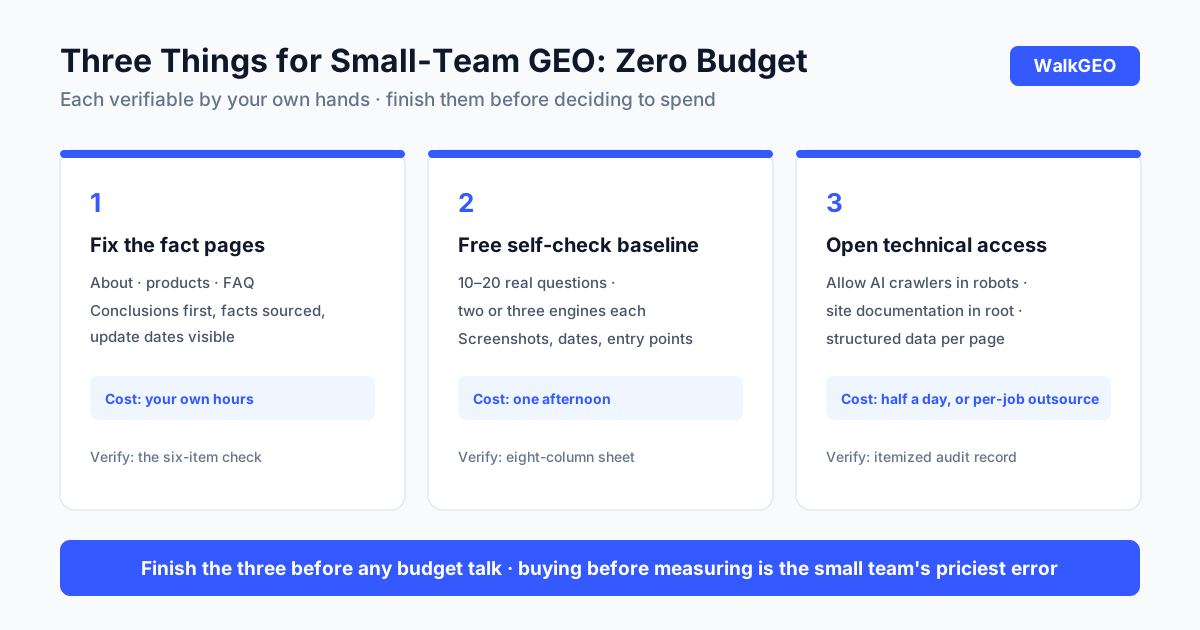
- Fix the fact pages: About, products, FAQ, so AI has something true to quote
- Free self-check: ask a round manually, establish your own baseline
- Open technical access: allow crawlers, add site documentation, add structured data
Now question by question.
Where should a small team spend its first GEO dollar?
Nowhere yet. All three things run on zero budget: fact pages cost hours, the self-check costs a free backend plus manual asking, and access work is configuration. The first real money belongs to a monitoring tool, placed after the free baseline, because only then can you tell whether the gap is readings, content, or access. Order matters too: fix pages first and the baseline measures your changes; measure first and the before-and-after becomes your first effectiveness record. Choose the latter.
Without buying a tool, how do I know how AI describes me today?
Ask manually. Ten to twenty questions real users would ask, run on two or three engines, answers screenshotted, with date, entry point, and mention noted per row. The free routes are laid out in free AI visibility checks; question design and freezing follow the prompt-set guide. Frequency and coverage are the weaknesses, not credibility: readings from a frozen set are enough to start, and enough to ask a vendor "compared to which round of mine?" Record in the eight columns of the baseline sheet, one row per question. Skip any column beyond screenshots and the second round collects the debt: readings without dates cannot be compared, and readings without an entry point cannot explain whether a difference came from the engine or the web-versus-app interface. For a one-person team the sheet doubles as the handover document: anyone can pick it up and continue.
Which pages on the site get fixed first, and in what order?
Three spots, ranked by how often they get asked. First, the About page: who the company is, what it does, whom it serves; the first place AI checks your identity. Second, product or service pages: specs, applicable scenarios, and pricing structure written as checkable sentences, adjectives left out. Third, the FAQ: questions in users' own words, answers given flat in thirty to fifty characters. The rewrite standard is the six-item citability check: conclusions first, facts sourced, update dates visible. A small site is a dozen or so pages; a week of evenings covers it. Sequence within the fix matters too: About first, then products, then FAQ, because About anchors the rest; once the company name and business description are set there, product pages written against them stay consistent. Run the six-item check on each page before moving to the next; batching the review at the end usually means rework.
What about the technical access work if I can't code?
The hardest of the three, with known paths for every part. The robots.txt check is reading a file and comparing entries, using the checklist in the robots.txt audit; llms.txt is placing one documentation file in the site root, format in the llms.txt guide; structured data in mainstream builders usually ships as a switch or plugin, compared in the Schema primer. If none of that lands, hire it as a one-off: hand the three-item list to a freelance engineer for half a day, paid per job, far cheaper than a monthly retainer.
When is spending money actually justified?
Three signals; negotiate budget when any one appears:
- Signal one: the free self-check cannot keep up. You want weekly rounds and more engines, and manual bandwidth is gone.
- Signal two: readings plateau while fact pages and access are already fixed, meaning the gap is sustained capacity.
- Signal three: you are entering procurement or partnerships and need continuous, exportable readings as negotiating evidence. While none of the three has appeared, every saved dollar is correct. At signal one, look at the tool tier on pricing first; do not jump straight to full-service.
Which two ways of spending waste the most money?
First: a monitoring tool whose readings never change any page; the subscription runs monthly, the numbers sit, and after three months of cancellation the verdict is "the tool didn't work", when the tool was fine and the sequence was wrong. Second: full-service for a site with no baseline, where lift claims have neither a comparison point nor agreed measurement rules, and acceptance becomes two parties reading different sheets. The shared cause is buying before measuring. Finish the three free things and both traps avoid themselves; the full paid-procurement flow, kickoff to retrospective, is in buying GEO services the first time.
If I outsource the technical work, how do I accept delivery?
Three items, checked against the list. The robots check ships as a per-entry record: each crawler's name, allowed or blocked, and which file was edited. The llms.txt work ships with a live URL you can open yourself. Structured data ships with a covered-page count reconciled against the count you expected, with any gap explained in the delivery note. All three pass, the job is done; a bare "all set" counts as not done. State the acceptance standard before hiring and put the three items into the quote; it makes pricing faster, too.
What did our own start actually cost?
The cost structure of our own start, because WalkGEO is itself a small-team case built from zero. The hard-cost list has three items: a domain's annual fee, ICP filing at zero cost (it costs waiting time), and labor. No paid monitoring tool at the start; the first readings came from a free search backend. No outsourced content; every article in this blog came off our own line. No purchased SEO service; the technical access work, robots, site documentation, structured data, was configured item by item along the paths above. What the start really cost was time: setting the plan, writing the question set, turning the six-item check into a daily habit, all of it paid in hours, and all of it verifiable. What you can check: this low-cost path produced the entire blog you are reading, fifty-six articles, none of them bought; and the three access items themselves were walked on the non-outsourced path, with verification methods identical to the acceptance list above. The judgment it hands you: a small team's weakness is budget and its strength is that every dollar can land where it counts, provided you do things in order.
Finish the three things and your GEO already runs ahead of those who only buy. Today's moves: copy the three-item card into your task list and schedule the fact-page fixes within a week. When readings need a weekly rhythm, the weekly routine picks it up; when budget appears, what GEO costs and vendor types help you buy against the right gap. WalkGEO is the living case of this piece: a low-cost start is not a low-standard operation; the three zero-budget things became a fifty-six-article asset.
Done reading? Run the same audit on your own site
Sign up, then let the agent scan every page and hand you a prioritized fix list. Your first audit is free.
Run a free site audit