Programmatic GEO: shortcut or poison?
Programmatic GEO poisons through zero increment, not scale: templates and distribution batch, fact-checking does not. Where the line sits, plus how our own pipeline stops at the skeleton.
Programmatic GEO is a shortcut or a poison depending on one sentence: are you batching distribution, or judgment? Templates, publishing, markup, internal links: mechanical work where batching is pure efficiency. Facts, entity consistency, the sense to say "this claim fails under these conditions": work where batching is a disaster. Engines penalize "programmatic" for nothing; they penalize zero increment. Draw that line clearly and the shortcut and the poison turn out to be the same machine, used on different sides.
Engines punish idling, not scale
Start from the other side's rules. Generative engines pick sources by cross-source checking: a claim stated consistently across several sources is safe to cite; a page that adds no fact to any known question is dead weight in that chain. Google's spam policies put it plainly: however content is produced, mass-creating pages without increment for users falls under "scaled content abuse". Read the wording: the target is missing increment, not the production tool. A human pasting out a thousand near-identical pages is in scope; a program generating a thousand distinct, useful pages is simply publishing.
So "will programmatic GEO get penalized" is the wrong question. The right one: what does each page you're about to batch add over the pages it replaces or sits next to? The addition is what users gain and what engines credit during cross-checking. Without it you're not producing pages, you're producing index noise, and noise fares worse in generative engines than in classic search: it never reaches a display slot at all, it just gets skipped.
One more channel to separate: training corpora versus retrieval. A batch page that happens to end up in a model's training set is a one-shot snapshot the model never sees update. Retrieval citations are the asset GEO actually manages: the page stays alive, facts refresh, and the next cross-check can pick it up. The worst outcome for a batch page is both at once: a stale copy frozen in training memory while the retrieval layer rejects it for lack of increment. Before asking "will AI learn from my programmatic content", ask whether it deserves to be remembered by the retrieval layer.
The comparison with legacy programmatic SEO deserves its own caution. In classic search, thin batch pages still won impressions through title matching. Answer engines have no tenth position: either they cite you or you're air. The floor that made legacy programmatic SEO survivable is gone, which is precisely why importing the old playbook wholesale is the most dangerous move available.
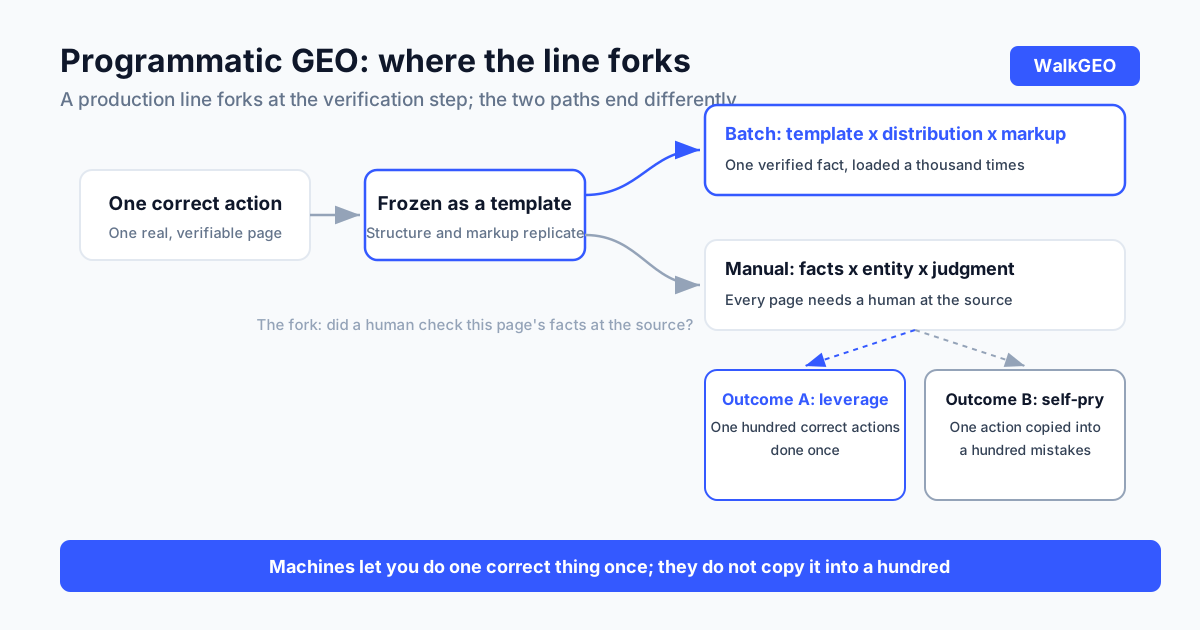
The line between what batches and what doesn't
Split GEO's work and the two sides separate cleanly:
| Task | Batchable? | Why, and where it stops |
|---|---|---|
| Page templates and layout | Yes | Uniform structure helps engines parse pages, so batching here is a plus |
| Internal links and navigation | Yes | Rule-based automation works; avoid generating link loops |
| Structured data markup | Yes | Generate from body data; same-source is the precondition |
| Distribution and submission | Yes | Sitemap, IndexNow, search console: pure mechanics |
| Fact verification | No | Someone must check every fact at its source; one wrong number stains the whole entity |
| Entity consistency | No | Names and claims must agree across pages; machines can't verify meaning |
| Judgment and experience | No | "When this advice fails" doesn't fit a template |
The three rows on the right are batch's natural boundary, and the site of most wrecks. The classic one is the city-page matrix: one template, the city name swapped, and even the local facts (climate, transport) recycled nationally. In classic search such pages still scraped long-tail traffic; in answer engines they're a liability. When an engine cross-checks "how much does GEO cost in Hangzhou" and three city pages return the same answer, your whole domain loses standing on that question class.
The honest counter-example is the database page. SKU specs, price tables, dimension charts: the data genuinely differs page to page, and the template is just a uniform shell around facts that vary. Verify the template once, feed the data source continuously, and every page hands the engine something nobody else has. That's what batching is for. The dividing line is never page count; it's whether facts change page to page. Where data moves, the template is a container. Where it doesn't, the template is a disguise.
The temptation is obvious: change one field, gain a page, marginal cost near zero. But near-zero marginal cost only holds where no human judgment is needed, and in GEO everything valuable needs judgment. Run the accounting honestly and programmatic's proper role emerges: automate the mechanical layer, and push every freed hour into verification and judgment.
Where our own pipeline stops
Our content production is a small pipeline that doubles as evidence for this line. The engine-guide articles share one four-step skeleton: access, entity, material, re-test. The skeleton batches: identical structure, identical image dimensions, markup generated the same way, build-time validation that blocks publishing on a missing field. Under the skeleton, every fact is verified per article: DeepSeek's crawler list, Yuanbao's ecosystem position, Perplexity's two-crawler regime, each checked against its own official sources, and where no official statement exists we write that down and lean on community lists as flagged evidence. The template saves layout time; it cannot save the hours of checking.
We also cut a piece we wanted to batch and couldn't. The first attempt templated FAQ selection across articles; one round in, answers started repeating, and repeated answers dilute each other in cross-source checking. Batch stopped there, not because the tooling couldn't do it, but because the day it could, quality would be dead.
Verification left a residue worth describing: every article keeps a source block recording crawler names, source pages, and evidence limits, archived after publishing. Nobody reads those records until the day an engine's answer disagrees with ours; then ten minutes with the log locates which check was rushed. Verification without a trail equals no verification, because you can't say it happened.
What this means for you, operationally: before going batch, list the tasks you plan to automate and ask, for each, "if this goes wrong, who notices?" If the answer is "the build script" or "the QA tool", batch it. If the answer is "nobody, until an engine cites the mistake", automate nothing there. Run the pre-publish checklist before any batch goes live; the five machine items come first. Timing matters too: hand-run a few pieces first, learn what checking actually takes, then freeze it into a template. Skipping the manual phase writes an unlearned process into the conveyor belt, and errors scale with it.
When to stop
Batch has momentum; stopping is harder than starting. Any of three signals means cut output first: citation rates on new pages running far below stock; inability to say what a page adds over its neighbor; verification speed falling behind production speed. Cutting output is not defeat. The first thing batch mode breaks is never content quality: it's the team's verification bandwidth, and bandwidth can't be borrowed.
The boundary compresses to one sentence: machines exist to let you do one correct thing a hundred times, not to turn one correct thing into a hundred copy-pastes. The first is leverage; the second is the lever prying at your own foundation. When you can't tell which one your batch is, a round of the free self-check settles it. The batchable side of monitoring and publishing ships ready-made in WalkGEO; the other side of the line no tool can carry for you. Pricing shows what's already automated.
FAQ
Can programmatic pages get cited by AI?
Yes, if every page carries increment. The unit engines cite is a fact block that answers one question on its own; batch pages qualify as long as each one is more accurate, complete, or current than alternatives. A thousand template pages with the city name swapped give an engine no reason to cite any of them. Scale decides cost; increment decides eligibility. Keep the two apart.
What does Google actually think of mass-generated content?
Its spam policies name the pattern "scaled content abuse": however it is produced, mass-creating content without increment for users falls inside the policy. The wording targets the missing increment, not the tool. A human writing a thousand near-identical pages is equally in scope; a program generating a thousand genuinely distinct, useful pages is fine.
I have hundreds of SKU or city pages. What now?
Classify first. SKU pages with real per-item parameters are database pages and batch perfectly. City pages need a reason to exist: what fact does each one add over its neighbor? No fact, no page: ten real pages beat a hundred templates. The test never changes: if you deleted this page, what would users lose?
When should I stop scaling?
Three signals: citation rates on new pages running far below your older stock; you can't say what one page adds over the next; your team's verification speed falls behind production speed. Any one of these means cut output first. The biggest cost of batch is never production, it's your own verification bandwidth.
Done reading? Run the same audit on your own site
Sign up, then let the agent scan every page and hand you a prioritized fix list. Your first audit is free.
Run a free site audit