The pre-publish GEO checklist: 20 items
Run this 20-item GEO checklist before publishing: machines, entity, material, measurement. Five items each, one action and one pass bar each, with execution notes. Ten minutes for the machine group.
Run this GEO checklist before you publish. Twenty items, four groups: machines, entity, material, measurement. Each item is one action and one pass bar, with our own execution notes inline. The machine group takes ten minutes; the ten items in the last two groups decide whether citations and trends ever come.
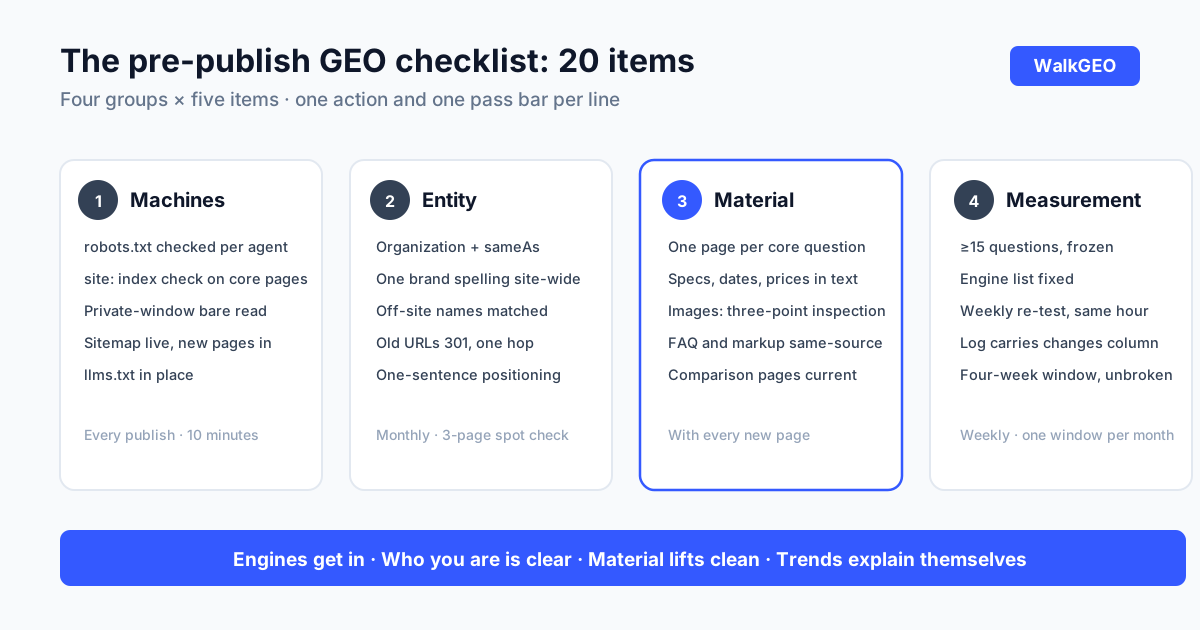
Machines: can engines get in?
- Read robots.txt UA by UA. GPTBot, ClaudeBot, PerplexityBot, Google-Extended, bingbot: none may appear in a Disallow. CDNs and firewalls blocking "unknown agents" fail silently; the console shows nothing. Verify the spelling of each token before allowing; a typo blocks nothing and protects nothing. Our own check once caught a missing OAI-SearchBot allow, fixed same day; the full story is in the crawler audit.
- Check indexing with site:. Search
site:yourdomain.complus a core-page keyword. Nothing there? Check crawl status in the search console before touching content. Indexing is the admission line for citations: no search base, no AI answer out of thin air. - Open core pages in a private window. No login, no cookie banner, full body readable. Crawlers rarely run heavy scripts; what doesn't render doesn't exist. Check the mobile viewport too; modules that fail on phones fail for crawlers as well. Turn off forced geo-redirects, or the crawler sees one region forever.
- XML sitemap alive. Open
yourdomain.com/sitemap.xml, confirm it loads, confirm new pages are in it, then submit in the search console. lastmod should follow real revisions; bulk-refreshing dates means nothing. - llms.txt in place. A small site guide at the root, listing key pages and what they're for. Not every engine reads it; it costs an hour. Keep it under twenty lines, each one earning its place; a dumped directory is worse than nothing. How to write it: the llms.txt guide.
Pass bar: five agents unblocked, indexable, body readable bare, sitemap and llms.txt live.
Entity: do engines know who you are?
- Organization markup on the homepage. Name, URL, logo, and a sameAs list covering every official property. Same-name confusion closes here; the markup guide has the details (structured data). Give the logo an absolute URL; a 404 logo voids the block.
- One spelling of the brand. For us that means WalkGEO everywhere: footer, about page, docs, bylines. Decide a destination for abbreviations and old names (a redirect or an explainer page), never let them drift. Finish site-wide renames the same day; two spellings coexisting is the most dangerous state, because both fail verification.
- Same name off-site. Account names on Quora-like platforms, video channels, and news columns must match the site exactly. Engines skip properties they can't reconcile. Put the site link in every profile bio, one more thread for entity binding. When engines get your facts wrong, the fix method lives in the entity correction piece.
- Redirect old addresses. Old domains and retired sections go 301 to their new homes. A set of 404s hands engines an extra, stale version of your facts. One hop, no chains; long chains make verification a mess.
- One sentence of business on the homepage. Title and opening paragraph answer "what is it, who is it for". Engines read those two first when verifying who you are. Write the positioning with your support team's exact words; slogans need to survive customers first.
Pass bar: markup present, spelling unified, properties matched, no dead ends, one sentence that holds.
Material: would an engine dare lift it?
- One page per core question, answering it outright. The definition sentence stands alone at 25–50 words, liftable into an answer without edits. One page, one question; a page answering five answers none well. How to pick questions: the what-is-GEO piece.
- Facts live in text, not images. Specs, dates, prices as text. Engines read images poorly; words inside a picture are words unwritten. Build spec comparisons as HTML tables; a crisp screenshot never enters an answer. Audit the pricing page separately; price is the field engines most often serve stale.
- Images pass inspection. Our rule is three checks: no brand logos, no readable UI text, semantics matching the paragraph; all three or it doesn't ship; social-card versions ship as compressed PNGs. The rule exists because of one real mistake: a search page described "a laptop with an open browser", and the downloaded file was a competitor's interface.
- FAQ and markup from one source. Once page Q&As are final, FAQPage markup generates from the same data. Questions not in the body don't go into markup; extras are mismatches. Change the body, change the markup in the same commit; split edits always drift.
- Comparison and spec pages exist. "How does it compare", "what are the specs": answers love table pages for these. Without a verifiable comparison page, those questions always land elsewhere. Keep comparison pages current; outdated specs hurt more than missing ones.
Pass bar: definitions stand alone, facts in text, images triple-checked, markup same-source, comparison pages stocked.

Measurement: can you explain the trend?
- Question set ≥15, frozen. Cover what-is, how-to-choose, how-to-use, versus-whom; collect sentences from real support conversations, never from internal jargon. Design method: the prompt set piece. Nothing changes inside a window.
- Engine list fixed. Domestic business: watch your market's four main engines first; going global adds ChatGPT and Perplexity. Test one fixed batch; the list follows your buyers, not your curiosity.
- Weekly re-test, same hour. Pin it to the hour; answer sampling drifts through the day. Fresh chat, verbatim question, log four things: mentioned or not, in what role, whose link, facts right or wrong. Four grades: absent, named, cited, rival-linked.
- A "changes this week" column in the log. New article, page edit, one line each. Log actions, not feelings; "it felt different" is not a record. Four weeks out, that column is the only thing that explains a swing. Log mechanics: the citation tracking piece.
- Four weeks per observation window. No question changes, no engine additions inside a window. You can publish content during a window; you cannot touch measurement settings. Keep the two apart. One week is noise; two weeks in the same direction is a signal. The cadence comes from the GEO timeline.
Pass bar: set frozen, engines fixed, weekly test logged, changes tracked, window unbroken.
Where the twenty items come from: machines and entity we have run end to end: the crawler block and the markup mismatch were both caught by this list; material and measurement are living rules, running with every publish and every weekly re-test. Part of the machine group is already automated in our pipeline: the build checks card formats and date fields, markup generates from body data, photos face a mandatory inspection, and humans only touch exceptions. The list itself iterates: when the engine list moves, group one moves with it.
FAQ
Who is this checklist for?
Split down the middle: the machine group belongs to engineering, material and measurement belong to content, entity is shared. Agree on the split before running the list, or item 1 will stall on day one.
Does all-green mean I'm done?
Green is admission, not outcome. All four groups earn you the right to compete for citations; the ten items in material and measurement are what actually separate winners. Those two have no finished state: every new page runs the material group, every week runs the measurement group.
How often should I run it?
Machines: every publish, ten minutes. Entity: monthly, three-page spot check. Material: with each new page. Measurement: weekly, in four-week windows. The full twenty items run once a quarter as a regression pass.
Will the items change?
The engine list changes first. New crawlers, merged entry points, shifting fetch policies all rewrite group one; the other three move slower, following engines and products. Audit quarterly, drop dead items, add new ones, note the version in the header.
Is this the same as the free self-check?
No, and the use cases differ. The free self-check is a diagnosis ("why can't AI find me?") for sites already live that feel wrong. This list is a gate ("will this launch be wasted?") run before content ships. Prevention first, diagnosis second.
Run group one today. Five machine items, ten minutes, and a single block can waste every content hour that follows; fix what it finds on the spot. Then let the list roll: machines with each publish, measurement weekly, everything quarterly. Machines and measurement are ready-made workflows inside WalkGEO; if you'd rather not maintain the list by hand, pricing is the doorway.
Done reading? Run the same audit on your own site
Sign up, then let the agent scan every page and hand you a prioritized fix list. Your first audit is free.
Run a free site audit