AI is wrong about your company: how to fix it
When AI gets your company wrong, it's usually stale or conflicting sources, not a glitch: write a canonical answer, publish it where engines check, then retire the old versions.
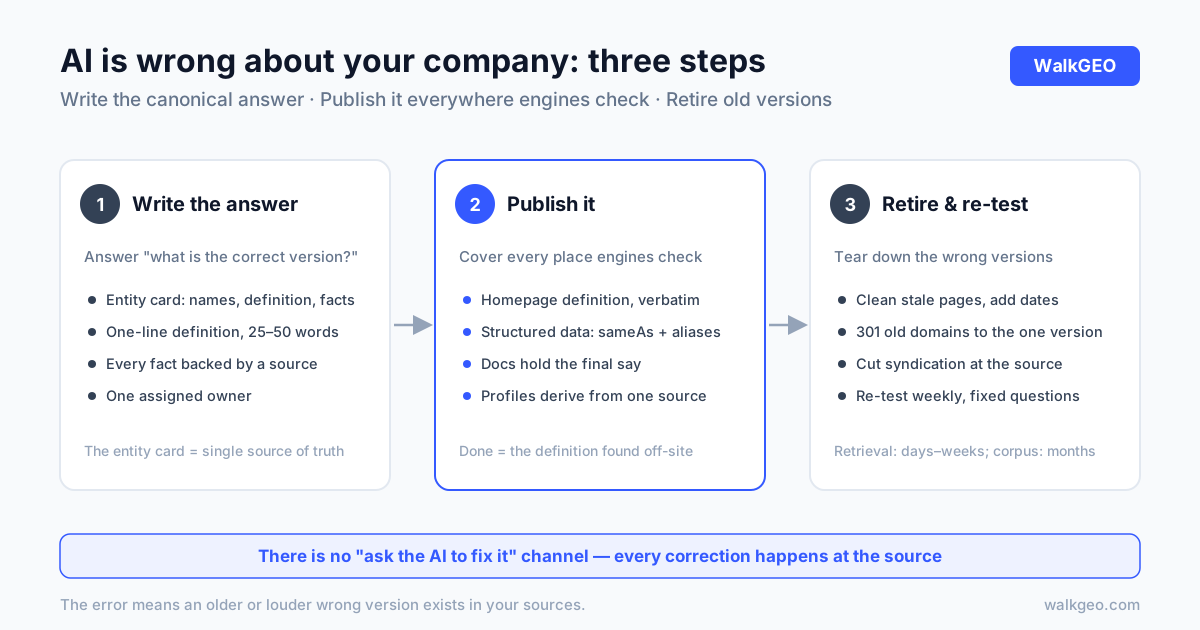
When an AI engine gets your company wrong — the name, the business, the product, the numbers — the fix is not an appeal to the AI. It's three steps: write a canonical "standard answer" you can back with sources, publish that answer everywhere an engine checks (your site, your structured data, your third-party profiles), then retire the old and conflicting versions and re-test weekly. Most brand-information errors are not model hallucinations in the pure sense: your source landscape contains an outdated version or two contradictory versions, and the model believed one of them. Your job is to make the correct version the only version.
First, classify the error
"AI got it wrong" is five different diseases in diagnosis. Misclassifying is the top reason fixes fail — treating entity confusion as a freshness problem and concluding a week later that "nothing works." Match your case first:
| Symptom | Cause | First move |
|---|---|---|
| Wrong name or category: AI puts you in the wrong industry or attributes your product to someone else | Weak entity binding — the model can't assemble "who you are" | Check your homepage definition sentence and structured data |
| Stale info: old pricing, old product names, discontinued lines still being described | Old training data + old copy still live on your pages | Update the source, retire the old version |
| Conflicting versions: your site says A, Wikipedia and media say B | Inconsistent sources; the model picked the bigger one | Align the wording everywhere |
| Mistaken identity: confusion with a similarly named company or product | Name collision, entities not disambiguated | sameAs binding + official statements |
| Invented details: features you don't have, customers you never served | Hallucination, or errors laundered through low-quality sources | Add verifiable authoritative sources |
None of the five is "the AI did it on purpose," and none has a complaint form. Classify first; then every repair step has a completion standard.
Why it happens: four mechanisms
Training data is old. Models have a knowledge cutoff. The rebrand from last year, the product line you retired last quarter — the corpus may still carry the old version. Retrieval-based engines do better, but when they can't find your page, they fall back to stale knowledge — which is why the same engine answers correctly one day and incorrectly the next.
Sources disagree. Before answering, a model cross-checks sources. Your site says A, an encyclopedia says B, a media piece says C. When the checks can't reconcile, it has three options: trust the highest-authority source, hedge vaguely, or skip you. The "error" you're seeing is often just it trusting a bigger but older source.
Errors replicate themselves. A third-party site gets your founding year wrong, reposters copy it, aggregators garble it again — the same error now lives in ten sources, and cross-checking ironically "confirms" it. Once an error forms a syndication chain, fixing it gets harder with every additional source.
There is no appeal channel. There is no "contact ChatGPT to correct my company profile" mechanism. Thumbs-up or thumbs-down on an answer adjusts feedback signals for that conversation; it changes neither retrieval nor training data. Every correction happens at the source — the single most important thing to accept before you start.
Mapped to a self-audit, the four mechanisms are four questions: where does the current version of the facts about me live? Do my sources agree? Is anyone else using my name? Which third-party pages circulate wrong claims? Four questions in, the error's structure is clear — and so is your repair list.
Step 1: write the standard answer
Before repairing anything, answer one question: what is the correct version? Without a canonical answer, every later step is improvised. Write this entity card and store it where the whole team can see it:
| Field | Content | Requirement |
|---|---|---|
| Company name | Official full name + public short name | One spelling, used everywhere |
| Brand name | Chinese/English names and their binding | State explicitly that "X is Y" |
| One-line definition | Subject + action + context | 25–50 words, quotable as-is |
| Key facts | Founding/launch dates, HQ, product lines | Each backed by a source |
| Website | The one domain | No alternate domains in play |
The card serves two audiences. For engines, it's the shared source of truth behind your homepage definition, structured data, and third-party bios. For your own team, marketing, sales, and support all derive their outward wording from it instead of freelancing. Assign one owner: wording changes start at the card and propagate outward, so you never get the half-updated state where the site changed but the sales deck didn't. Tie the card's revision date to your product release cadence — rebrand, update the card first.
Step 2: publish where engines actually check
With the standard answer written, ask: when an engine verifies facts about me, where does it look? Enumerate the list and cover it:
- Homepage and about page. The definition sentence sits near the top, word-for-word identical to the entity card. What makes a sentence quotable is covered in how AI picks sources.
- Structured data. A complete Organization markup — name, URL, logo — with sameAs pointing at official social accounts and encyclopedia entries, and alternateName declaring multi-language name bindings. This is the machine-readable way to say "these names are one company"; see the schema.org Organization definition.
- Help center and product docs. Features, parameters, pricing — final authority lives on your own domain, so when a third party describes you wrong there's an authoritative version to check against.
- Third-party profiles. Social accounts, encyclopedias, recruitment pages — every profile you own derives its bio from the entity card. Each one doesn't need to be active; each one needs to agree.
One completion standard: search your card's definition sentence and find at least one off-site platform stating the same thing. If you can't, the correct version exists only in your own head.
One more placement that's easy to miss: date-stamp your fact pages. Pricing pages carry an "updated on" date, product pages a version number, about-page milestones carry years. Dates are the strongest signal engines have for which version is current. When both an old and a new version of a fact exist online, the dated, newer one wins the cross-check by a wide margin; an undated page forces the model to guess on other signals, and that's how a discontinued product keeps being described as available a year later.
Step 3: retire the old versions
Once the correct version is everywhere, tear down the wrong ones:
- Clean your own pages. After a rename, a price change, or a sunsetting, stale wording on old pages is the most common source of conflict. Sweep your core pages: update, or annotate "as of [date]".
- Redirect old domains. A retired domain that still serves content keeps feeding engines old facts. 301 it to the new site so every old entry point resolves to the one version.
- Update stale third-party bios. Agency profiles, recruitment pages, and media fact sheets that still carry the old name are entity confusion waiting to happen. Keep a profile inventory and work through it.
- Cut syndication at the source. For third-party errors, contact the origin first; once the origin corrects, reposts follow. Fixing reposts before the origin just means the error regrows.
Completion standard: search your own site for the old name and old claims — zero hits on core pages; off-site, everything editable is edited, and the rest is on a monitored list.
Case: binding two names into one entity
A real one from our own operation. WalkGEO runs under two names: Chinese-language content uses WalkGEO's Chinese brand (立言GEO), while the site name, domain (walkgeo.com), and English content use WalkGEO. The dual brand is a real business requirement — and it carries a real entity risk: two names without an explicit binding are two companies as far as a model is concerned. Retrieval on one name surfaces one set of material; the other name surfaces another set; neither assembles into a complete entity, and citation confidence for both suffers.
We bound the names at three layers, all in code and publishing rules:
- Structured data. Our Organization JSON-LD carries the Chinese brand in its alternateName array — a machine-readable declaration that both names are one entity. This layer ships first among all bindings because it requires no inference from the model; it's a direct statement.
- Page layer. Chinese pages use the Chinese brand consistently in title suffixes, og:site_name, and breadcrumb roots; English pages keep WalkGEO; the Chinese name has exactly one written form across all zh pages — no spacing variants to muddy the entity. We completed that site-level unification on October 27, in one pass across all zh pages.
- Off-site layer. Every platform profile bio derives from the same definition sentence; per-platform rewriting is banned. Variation introduced by well-meaning copywriters is exactly the kind of "conflict" models trip over.
One rule completes the set: Chinese content binds the names on first mention — "立言GEO(WalkGEO)" — then uses the Chinese brand alone. It's in our writing standard and checked before every article ships. After these layers went in, the two names on the entity card say the same thing in three places: the site, the structured data, and the off-site profiles.
Machine-face files can spread wrong information too: on November 1 we found llms.txt recommending a pricing URL that robots.txt was blocking — engines following the guide arrived at a locked door. That's a different flavor of "wrong," and the fix is documented in that article's case section.
What's fixable and what isn't
An honest boundary before you start: corrections run on two clocks. Don't mix them.
- Retrieval-based engines (answering from live web search): fixes take effect with the next re-crawl and re-retrieval, days to weeks. You update the site; the engine's next pass carries the correction into retrieval-style answers first.
- Knowledge answers (from training data): months, not weeks. The corpus refresh window isn't yours to control. Correct versions published today enter training data on the next training cycle or large refresh. That's not a failed fix — it's just not that row yet.
Re-testing follows the usual discipline: fixed question set, fixed engines, weekly, with retrieval-style and knowledge-style questions logged separately. The framework lives in how to measure your brand's AI visibility. Don't judge the retrieval fix by old knowledge answers, and don't undo a freshly aligned wording because the corpus side feels slow.
And one thing that isn't fully fixable: pure hallucinated details. Source work squeezes their room to appear but can't guarantee zero — a model without supporting sources will occasionally guess. What you control is making sure a guess lands on correct material: the odds of self-correction rise with the density of correct sources. Any vendor promising "guaranteed correction" is telling on themselves.
FAQ
Why does AI get my company's information wrong?
Four mechanisms cover most cases: stale training data, conflicting sources, name collisions with similarly named companies, and errors copied across third-party sites that keep recirculating. Models cross-check sources; when the checks disagree, they either trust the bigger source or skip you entirely — getting it wrong and not getting mentioned are two faces of the same problem.
Is there an official channel to ask an AI to correct information about my company?
No. There is no "contact ChatGPT to update my profile" mechanism, and thumbs-down on an answer doesn't change retrieval or training data. Every correction happens at the source: align your website, structured data, and third-party profiles, then wait for the engine's next crawl and cross-check.
How long until AI answers correctly after I fix things?
Two clocks. Retrieval-based engines (the ones that search the live web) pick up fixes with their next re-crawl — days to weeks. Knowledge answers drawn from training data move on a scale of months. Re-test weekly with a fixed question set and log the two classes separately; don't judge the retrieval fix by stale knowledge answers.
A third-party site has wrong information about my company. What do I do?
Fix the source first. Errors replicate along syndication chains; leave the origin wrong and every repost regenerates the mistake. Contact the site owner where you can, claim and edit profiles where possible, and where neither works, make sure authoritative correct sources outrank the wrong one — models always cross-check, and they side with the more credible source.
An error in an AI answer means your source landscape carries an older or louder wrong version. Write the standard answer, publish the correct version where engines verify facts, and retire the old ones — leave the error nowhere to live, and the answers correct themselves. WalkGEO builds entity consistency into its monitoring workflow: every entity-type Issue points at a specific place where wording should align, verified by weekly re-tests after the fix. To skip the manual sweeps, look at product and pricing; to classify your own case first, start with why AI doesn't mention your brand.
Done reading? Run the same audit on your own site
Sign up, then let the agent scan every page and hand you a prioritized fix list. Your first audit is free.
Run a free site audit