How to track AI citations: methods, logs, and when to use tools
Tracking AI citations means weekly same-method recording, not one-off checks. A five-column log, mentions vs citations counted separately, decay rules, and the signals it's time for a tool.
How do you track AI citations? Split the job in two. If you want to know, once, whether an answer links to your site, ask an engine and you have a snapshot — an hour is enough. If you want to know whether citations are rising or falling, you need the same questions asked the same way every week — that's tracking, a time series, not a Q&A. This article gives the minimum viable version: a five-column log, thirty minutes a week, four rules for reading a vanished citation, and the point at which a tool beats the spreadsheet.
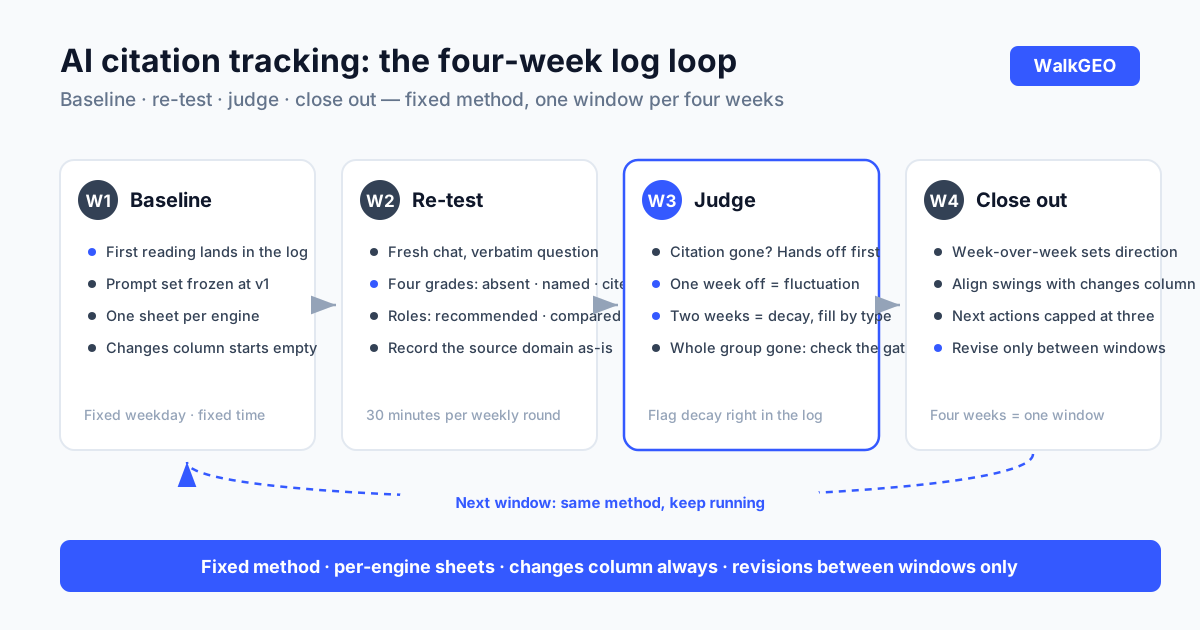
Friday afternoon, asking last week's twenty questions again
A scene you'll run into sooner or later. Last week you ran a check; one category question returned an answer linking to a competitor. This Friday — fresh chat, identical wording — the link belongs to someone else. Panic? Without a log, the question can't even be answered: you don't remember which week you last asked, what the answer said, or who it linked to. A snapshot answers "am I there?" — it cannot answer "did that change?" The free self-check article covers snapshots; this one adds the time axis.
Tracking rests on one sentence: pin every reading to the same coordinate system so weeks can be compared. The system has three parts — a frozen question set, a fixed engine list, and one shared vocabulary for grading answers. The first two deserve their own article (prompt set design covers them); this one handles the grading vocabulary and the weekly routine around it. The first reading that lands in your log is your baseline day; every rise and fall after that is measured against it.
Count mentions and citations separately
Freeze your scoring before tracking starts. Your brand can surface in an answer at four levels, and lumping them together guarantees you'll never know which layer is broken:
| Signal | What the answer looks like | What it tells you |
|---|---|---|
| Absent | No trace of you | Missing material, or a blocked gate |
| Named, no link | Your name, no link | The model knows you; your site has no citable material |
| Cited with link | A link to your page | Your citable material is working |
| Competitor linked | A link to a competitor | Their material wins; reverse-engineer the page type |
The measurement framework already defines the metrics — mention rate, citation rate, share of voice — so we won't redefine them here. The point that actually trips people up during tracking: citations come in two forms, indexed and real-time. Indexed citations come from answers built on the engine's index — its crawler fetched your page earlier and answers draw from that. Real-time citations happen the moment a user asks — the engine fetches pages on the spot. Perplexity is the cleanest example, with PerplexityBot and Perplexity-User following opposite rules. The same link can arrive through either channel, the dynamics differ completely, and your log needs separate columns.
One more detail: role. Being cited as a recommendation, as a comparison option, or as a passing background mention are three different things. Three grades — recommended / compared / mentioned — are enough for the first round; role upgrades say more than raw counts.
Five columns, thirty minutes a week
Here is the log, directly:
- Date — fixed weekday, fixed time of day, on the calendar like a meeting;
- Question, verbatim — frozen; change one word and the whole column goes invalid;
- Engine — one sheet per engine; never merge ChatGPT with Perplexity;
- Signal — one of the four grades, plus the role grade;
- Source — the domain the answer links to, whoever owns it.
The sixth column lives outside the table: what you changed this week. New article, page rewrite, robots.txt edit — one line each. It looks redundant until week four, when it becomes the only thing that explains a swing; without it, you and your boss will both misread a competitor's move as your own success or failure.
The weekly run: fresh chats, verbatim questions, record engine by engine, then spend ten minutes comparing weeks — which items moved from "absent" to "named", which citations vanished, which line in the changes column lines up in time. The comparison produces next week's actions, capped at three. Thirty minutes per round is what keeps this alive; a tracking routine you can't sustain is worth nothing regardless of its rigor.
A sample line, to copy: date "week N, Friday", the frozen question verbatim, signal "named, no link (compared)", source "none", changes "published a comparison article this week". Ten seconds a line; twenty questions take under ten minutes — the rest goes to comparing, which is where conclusions come from. Recording is just feeding the machine.

A citation vanished: fluctuation or decay?
Once the log is running, your first vanished citation will arrive. Four rules, in order:
- One week off: don't touch anything. Answers fluctuate; a single reading proves nothing. The weekly cadence and the four-week checkpoint come from the "how long does GEO take" article — no need to re-invent them here.
- Two consecutive weeks off, source steadily replaced by one page type: treat it as decay. Check yourself first — redesigned pages, removed sections, domain changes. Then check the winner — what page type is the new source, what did they add.
- A whole question group vanishing at once: suspect the gate or the index, not your content. Did robots.txt change? Did the site go down? Is the page still indexed? Content problems don't erase a whole group overnight; gate problems do.
- Confirmed decay means filling a gap, not rewriting. Reverse-engineer the new source's page type, compare against what you have, add the missing type, and write it into next week's actions.
One misconception to clear up: citation decay is not "being blacklisted". It's usually re-ranking — an index refresh, a new source arriving, the answer reorganizing itself. Treat it as normal metabolism and Monday mornings get calmer.
Two misreads to watch for as well. First, reading a competitor's routine rotation as an attack: a source changing hands doesn't mean someone took your spot — your page may still be in the pool; only two steady weeks pointed at one page type counts as displacement. Second, blaming your content for engine-side shifts: when a whole group's source structure changes suddenly, check whether peer sites shifted the same week and whether the community is discussing an engine update — if everyone moved, it's not you.
When the manual log stops being enough
Any one of three signals means it's time to look at tools:
- Scale. Past fifty questions or four engines, one round eats a day — tracking's value is continuity, and a routine you can't sustain gets abandoned.
- Attribution. "Did that comparison article cause this rise?" — a manual log can't align changes with outcomes automatically.
- Reporting. Stakeholders want a four-week trend line, not a folder of phone screenshots.
Choosing a tool is its own topic — the tracker landscape piece covers categories and what to verify — but one rule first: bring your question set to the trial, don't buy a tool and then wonder what to measure.
There's also a free signal worth wiring in: AI referrals. Filter your analytics for referrers like chatgpt.com, perplexity.ai, or copilot.microsoft.com and you'll see how many visitors clicked through from AI answers. Know its two blind spots: it only counts clicks — most exposure is cited-without-clicked and never shows up — and redirected outbound links lose referrer data entirely. It's a thermometer for direction, not a ledger. The check takes five minutes: open your analytics' source report, search those domains, note the number in the log's margin, move on.
How our log actually runs
The case material for this article has been spread through the sections above; here it is as one picture. Our grading vocabulary grew in stages: the first log had four columns (mentioned, role, source, factual accuracy); a few weeks in, four weeks of data sat side by side and we couldn't tell our moves from the environment's — so the "changes this week" column was added. Then we found domestic and international engines behave differently enough that merged sheets were hiding swings, and the log split per engine. Those conventions later hardened into our weekly close-out routine.
Off-site signals feed the same log. After we hooked up Google Search Console, the first batch of real queries — nine impressions, zero clicks, all English measurement-intent phrasings — went straight into the log. Small numbers, clear direction: real people search "how to measure AI visibility" in words close to, but not identical with, what we had assumed. The query report is now a standing input; it answers a different question than the log — not "am I in AI answers" but "what words do real people use to find us" — and where the two meet is exactly where the question set needs revising, as the prompt set article explains.
The boundary on numbers, stated plainly: we're accumulating weeks, but not enough for a publishable before/after comparison — so this article ships with the method, not the metrics. When the observation window is long enough, the numbers go into a follow-up. That's part of log discipline too: a claim should match the weeks behind it.
FAQ
Is an AI citation the same as a brand mention?
No. A mention means your name appears in the answer; a citation means the answer links to your page — one reflects awareness, the other reflects sourceable material. Count them separately: mentions alone can't tell you whether the model learned about you from your own pages; citations alone miss the "named but not linked" material gap. Citations also split into two forms — indexed (the answer draws from the engine's index) and real-time (the engine fetches pages as it answers) — and each deserves its own column.
My citation disappeared this week. Should I rewrite content right away?
Not yet. Answers fluctuate; a single week proves nothing. Treat it as citation decay only when the same question loses your citation two weeks in a row and the source steadily moves to one competitor's page type. Then check your own site first — redesigns, removed sections, domain changes — and only after that reverse-engineer the new winning source and fill that specific gap. No teardown rewrites.
How long can a manual tracking log keep up?
With a question set under twenty and one or two engines, thirty minutes a week lasts indefinitely. Past fifty questions or four engines, one round eats a full day — that's when to move to a tool. Two more upgrade signals: you need to attribute visibility swings to specific changes, or you need trend charts for your team instead of a folder of screenshots.
What fields should a citation-tracking log have?
Five columns plus one: date (fixed weekday and time), frozen question verbatim, engine (one sheet per engine), a signal grade (absent, named-but-not-linked, cited with link, competitor linked) plus role (recommended / compared / mentioned), and the source domain the answer links to. The extra column logs what you changed on your site that week — without it you can't tell your moves from your competitors' when you look back four weeks.
Can AI referral traffic replace citation tracking?
No — treat it as a supporting signal. Filtering your analytics for referrers like chatgpt.com or perplexity.ai only shows the minority who clicked; the much larger exposure of being cited without a click never appears in referrer data, and some engines route outbound links through redirects that drop referrer entirely. It's a thermometer, not a ledger.
Tracking citations is won by keeping the scoring fixed, not by buying expensive tools. Five columns, half an hour a week, a four-week observation window — that turns "is AI citing me?" from a feeling into a number. Once the log runs itself, a tool buys you efficiency, not direction. WalkGEO built this log into a weekly close-out routine; if you'd rather skip the spreadsheet, pricing is the doorway.
Done reading? Run the same audit on your own site
Sign up, then let the agent scan every page and hand you a prioritized fix list. Your first audit is free.
Run a free site audit