WeChat official accounts: getting cited through Search and beyond
WeChat content gets cited along two rails: in-ecosystem via Search and Yuanbao, outside via site mirrors. Eight real questions on citable writing, entity binding, and the dual-track setup.
Ask an AI inside WeChat "are there tools that get my brand into AI answers", and look at where the cited links come from. Then ask the same question on a classic search engine and look again. The moment the two answers disagree, you've found this article's subject: WeChat article content gets cited along two rails. Inside the ecosystem, Search and Yuanbao draw from official accounts and video channels; outside it, other engines draw from your website and off-platform mirrors. Eight questions, eight answers, covering everything you can do on both rails.
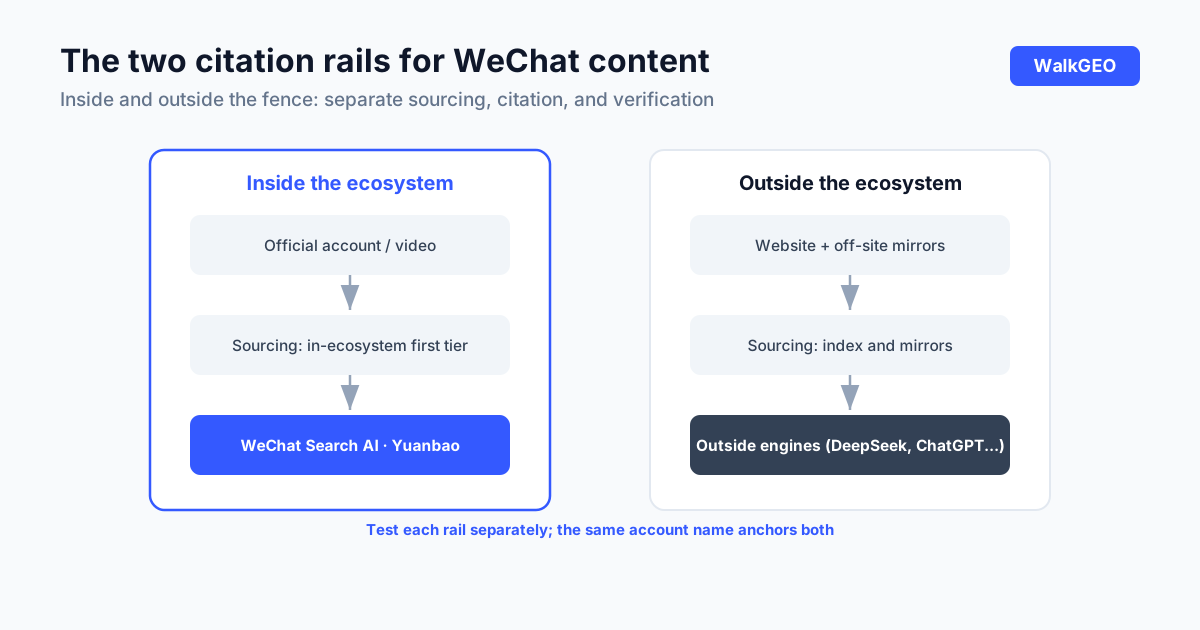
When I ask AI inside WeChat, where do the citations come from?
WeChat's own AI experience lives in its Search: type a question, and the answer draws first from inside the ecosystem: official account articles and video content are the first tier. This isn't speculation; the Yuanbao piece verified Tencent-family engines' preference for in-ecosystem sources, and the mechanism here is the same: content inside the fence is reachable, trusted, and citable.
The operational meaning is direct: your official account is your "website" inside the WeChat ecosystem. Hundreds of millions of daily questions happen there, and whether the in-ecosystem half of the battlefield contains you depends on the account's citability, not on how good your actual website is. Running the account as a side marketing channel hands the in-ecosystem position to whatever competitor takes it seriously.
Hold on to the two-rail framing from this first answer: inside and outside are different rails with different sourcing, citation habits, and verification. The remaining seven questions walk both.
Do Baidu and Google index WeChat articles?
No, not the body text, and it's platform mechanics, not an SEO gap: WeChat articles live behind the fence, and classic search engines have long been unable to crawl them. The root is content ownership. The account is an asset of the platform, and the platform has no obligation to open it to outside crawlers, nor the intention to.
Two consequences follow. First, don't spend off-site SEO time on the account: the route "get indexed by Baidu, funnel traffic" doesn't exist, and that's a gate problem no optimization can fix. Second, outside engines cite the same content's off-platform copies: your site mirror, your distributions on third-party platforms. That's why mirrors matter: articles that perform well in the account deserve a content-identical copy on your site, giving the same facts two addresses so both rails can find them.
One anti-pattern deserves naming: publishing the full article as images. Images dodge transcription losses by dodging citability entirely; engines can't read the words in the picture, so both rails are abandoned at once.
Which AI engines can cite WeChat content directly?
In-ecosystem engines cite directly; outside engines cite the copy. The test takes three steps and ten seconds: look at the link domains in the answer. mp.weixin.qq.com means an in-ecosystem direct citation; your own domain or a third-party site means the mirror rail.
The mix shifts over time as engines upgrade sourcing and platforms adjust openness. Don't guess, and don't rewrite materials chasing every shift; weekly re-tests show the movement (method in question 8). The trap to avoid is betting one side: "WeChat is enough" forfeits the outside battlefield; "the site is enough" means you never entered the ecosystem. (k) Prepare both sides' materials and every citation that arrives finds something to land on.
The two citations also differ in depth. In-ecosystem direct citations tend to show larger passages with a natural path to follow your account; outside citations work as verification and backing, helping you stand in cross-source comparisons. Different values, different rulers, and neither compensates for the other.
How should WeChat articles be written to get cited?
Write answer capsules with four parts: the title is the user's question (they search "what should I do", not wordplay); the opening holds a standalone definition sentence, 25–50 words, liftable into an answer unchanged; the body lays out specs, use cases, and FAQs as text blocks with the conclusion first; and three to five real Q&As at the end. (k2) The unit of citation is a fact block that lifts cleanly — lyrical openings, words inside images, and spoken-word transitions never make it. The standard is identical to your website's citable material; learn it once, use it on both.
Three actions you can take today:
- Retitle existing articles as questions;
- Add a "one-sentence answer" paragraph at the top of each, standing on its own;
- Append three to five real Q&As at the bottom.
Refreshing beats writing; start with the ten articles your question-1 test shows being missed.
Three common anti-patterns while you're at it: pun titles with zero question information; the first third of the body spent on rhetoric with the facts in screen three; and key specs published only as poster images with no text version. All three sit near zero citability, and all three are quick to fix.
What about the account name and bio?
The account name matches your site brand character for character; the bio carries the site link. When an engine verifies "is this account the same entity as this website", identical names plus cross-links are the cheapest evidence. A mismatched name means the in-ecosystem citation slot can't be bound back to your entity: traffic without assets.
Our own practice lives on the site side: both brand names (Chinese and English) are bound as one entity through structured-data alternate names, and off-site accounts reuse the same name. Whichever property an engine enters from, it verifies the same entity. (k3) Multi-brand, multi-account teams should freeze a name table first — official, aliases, banned variants — and run registrations, bylines, and bio links off the table. The name table outranks the content calendar: without it, more content means a more scattered entity.
Three bio elements: one verifiable sentence of business definition, the site link, and what the account publishes. No slogans; the bio is verification material, not a slogan wall.
Can I run only the account and skip the website?
No. The site is the entity's anchor and carries four things the account cannot: structured data and sameAs for machine verification; spec and comparison pages holding checkable facts; all off-engine indexing and citations; and the long accumulation (link history, index history, re-test data) that only grows on a domain you own. The account is a tenant of the platform; it can't hold the anchor.
The right relation is dual-track: the site bears the load, the account reaches the audience, one fact source feeding both copies. Which goes first depends on buyers: if buyers ask inside WeChat, the account leads with the site laid under it; if buyers search, the site leads and the account stakes the in-ecosystem position. Either way, the split of duties is four lines:
- The site produces the fact source and markup;
- The account produces reach and frequency;
- Mirrors keep facts identical;
- Measurement keeps both rails visible.
A team where two of those four lines have no owner has two dead rails. (k4)
Video channels or articles first?
Articles first. The unit of citation is text, and video content passes through transcription, truncation, and timeline alignment — each step a citability loss. Articles go from title to body in engine-ready text with zero loss. (k) Existing videos aren't wasted: turn the spoken script into an article, strip the filler, add the specs and FAQs, and one piece of content serves two properties. Video isn't off the menu; it's after articles, and when you do it, write titles and descriptions as questions so it's findable in search too.
Live streams are the same story one step further: they're reach and trust tools, not citation assets; engines can't pull from a replay. The questions people asked repeatedly in a stream are worth an article; that's the part that settles.
How do I know whether my content is being cited?
Weekly tests on a frozen question set, logged separately for the account and the site. The same question yields two signals, whether in-ecosystem engines cite your account and whether outside engines cite your site mirror, and merging them into one number guarantees you'll never know which rail works. Testing only the site misses half the battlefield; testing only the account leaves you without a baseline. Keep the discipline — fresh chat, verbatim question, fixed hour — and add one column to the log: "which property got cited". The methods freeze from the prompt set and citation tracking pieces carry over with a renamed column.
A picture of the signals working: the question "X or Y, how do I choose" shows a competitor's account cited in week one; by week three yours; meanwhile the site mirror's citations outside didn't move. The in-ecosystem rail fired first, so effort goes into account content. If only the outside moved, the site mirror is your increment. Two signals, read separately — that's what gives actions direction.
Worth repeating: citation opportunities live on two rails, and your job is making sure both rails carry the same-named you with liftable material. Which rail fires first is a measurement result, not a bet. The workflows for this live in the help center; to get in- and out-of-ecosystem citations into one weekly report, WalkGEO's monitoring line is ready-made — pricing has the doorway.
Done reading? Run the same audit on your own site
Sign up, then let the agent scan every page and hand you a prioritized fix list. Your first audit is free.
Run a free site audit