Zhihu content: how to get it cited by AI engines
Zhihu content fits AI engines' sourcing logic: Q&A form, open indexing, long-tail questions. Eight questions on answer-capsule writing, account entity binding, and citation tracking.
Search "how is GEO different from SEO" on Zhihu and you'll find our article title is practically that question's echo; no accident. The comparison piece started by finding buyers' actual words on a real Zhihu question page. That story is the doorway to this article: eight questions on how Zhihu and AI engines relate.
Do AI engines cite Zhihu content much?
Yes, and structurally so. Zhihu is a question-and-answer community: content is natively organized by question, and a good reply is a ready-made answer-capsule candidate. The easiest source for an engine is exactly that: a block of text already aimed at a question. Add open indexing (search engines can crawl it) and every retrieval base has access; the citation channel is open.
Note the shape of the citation: engines lift a paragraph or a conclusion, rarely the whole post. So the paragraph worth stealing must stand alone; the rest of the answer exists to hold it up.
Compared with a site citation, the position differs. A site citation links your domain and endorses your entity directly. A Zhihu citation links Zhihu and endorses "a credible answer in the community". The first is heavier; the second is broader; for long-tail questions, a Zhihu reply is often the only structured material an engine can find, and even a light position held beats a heavy one empty. Don't judge Zhihu by your site's standard, and don't skip it because it doesn't link your domain. Practically: end replies with a natural one-liner pointing to the fuller comparison page on your site: a path for the engine back to the entity, and for the reader too. No hard selling; one sentence.
Does doing Zhihu conflict with doing the website?
No; it's a division of labor. The site bears the load: fact source, structured data, spec pages, the entity's anchor on your own domain. Zhihu is the reputation and long-tail channel: specific buyer questions that no single website article catches, one reply at a time. Both feed from the same fact source, each in its own form.
Conflict happens in exactly one case: shipping the site's content verbatim to Zhihu. Duplicated content dilutes itself in cross-checking (next question).
Zhihu's value has two layers, though. The first is the candidate set: replies to buyer questions compete for the answer slot directly, alongside your site. The second is verification backing: when an engine cross-checks "what is this company like", independent community discussion is a third-party voice that outweighs self-description. The second layer works even without a link: a positive mention in the community adds a vote to the check. Plan for both: replies aimed at questions, plus professional output others can cite, half and half.
How should a Zhihu answer be written to get cited?
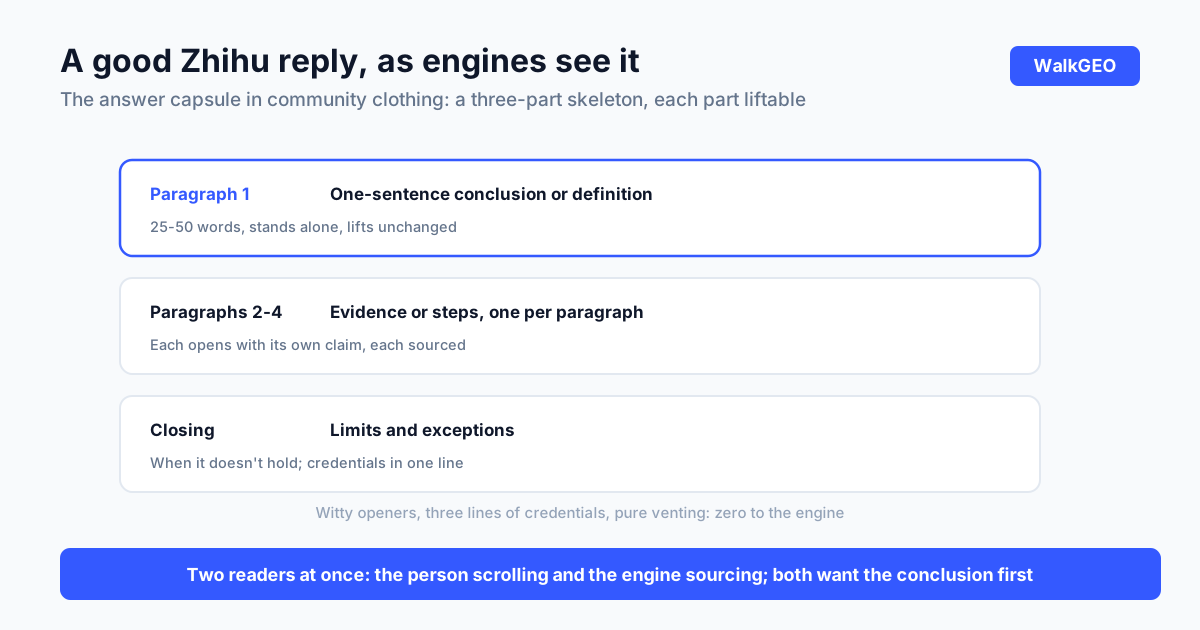
Move the answer capsule into the reply. Three-part skeleton, ready to use: paragraph one, a one-sentence definition or conclusion that stands alone; paragraphs two to four, two to four evidence points or steps, each opening with its own claim; final paragraph, limits and exceptions; when this conclusion doesn't hold. Community readers like this structure; so do engines. It's the answer capsule in community clothing, and the standard is identical to the citable material piece.
One anti-pattern: opening with three lines of "as someone with X years in the field". Credentials can stay, as one sentence at the end; the top of the answer belongs to the conclusion: the spot engines weigh most and quote most.
Self-check with one question before shipping: if someone copied this paragraph verbatim, would a reader understand it? Witty openers, three paragraphs of throat-clearing, pure venting; they may farm upvotes and they score zero with engines. Your reply serves two readers at once: the human scrolling Zhihu, and the engine sourcing material. Both want the conclusion first.
Can I just copy my website articles to Zhihu?
No. Identical content in two places gives the engine duplicate information during cross-checks, and both copies end up diluted. And the community context punishes the format: a sectioned website article pasted into an answer box doesn't get read through, engagement signals sag, citation odds sag with them.
Split instead: one section of a website article maps to one Zhihu question and becomes one reply. One section can feed three to five questions; one article grows three to five replies, each in native form. The traffic also runs backward: a judgment that got fully developed in a reply deserves a place in the website article afterward, thickening both.
A rewrite example, concretely: the site section "Technical foundations shared between GEO and SEO" is two thousand words; the Zhihu question "Ten years of SEO; do I still need GEO?" becomes a six-hundred-word reply: open with "Yes, but not from scratch", then three SEO skills that transfer directly, then three things genuinely new, one closing line of credentials. One fact source, two forms, no dilution.
Finding questions: search your category terms on Zhihu sorted by followers: the questions themselves are the topic library; and take the phrasings from your support transcripts and search them on Zhihu. Chances are someone already asked; answering the live question harvests faster than creating one.
Company account or personal account?
Both, with a division of labor; not either-or:
- The company account carries official voice: product facts, parameters, statements, written to site standards, bio linking home;
- The personal account carries judgment and field experience under a real identity; in a Q&A community, human answers read more naturally. Name both accounts on the same brand with different suffixes, cross-link the bios, and entity verification stays untangled: same name-table discipline as the WeChat Search piece.
Draw one line for content: facts that belong on a spec page go to the company account; judgments and experience go to the personal account. "How many engines does our tool support" is company; "a mistake our team made" is personal. The line keeps both voices stable so neither readers nor engines wonder which one counts.
Short on resources? Start the personal account; company accounts launched on announcement-style content get ignored. A company account's cold start works only as official Q&A: answer questions directly about your own product, restrained and sourced. The community tolerates official accounts in proportion to how little they resemble ads.
Do upvotes and collections affect citations?
Unknown; say so plainly. No reliable public data ties engagement to AI citations, so we won't manufacture a conclusion. The conservative advice is one line: polish the reply as independent material, not as a traffic instrument. Highly-upvoted answers are probably good; you build quality and upvotes are the by-product. Betting on engagement weights has no evidence behind it: and that boundary saves you time: no gaming, which would break platform rules anyway.
Quality's own checklist is three items: does the definition stand alone; is there at least one specific experience or number found nowhere else; are the limits written. All three pass, ship. Any one missing, fix first.
Can I track whether I'm being cited?
Yes; the machinery exists. Weekly re-tests on a frozen question set, with one added column: which property got cited: Zhihu, your site, or a third party. Zhihu cited and site cited are different signals demanding different actions, and mixing them into one number makes the split unreadable. The full discipline carries over from the prompt set and citation tracking pieces.
A sample log line: week five, "how many hours a week does GEO take for a small team", DeepSeek, Zhihu link (your reply), role: recommended. One line answers three things; cited or not, which rail, in what role. Four weeks on, the distribution across questions and rails surfaces by itself, and the next batch of content allocates itself accordingly. Don't skip the column; a mixed ledger can't split the accounts between rails, and the division of labor loses its evidence.
How long until Zhihu content gets cited?
Indexing is fast; accumulation is slow. Community content can be crawled the day it ships; a citation waits for the answer to become a quality source on some question. Re-test weekly, four weeks minimum per window, cadence matching the GEO timeline. Spend the window's patience on material: when a re-test shows someone else's reply cited, reverse-engineer which paragraph won, and fold the missing content into yours. Four weeks a round; the material thickens round by round.
Go long-tail with topic selection: head questions ("what is GEO") compete against every website and big account; long-tail questions ("how many hours a week does GEO take for a small team") have thin competition, and your specific experience is the increment: the same increment principle the programmatic GEO piece established: engines remember what you add that others lack. Half your question set should come from two sources:
- The buyer phrasings in your support and sales records;
- The real question pages under your category terms on Zhihu itself.
Those two fed the opening story's title; that's where the opening story's title came from, and it caught search traffic the week it shipped.
Zhihu is worth doing, worth doing as the off-site reputation and long-tail channel rather than a second website. Write replies as material, mine questions as topics, bind accounts as entities: and let weekly re-tests do the rest. The in-ecosystem playbook lives in the WeChat Search piece; the two read well together. To get Zhihu, site, and in-ecosystem citations into one weekly report, WalkGEO's monitoring line has seats ready; pricing is the doorway.
Done reading? Run the same audit on your own site
Sign up, then let the agent scan every page and hand you a prioritized fix list. Your first audit is free.
Run a free site audit