GEO vs SEO: what actually differs
SEO earns the rank, GEO earns the mention. Eight dimensions separate ranking in results from being named and cited in AI answers — plus which one your site needs first.
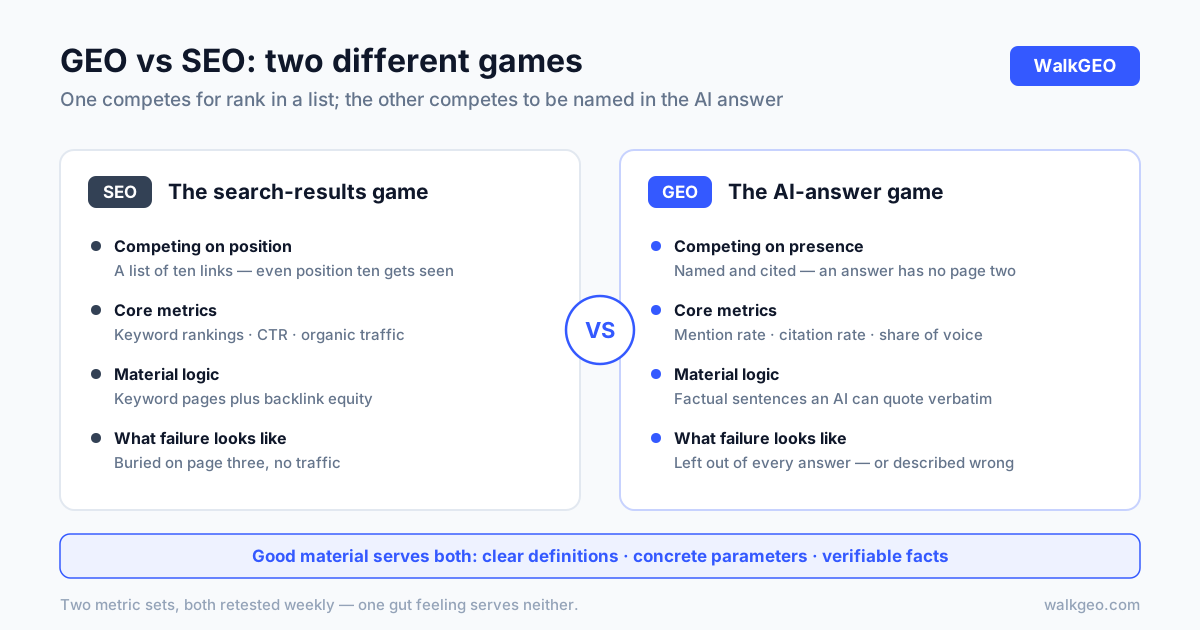
SEO and GEO are not two generations of the same technology. They are two different assignments. SEO's assignment: where does your page rank in a list of results. GEO's assignment: does the AI answer include you at all, and how does it name you. However good your ranking is, it does not govern those three lines inside an answer — and every other difference between the two disciplines follows from that.
The eight dimensions at a glance
| Dimension | SEO | GEO |
|---|---|---|
| Problem being solved | Get found: rank high in a results list | Get answered: be named and cited in AI answers |
| Competitive position | Ten blue links; even position ten gets seen | A handful of names inside one answer — there is no page two |
| Core metrics | Keyword rankings, click-through rate, organic traffic | Mention rate, citation rate, share of voice |
| Unit of content | Pages organized around keywords | Self-contained factual statements organized around questions |
| Weighting logic | Backlink volume and domain authority | Specificity, consistency, verifiability |
| Technical floor | Crawlability, indexing, speed, structured data | All of the above, plus AI-crawler access, llms.txt, entity consistency |
| Review cadence | Adjust when algorithms update | Fixed prompt set, retested weekly |
| What failure looks like | Buried on page three, no traffic | Left out of every answer — or described wrong |
Of the eight rows, "competitive position" drives all the others. Change the surface where the contest happens and the metrics, the content, the tech, and the cadence all change with it. Working harder at SEO does not move this needle.
Two different games with different rules
A search results page is a list. Users compare for themselves and decide what to click; position shapes click-through decay, but position ten still exists. Most SEO craft — title formulas, internal link equity, link building — rests on the assumption that a list will surface many candidates.
A generative engine's interface is the answer. The model filters on the user's behalf: a few names make it into the prose, some more land in the source list, everything else is invisible. Two corollaries run against SEO intuition:
- The competition moved earlier. In SEO, the gap between page one and page three is traffic volume. In GEO, the gap between "in the answer" and "not in the answer" is existence versus nonexistence. Get named first; worry about prominence later.
- The source list is a second chance. If you appear in the sources but the prose names someone else, your material is fine and your entity binding is weak. If the prose names you but cites another domain, the model knows you but cannot find citable material on your site. The fixes are different, which is exactly why mention rate and citation rate are measured separately — see how to measure brand AI visibility.
One more subtlety: being named is step one. The role you are named in — the default recommendation, one option among several, or the cautionary example — decides how that mention converts. So a fixed prompt set should record not just whether you were mentioned, but in what role. The four checks engines run before quoting a source are broken down in how AI picks sources.
The shape of questions is changing too. Generative engines rarely run your literal query once; they fan it out into variants. "GEO vs SEO" becomes "difference between GEO and SEO," "is AI search optimization the same as SEO," "how do generative engines choose sources" — a cluster of phrasings searched in parallel. Content no longer targets a keyword; it covers a cluster of questions, and every variant is another chance to be retrieved. Swap the keyword mindset (find one term, rank for it) for the prompt-set mindset (fix a cluster, answer every phrasing).
The content divide: keyword pages versus citable material
SEO content is organized around keywords: the term in the title, covered in the body, reinforced by internal links. The unit is the page. GEO content is organized around questions, and its unit is the answer capsule — a 25-to-50 word statement that stands on its own when lifted out of context. The industry term is an "answer capsule": a complete, self-contained claim an AI can quote verbatim.
The same information reads very differently in each style:
- Wrong: "We have deep industry expertise and provide one-stop solutions." — Lift this into any AI answer and it conveys nothing. The model cannot use it to answer "what does this company do?"
- Right: "WalkGEO monitors brand mentions and citations across engines including DeepSeek, Doubao, Qwen, Tencent Yuanbao, ChatGPT, and Perplexity, and attributes visibility gaps." — Subject, action, scope. The model can adopt the whole sentence.
The test is blunt: pick any sentence, lift it out, and ask whether a reader learns something without context. If yes, it is citable material. If no, it is a slogan.
The good news: good material serves both channels. A page with a clear definition, concrete parameters, a comparison table, and an FAQ is a quality result to a search engine and low-cost raw material to a model. Make your factual sentences self-contained first; distribute keywords second. Most sites do not need new content — they need rewrites: slogans replaced with factual statements, scattered facts gathered into comparable structures.
The technical stack: GEO is a superset of SEO, not a replacement
Every item of the SEO technical floor still applies under GEO: crawlability, indexability, speed, structured data. Generative engines either draw on training corpora or run live retrieval — and the live-retrieval path rides on search infrastructure. Google folding AEO/GEO guidance into its own search documentation says the same thing.
On top of that floor, GEO adds three layers:
- AI-crawler access. Check
robots.txtand CDN rules; make sure user agents like GPTBot, ClaudeBot, PerplexityBot, and Google-Extended are not blocked site-wide. CDNs and firewalls silently blocking unknown user agents is a common failure worth a dedicated audit. - Site guidance.
llms.txtlists a site's key pages in Markdown for crawlers that read it. Not every engine does — but it costs almost nothing, so publish one anyway. - Entity consistency. Bind your English name, legacy domains, and product lines to one entity in structured data, and keep one consistent story across pages and platforms. When a model cross-checks facts across sources, consistent entities reinforce each other; conflicting ones get dropped together.
Structured data earns double duty here: FAQPage markup wins rich results on the search side and hands question-answer pairs to models in machine-readable form on the answer side. One markup, two channels — which is why the FAQ below matches our structured data line by line.
The smallest useful step is confirming access explicitly in robots.txt:
User-agent: GPTBot
Allow: /

User-agent: PerplexityBot
Allow: /
And if there is material you do not want AI systems to use, the same file distinguishes by agent. Allow or block by deliberate decision — never by CDN default.
Backlinks changed roles, too: in SEO they were votes of authority; in GEO they work more like external echo — independent sources confirming the same facts. Chasing volume matters less than keeping core facts consistent across your site, docs, and directories.
Case study: this article is itself a dual-channel production
Rather than describe the method, here is the procedure as it happened for the piece you are reading — every step feeds both channels:
- Keywords on two tracks. For search, the primary terms are "GEO vs SEO" (and its Chinese equivalent) — what users actually type. For answers, the lede above is written to be lifted verbatim. One topic, two entry points.
- Machine signals configured once. TechArticle structured data with publication dates, FAQ structured data matching the text line by line, a dedicated og image, hreflang pairs pointing zh and en at each other, and an llms.txt listing entry. None of these signals care which channel reads them.
- Reusing a verified pipeline. When we productized this "preview, then one-click fix" procedure, we measured a legacy page going from a 63.5 to an 85 composite score — the walkthrough is in our GEO page-optimization guide. This article was scored with the same logic.
- Acceptance on both sides. The search channel gets checked in Google Search Console — indexing and queries. The answer channel gets a fixed prompt ("what is the difference between GEO and SEO?") re-asked weekly to the target engines.
The conclusion of the procedure: dual-channel does not mean writing everything twice. It means building machine-readability into one piece of material. Twenty extra minutes wiring up signals saves the rework of doing it all again later.
Which one first: SEO or GEO?
Both assignments matter; when resources are limited, order matters. Match your situation:
- Buyers already ask AI for recommendations — take the questions your sales and support actually hear and put them to DeepSeek or ChatGPT. If competitors are in the answers and you are not, start with GEO. Those answers are filtering your customers right now.
- Incomplete indexing, core pages unfindable — fix the SEO floor first. Crawling and indexing feed the live-retrieval path; with the door shut, GEO has nothing to stand on.
- Both are lacking — start with one citable page: how to choose, compared against what, who it fits. One asset, two channels, best return on effort.
- Pre-launch, facts unwritten — pause both and write the definition, parameters, and use cases first. With no factual sentences, neither channel has anything to work with.
- Rich backlog of existing content — do not write new pieces yet; rewrite. Run old articles against the citable-material standard. One reworked page usually beats one new article; page-level method lives in what GEO is.
One more axis: engines follow the customer. China-first buyers mean DeepSeek, Doubao, Qwen, and Tencent Yuanbao, with echo platforms like Zhihu and WeChat; overseas buyers mean Google AI Overviews, ChatGPT, and Perplexity. Test the wrong engines and the most disciplined weekly retesting measures nothing.
The single deciding question: which door are your customers queuing behind right now?
FAQ
Will GEO replace SEO?
No — it is a division of labor. Search results still earn clicks, so keep doing SEO. GEO takes over the other half: moments when users never click and simply trust the answer. Two metric sets, neither replaces the other.
Can one piece of content serve both SEO and GEO?
Yes, and it should. A page with complete definition sentences, concrete parameters, and an FAQ that matches its structured data is a quality result to search and citable material to a model. Make factual sentences self-contained first; do keywords second.
If I rank well, will AI cite me?
Not necessarily. Rankings help a page enter the candidate pool, but generative engines select sources by their own standard: specific, consistent, verifiable. Sites that rank yet never get named usually lack citable material and entity consistency — not authority.
Should I start with SEO or GEO?
Follow your buyers. If they already ask AI for recommendations, start GEO. If indexing is incomplete and core pages cannot be found, fix the SEO floor first. If both are lacking, start with one citable page.
How do I know if GEO is working?
Not by feel. Retest a fixed prompt set weekly — same questions, same phrasing — and watch mention rate, citation rate, and share of voice. The full method is in measuring brand AI visibility.
SEO answers the question of position; GEO answers the question of presence. The rules of the position game are mature; the rules of the presence game are still being written. The highest-leverage move right now is making your existing material legible to both. WalkGEO runs monitoring, gap attribution, rewriting, and retesting as one weekly loop — see pricing, or start with the help center.
Done reading? Run the same audit on your own site
Sign up, then let the agent scan every page and hand you a prioritized fix list. Your first audit is free.
Run a free site audit