Local GEO: the checklist for brick-and-mortar and service businesses
Local GEO starts by knowing which of three starting points you're on — own-site storefront, platform shop, service-area business — then a 12-item checklist: entity, content, tracking.
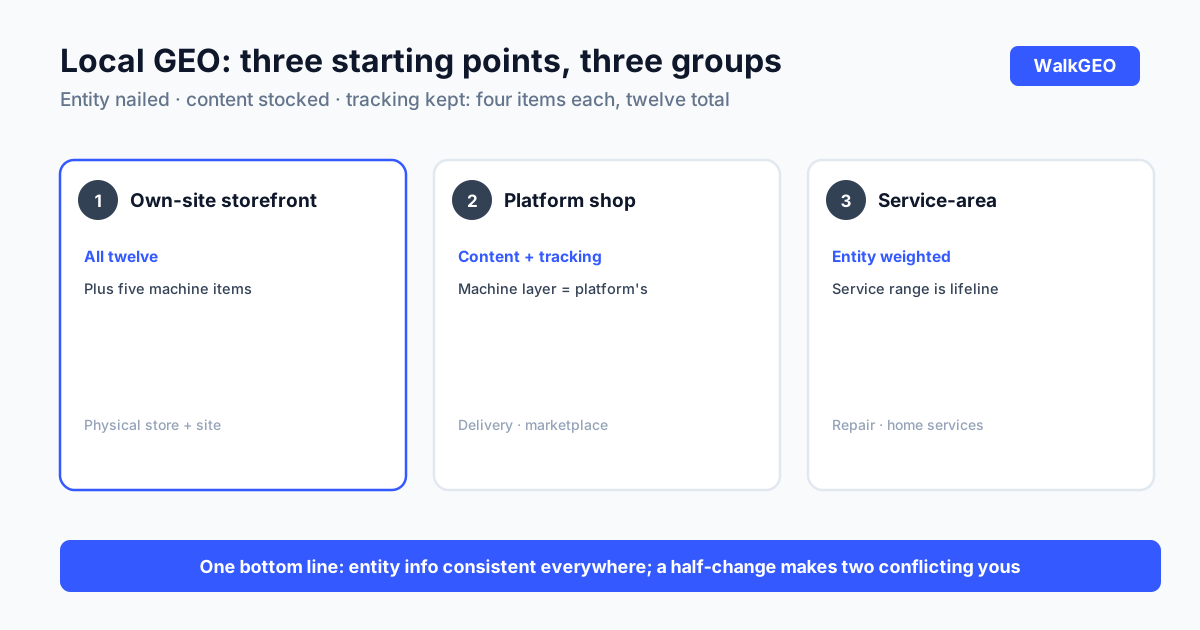
Local GEO starts by knowing which of three starting points you're on, then picking up the right checklist. Local businesses come in three kinds: own-site storefronts (physical location plus a website), platform shops (delivery apps, marketplaces, local-service platforms), and service-area businesses (you travel; no storefront). The checklist below covers the common ground, with branch notes where the paths fork.
First, where this checklist comes from: it's the product of a correction. We previously published a pre-publish checklist of twenty items, written with the assumption that the reader controls their own website. Auditing it item by item for local businesses surfaced a problem: platform shops fail the entire machine group: the shop page lives on the platform's domain, you can't touch robots.txt, the sitemap isn't yours, the markup isn't yours to send. Twenty items, half-applicable to platform shops. Hence these twelve, and hence the typology.
The honest tail of that mea culpa matters more than the admission: the failed half isn't "local businesses can't do GEO"; it's "that job's owner changed." In the platform-shop scenario, the machine layer belongs to the platform; your action shifts from "edit the config yourself" to "watch platform announcements and use the tools the platform gives you." The work didn't disappear; its address changed. Typology exists to redraw exactly that ownership map, so nobody burns out executing the wrong checklist.
Entity: one story everywhere
- Align the name, property by property. Storefront sign, map listing, platform shop name, social handles: one shop in four spellings is entity verification's worst enemy. Pick the official name; align everything to it. Keep an alignment sheet: one row per property, check off as fixed. Entity checks are the first verification an engine runs for the user; make that check easy and citations get their turn.
- One address, one phone, everywhere. One phone per location, never the head-office switchboard standing in for a branch; addresses down to the street number; engines verify at street level. Multi-location businesses add one rule: each branch gets its own listing. One mega-account for all branches helps no branch in "near me" answers.
- Business hours updated with the seasons. The field AI repeats wrong most: holiday hours changed on the door but not online, engine recites the stale time, user drives out for nothing, blame lands on you. The physical sign and the online listing are two halves of one action.
- Service area, written out. Service-area businesses spell out covered neighborhoods and districts, not just the city; "District X and three kilometers around" is verifiable where "serving the whole city" isn't. A stated range also rejects the wrong customers: half the useless calls disappear, and engines recommend you more readily on "near me" questions because they can verify you actually cover the asker.
Content: give the engine something to lift
- One sentence: what, for whom, where. The first paragraph of your homepage or platform page carries all three. Every citation grows from that seed sentence.
- FAQ from real in-store questions. Parking, reservations, returns: the ten most-asked questions move onto a page, using the answer capsule method. Local FAQ's unique value is the "visit details": where to park, which metro exit, kid-friendly or not. Big-brand articles never cover these; they're the last centimeter of the visit decision, and they're exactly the material increment a local shop has over the chain.
- Real photos only. Storefront, interior, products; the three-shot set. Renders and stock images don't help entity verification; real photos are your physical evidence. After shooting, run them through the image inspection discipline: if a neighboring shop's sign appears in your storefront shot and is readable: or a competitor brand shows up; reshoot. The mis-selection lesson applies here too.
- Services and prices, written concretely. "X service, from $X, about X minutes": verifiable details are the easiest material for an engine to cite. Vague adjectives never enter answers; concrete facts do. A note on price wording: write "from" or a range, never a hard number; stale prices are the field engines most often serve old, as the checklist warned.
Tracking: hold the position
- Map platform profile: full and verified. The map platform's official guidance is the standard: check category, attributes, photos, one item at a time; completeness feeds eligibility in local answers. What the official docs don't say (like "completeness is worth X points of ranking"), don't invent. The docs say what they say; that's the data red line, local edition.
- Reply to every review. Weave shop facts into replies ("we're open till nine, reservations welcome"); replies are citable text and a credibility display. No public data proves replies move citation rankings, but the two certain effects justify the habit. A reply template: thanks first, one shop fact second, an invitation last. Thirty seconds each; reply to negative reviews too: calm tone, clean facts. The audience is future customers and engines, not your venting channel.
- Add "near me" questions to the set. "Is there a good X nearby", "which X is reliable"; test weekly, log which shop gets cited. Your first citation will most likely arrive through this kind of question. Sources for the set, as always: what in-store customers actually ask, and what gets searched on the platforms themselves; collect twenty, freeze them, prompt set rules apply unchanged.
- Keep the four-week window frozen. Local businesses run the same window rules as online ones: nothing in the set moves for four weeks; single-week wobble is noise. Impatience is the enemy here: and local patience has an extra dividend: word-of-mouth and citations feed each other. A cited answer brings a walk-in; the walk-in writes a review; the review becomes new material. The loop starts slow; once it turns, catching up gets expensive for the shop next door.
Branch reminders, all three types: own-site storefronts do all twelve plus the big checklist's five machine items; platform shops do groups two and three plus group one, watching platform announcements for the machine layer; service-area businesses weight group one hardest (the service range is their lifeline) and swap item nine for their industry's profile platforms. All three share one bottom line: entity information consistent everywhere. Under that line, all three types fight the same enemy; changing entity info in one place only. New sign, old map listing; new address, stale platform page; dead phone number still on the website. Every half-change creates two conflicting versions of your own entity.
None of this is expensive. The entity group takes an afternoon; content a week; tracking thirty minutes weekly. The AI-citation battle for local business isn't won by budget: it's won by whoever does these unglamorous things first and completely. A shop that does them is a clear entity to the engine; one that doesn't never gets checked at all. And the unglamorous work is exactly what the big chains can't be bothered to do for your street; one of the few home-field advantages a small shop holds. Start group one this week; entity fixes show up the same week you start testing. To skip the manual tracking, WalkGEO's weekly close-out routine covers question sets and re-tests: pricing has the entry.
Done reading? Run the same audit on your own site
Sign up, then let the agent scan every page and hand you a prioritized fix list. Your first audit is free.
Run a free site audit