GEO pricing: what you're actually paying for
There's no single price for GEO: tools, retainers, and pay-for-performance price three different things. Here is each model's cost structure, five questions for any quote, and the scam patterns.
How much does GEO cost? There is no single answer, because "GEO" covers at least three different purchases: tool subscriptions, agency retainers, and pay-for-performance contracts — three pricing logics, three sets of what you actually receive, three risk structures. Taking one number you heard somewhere and fitting it to your budget is the most expensive way to get this wrong. This article doesn't quote market price ranges (sources contradict each other, numbers move quarterly, and quoting them responsibly is impossible); it gives you the durable parts instead: the cost structure of each model, five questions for any quote, a table of scam patterns, plus a real case of how we made our own pricing machine-verifiable.
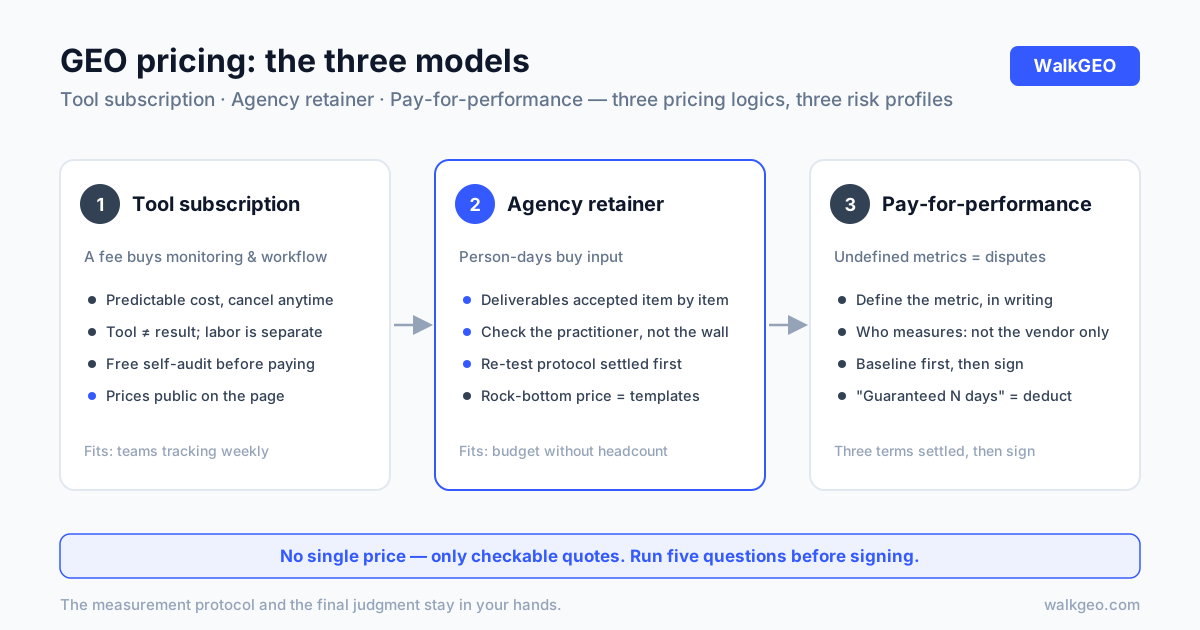
First, identify which of the three you're buying
Before asking what GEO costs, ask the vendor what they're selling. The differences between models matter more than the numbers:
| Model | Pricing | What you actually get | Main risk |
|---|---|---|---|
| Tool subscription | Monthly / annual fee | Monitoring, question-set management, gap attribution workflows | Buying tools isn't doing GEO — labor is separate |
| Agency retainer | Person-days / monthly package | The vendor's labor and deliverables | Deliverables can't be accepted; money buys headcount |
| Pay-for-performance | Settled on achieved metrics | Results under an agreed protocol | Undefined "performance" is the source of disputes |
Hybrids exist (tools + service, base fee + performance bonus), and hybrids are fine — as long as you know what each part is buying. Now, one model at a time.
Tool subscription: transparent cost, labor is separate
Subscriptions have the simplest cost structure: a monthly or annual fee buys monitoring and workflow — question-set management, cross-engine probing, mention and citation logging, gap attribution, optimization suggestions. The defining property is predictable cost, cancellable anytime — closer to a utility bill than an engineering contract.
But be clear-eyed about one thing: the tool is not the result. A monitoring subscription doesn't remove any of GEO's actual work — writing definition sentences, building citable material, weekly re-tests, content updates. What the tool amplifies is labor efficiency: turning "what to test this week, where are the gaps, which change caused which movement" from a hand-made spreadsheet into a process. So when evaluating a tool fee, the real question is how many hours it saves — benchmark against the workload of the weekly routine in our help center and do the arithmetic.
Our own pricing follows that logic: WalkGEO Pro at ¥99/month (¥950/year) and Business at ¥299/month (¥2,870/year, as of November 2026 — current figures on the pricing page are authoritative), tiered by engine coverage and seats, all public. That's what a subscription model should look like: the price hangs in the open and the feature list matches the bill.
One money-saving order is worth remembering: run the free verification before paying. Whether a gap exists and is worth tracking takes an hour to find out: read your own robots.txt, ask a few engines your customers' real questions, log which questions return nothing about you. Confirm the gap and the need for weekly tracking first; then pay for the tool. In reverse order, you may be buying a question-set manager you never needed. The hour-long audit lives in why AI doesn't mention your brand.
Agency retainer: you're buying person-days, so watch deliverables
Retainers are a labor business. The quote's big line is person-days: diagnosis, content, placements, re-testing. Nothing wrong with that — GEO genuinely is labor-heavy — but person-days buy input, not results, and whether input becomes results depends entirely on deliverable acceptance.
Three things to check in any retainer quote:
- The deliverable list. Every person-day maps to something you can accept: how many articles, how many page rewrites, how many re-test reports? "Strategy planning — 5 days" demands a follow-up question: what artifact? A slide deck and a shipped set of content rewrites are not the same price.
- Who actually does the work. GEO is a young field; plenty of "vendors" entered it three months ago. Ask for real cases from the actual practitioners, not the company's case-study wall.
- The re-test protocol. After delivery, what question set, which engines, what cadence measures the outcome? If this can't be agreed, the performance dispute is already scheduled. Protocol design lives in how to measure your brand's AI visibility.
An honest note: retainers fit teams with budget but no headcount. If you have content capability, don't outsource core content — models cite your facts, and ghost-written fact density rarely survives a cross-check.
Pay-for-performance: undefined metrics are the dispute factory
Pay-for-performance sounds fair to both sides — no results, no fee. In GEO it produces the most disputes of any model, and the disputes share one root: the word "performance" was never defined. ("How do we pay for GEO by results?" is a real, recurring question on practitioner forums — and the thread is always the same story.)
Engine answers are governed by engine-side rhythms — crawling, retrieval, corpus refresh — that no vendor controls; we split those variables out in how long GEO takes. A strict "guaranteed citations" clause is therefore un-signable. What can be signed is "measurable movement under an agreed protocol." Before signing, settle three things:
- What the metric is. Mention rate, citation rate, source inclusion, answer position? Each has different measurement mechanics and difficulty; blurring them plants a landmine.
- Who measures. Whose tool, which question set, which engines, what period? A performance clause measured by the vendor's own internal metrics makes the referee a player.
- What the baseline is. Without a pre-contract baseline measurement, "it went up" means nothing. The baseline method is the measurement framework: fix three things, run one round.
If all three settle, pay-for-performance can be a good model — it forces both parties to build a measurement system first, which is GEO's legitimate first project anyway. If they don't settle, the vendor's understanding of "results" differs from yours, and finding that out early is cheaper.
Five questions for any quote
Whatever the model, run the quote through five questions:
- Can deliverables be accepted item by item? Every cost line maps to a checkable artifact, acceptance standards written into the contract.
- Who measures the effect? Tool ownership, question set, cadence — in writing.
- Are the cases publicly verifiable? Ask for URLs you can visit, not chat screenshots.
- Who owns the data? Question sets, historical measurements, content assets after the contract ends — this decides whether switching vendors means starting from zero or moving house with your furniture.
- How does a mid-term exit settle? By person-day or by stage? Vague exit clauses usually travel with vague performance clauses.
Two weak answers out of five: walk. That's not pickiness; it's the standard origin story of this contract genre's disputes.
Scam patterns at a glance
| Pitch | Risk | How to check |
|---|---|---|
| "Guaranteed results in N days" | No one controls engine rhythm | Ask "determined by what?" — no engine-side answer means it's a script |
| "Guaranteed AI citations" | Same, plus possible gray-tactic shortcuts | Ask them to put it in the contract with a citation definition; watch them decline |
| Results shown only in the vendor's own dashboard | Referee and player are one | Demand raw data exports you can recompute |
| Cases that are screenshots and verbal claims | Cases may not exist | Demand URLs — only publicly accessible ones count |
| A quote far below market common sense | Person-days filled with template mass production | Ask about practitioner seniority and per-item deliverables |
One more word on the last row: rock-bottom retainers usually mean programmatic template production — hundreds of near-identical pages. Beyond useless, that path backfires; we break down why in the "three exits" section of when AI recommends your competitors.
Case: making our own pricing machine-verifiable
A real one from our side. The pricing page is the first-hand answer to "what does WalkGEO cost," and we rebuilt it to a "verifiable" standard — every item below is an actual piece of shipped work:
- Prices render statically. At build time, the public catalog prices are rendered into the HTML — any crawler that never executes script still reads complete pricing; in the browser, a billing API refreshes live prices, and on API failure the static values stay. Two layers, so any fetch at any moment gets an authoritative price.
- Structured data. The pricing page carries Offer markup (CNY) and FAQPage — pricing delivered to engines in machine-readable form, so "how much" has a standard answer to lift.
- An indexable path. On November 1 we moved the pricing page off an application path that robots.txt was blocking — llms.txt recommended the URL while the gate forbade it; engines following the guide found a locked door. Same-day fix: migrate, 301 the old path, re-align the two machine-face files (full story in that article's case section).
- One authoritative statement. Every tier, period, and price hangs publicly on the pricing page; when our blog cites prices, it says "current figures on the pricing page are authoritative." Prices change; the authoritative answer lives in exactly one place.
None of those four items decides "how much to charge" — they make the pricing verifiable. Which is our real answer to the pricing question: the number is a business decision; pricing transparency is a GEO engineering problem. A vendor whose own prices are ambiguous to machines is a poor bet for making your brand information clear to machines.
DIY or outsource: one checklist
The unavoidable final question, in order:
- Do you have content labor? If yes, start DIY — the opening work (gates, definition sentences, entity consistency, first citable material) runs hour-to-day scale, and the steady-state weekly rhythm fits inside two hours.
- Do you have measurement capability? If no, a tool subscription comes before a retainer: see your mentions and citations move first; decide on buying labor second.
- Budget with no headcount? Now consider a retainer — audited with the five questions and a deliverable list.
- In every case, don't outsource the measurement system — it must live on your side. It's the one thing no pricing model should ever take away.
The honest answer to "how much does GEO cost" is a menu: subscriptions buy efficiency, retainers buy labor, performance deals buy a wager — but the measurement protocol and the final judgment stay in your hands. WalkGEO packages monitoring, gap attribution, and re-testing into a weekly closeable routine, with pricing public and verifiable; to start DIY, begin with the three steps in what is GEO and then decide what, if anything, to buy.
FAQ
How much does GEO cost?
There's no single number. "GEO" covers three different purchases: tool subscriptions (monthly fees, predictable cost), agency retainers (priced in person-days and deliverables — labor is the big line), and pay-for-performance (the most dispute-prone). Reading a quote beats memorizing a range: make the vendor split out labor, tools, and deliverables, and check each item against an acceptance standard. Prices move with the market; specific numbers expire fast. Cost structure and acceptance criteria are what stay true.
Is pay-for-performance GEO reliable?
It is, if "performance" is defined; undefined performance is the source of nearly every dispute. Before signing, settle three things: what the metric is (mention rate, citation rate, something else), who measures it (whose tool, which question set), and what the baseline is. If performance can't be measured, don't sign. If it can only be measured by the vendor's own internal metrics, it isn't defined.
Does a small team need to spend big on GEO?
Do it yourself first. Gate fixes (robots.txt, llms.txt), definition sentences, and entity consistency are hour-scale work; a steady-state weekly re-test rhythm fits inside two hours. When budget is tight, spend on content labor — citable material is GEO's raw input, and tools amplify labor, they don't replace it.
How do I judge whether a GEO vendor is trustworthy?
Run five questions past any quote: Can deliverables be accepted item by item? Who measures the effect? Are case studies publicly verifiable? Whose tools, and who owns the data? How do mid-term exits settle? Two weak answers out of five means walk. And any "guaranteed in N days" or "guaranteed citations" promise is an automatic deduction — nothing decided by engine rhythms can be guaranteed by anyone.
Done reading? Run the same audit on your own site
Sign up, then let the agent scan every page and hand you a prioritized fix list. Your first audit is free.
Run a free site audit