Measure Your Baseline Before Buying Any GEO Service
Without a baseline, a vendor's "we lifted clients 50%" is unanswerable. Three signals, an eight-column template, frozen sampling, scheduled retests, plus our measurement-rule rework.
When a vendor says "we lifted a client 50%", ask one question: measured how, compared against when? If they cannot answer, or their method does not match the records in your hand, the sentence is a pitch. What gives you the footing to ask it is a baseline you measured yourself before signing. This piece delivers a copy-ready baseline record template with column-by-column notes: the three signals to measure, how to freeze sampling, how often to retest.
The baseline record sheet, template first
| Column | What goes in | Filling notes |
|---|---|---|
| Date | The sampling day | One round must finish same-day; numbers crossing days do not share a round |
| Engine | Engine and entry used | Web vs app recorded separately; a changed entry gets its own column |
| Question verbatim | The question, word for word | Reused exactly after freezing; one changed word voids the row |
| Mentioned | Yes / no / refused | Three states recorded, never collapsed to two |
| Cited | Your page in sources or not | Cited-but-wrong goes to the next column |
| Facts right/wrong | Right / wrong / not touched | Every answer touching your facts gets checked line by line |
| Screenshot | File path of the capture | Fixed directory, filename carries the date |
| Recorder | Who measured | Handover of method if the person changes; better yet, don't change |
That is the whole skeleton of the template. Below, each block in practice, plus the hole we fell into ourselves.
The three signals: visibility, citation, factual errors
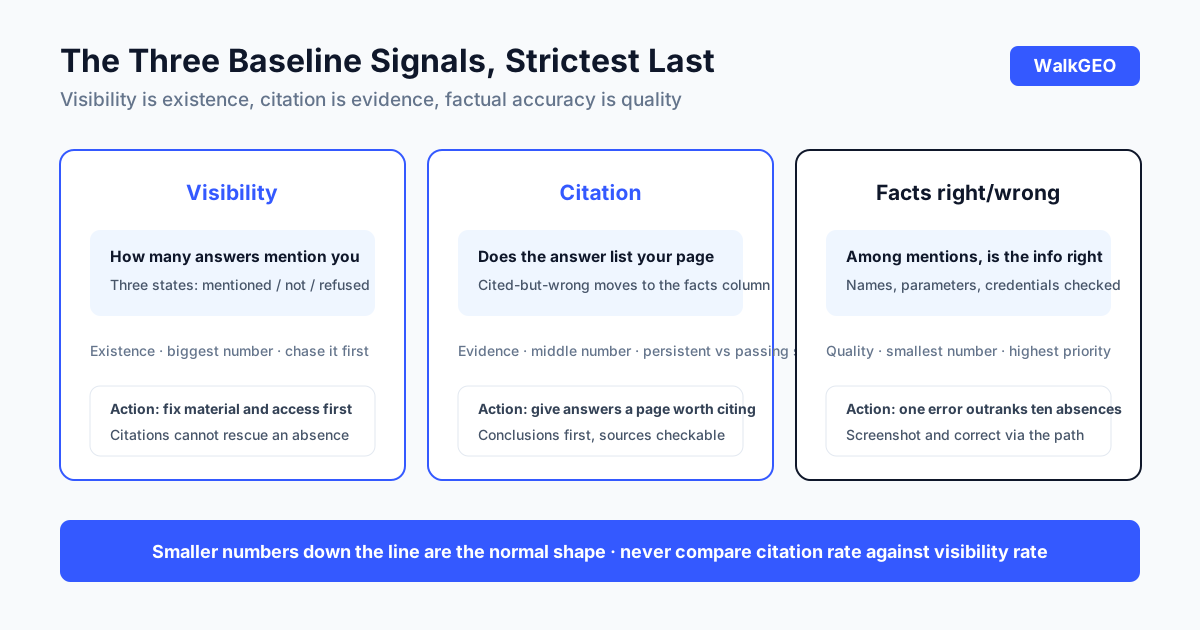
First, visibility: how many answers in the frozen set mention you. Numerator, denominator, and exclusions follow the definition sentences in our metrics piece; do not invent them on the spot. Second, citation: beyond mentioning, whether the answer lists your page in its sources. Third, factual errors: among answers that mention you, whether the information is right. The order matters: visibility is an existence question, citation an evidence question, factual accuracy a quality question. Each is stricter than the last and the numbers get smaller; comparing citation rate against visibility rate for size is a category error.
Sampling: freeze, same method, multiple rounds
Write 15 to 30 questions using the quadrant balance in our prompt-set guide, then freeze for four weeks. Pick two or three engines your customers actually use, and fix the entry point: web stays web. Each round runs the full set; changing a question halfway is the most common death of a baseline. Multiple rounds means: one baseline before signing, weekly retests during engagement, intervals and triggers listed next.
How often to retest
One baseline round before signing; weekly rounds during any engagement, four weeks to a window; nothing changes inside a window. Three triggers justify an extra round: a major engine change (new model, new answer format), a major redesign of your own site, or an industry event that touches you directly. Mark triggered rounds separately and compare them apart from routine rounds, or the two kinds of change blur into one unexplainable number.
The boundary of free self-checking
Manual baselining covers every action above; the price is time. Twenty questions times three engines times every week is about one person's ceiling. When you need higher frequency, more engines, automatic screenshot retention, manual bandwidth runs out and tooling earns its keep. The free methods and their three routes are listed in free AI visibility checks; start free, switch when volume demands, and never change the measuring method midway.
The hole we fell into
One real mistake of ours, told as a lesson. Our content line carries three hard rules, and the summary-length rule was broken three times in one month: once at 259 characters, twice around 250, all the same error: the rule was not checked while writing, and the machine bounced the draft at delivery. After the third bounce we moved the length band into the pre-writing checklist and the bounces went to zero. The connection to baselines: rules that are not set in advance guarantee rework. Your baseline's measurement rules are your length band: leave them unset before signing, and every later reconciliation is a rework. The companion habit: our Search Console log uses a four-column format (query, impressions, cluster, action, with source and date); the format never moves, which is why monthly reviews line up. The record format is part of the rules.
Taking the baseline into negotiation
Walk in with the record sheet and three things change. First, the vendor's "50% lift" must answer the how-measured question first; vagueness is an immediate exit. Second, acceptance metrics are negotiable, but the measurement rules follow your record sheet; ready-made contract clauses are in the ten-clause piece. Third, what you need to buy becomes obvious: if the gap is only citations, buy content execution; if visibility is absent too, fix technical access first. Match the purchase to the gap; the full flow is in buying GEO services the first time.
Common questions
How long does one baseline round take?
Manually, twenty questions across three or four engines takes an afternoon, plus an evening to sort results into the record sheet. The real cost is not running the numbers; it is freezing the question set and the record fields first. Half a day measuring, half a day setting rules, one working day total.
Are free self-check results good enough as a baseline?
Good enough to start, provided the recording matches a formal baseline: fixed questions, fixed engines, fixed entry points, with who measured and when noted every time. The weakness of the free route is coverage and frequency, not legitimacy. Switch to tools when weekly volume outruns manual bandwidth, and never change the measuring method midway.
The vendor offers to measure our baseline. Is that fine?
Their participation is fine; their rule-setting is not. What to measure, what counts as a valid sample, what counts as a citation: these rules must be fixed by you before the contract, otherwise the other party is both athlete and referee. The workable split: you supply the question set and the rules, they run one round and hand over raw records, and you compare before talking further.
How do I measure factual errors when they are rare?
Track them as their own signal anyway. Of twenty questions maybe two or three touch your facts; check each one line by line, company name, product parameters, credentials, and mark right or wrong with a screenshot for evidence. Rarity does not mean low importance: one factual error is worth fixing before ten absences.
The template ends here; what remains is execution. Two things can land on paper today: copy the eight columns into your spreadsheet tool, and write your first ten monitoring questions and freeze them. By this time next week you should hold a baseline you can take into a negotiation. To keep it running weekly, the weekly close-out routine picks up the rhythm; when sampling needs tooling, pricing shows the hand-off. WalkGEO's own baseline runs on this sheet; the measurement hole we fell into is one you can skip.
Done reading? Run the same audit on your own site
Sign up, then let the agent scan every page and hand you a prioritized fix list. Your first audit is free.
Run a free site audit