Buying GEO Services for the First Time: The Complete Process
Wrong order poisons everything: goals and baseline first, vendors second. The ten-stage flow from kickoff to renewal, what RFI/RFP should ask, unified shortlist inputs, and why exit terms come first.
In GEO procurement, the wrong order poisons everything after it: goals and baseline come first, vendors come second. Reverse it, find vendors before clarifying goals, and the comparison will be about who pitches better. This piece lays out the complete ten-stage flow from kickoff to retrospective, with each stage's actions, deliverables, and most common failure, ending with a miniature procurement we ran ourselves.
The ten stages, full picture first
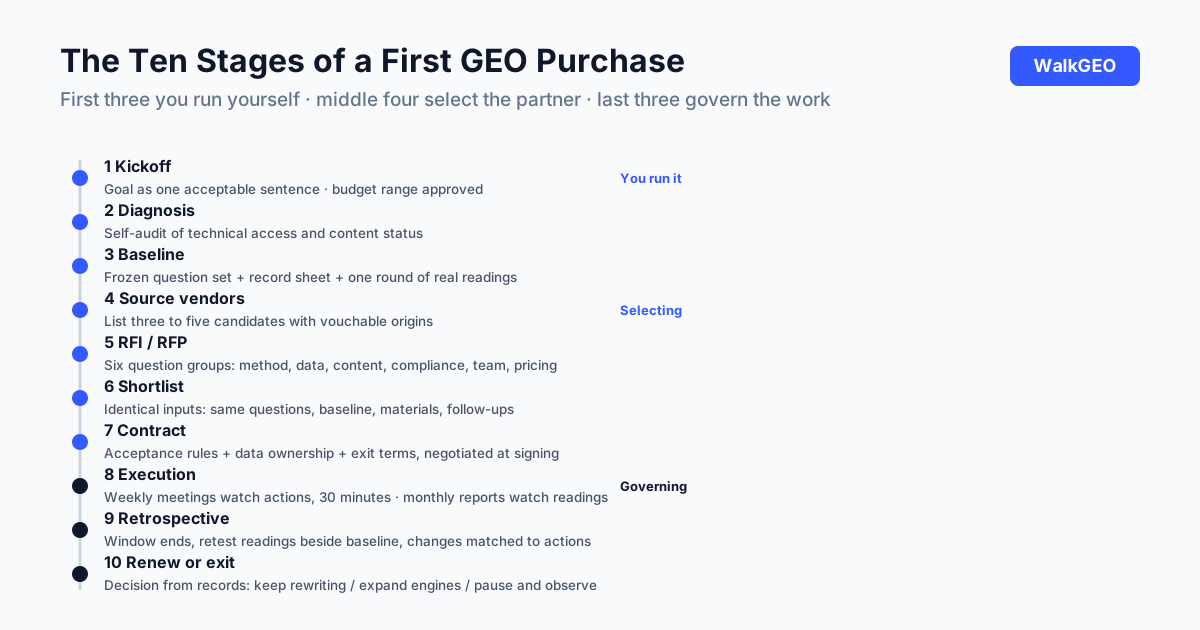
One line, ten stages: kickoff, diagnosis, baseline, sourcing vendors, RFI/RFP, shortlist, contract, execution, retrospective, renewal or exit. You run the first three yourself; the middle four select the partner; the last three govern the work. Below, stage by stage.
Kickoff: writing a goal that can be accepted
A slogan goal is "improve AI visibility"; an acceptable goal is "in the frozen 20-question set, mention rate moves from baseline X% in explainable steps, four weeks to a window". The difference is not wording; it is whether the sentence points back to records you hold. Kickoff delivers two things: the goal on paper with its measurement method, and an approved budget range. Our domain purchase kicked off with a five-line list of hard constraints: the name must contain GEO, must be spellable by ear, must plan for both the international site and domestic filing. One page, five lines, and every later step returned to it. Write the goal short enough to pin above your desk.
Baseline: where your bargaining power comes from
Measure the baseline before contacting vendors, using the method and record sheet in measure your baseline first; one working day covers it. Without a baseline, shortlisting cannot separate claims, because everyone promises lifts and you hold no ruler. The deliverable here is the record sheet plus one round of real readings.
Sourcing and the RFI: scout before you solicit
Candidates come from peers who vouch from experience, from vendors who keep publishing method rather than slogans, and from tools you have already tried. List three to five, then run the RFI: who they are, how the team is built, what they have delivered. A conversation carries the scouting if you bring six question groups:
- Method: what they change, and on what grounds
- Data: measurement rules, samples, whether raw records are handed over
- Content: who writes, who reviews, what before/after looks like
- Compliance: which red lines they accept, and whether they sign them
- Team: who actually does the work, how much is outsourced
- Pricing: how fees accrue, what is included, what happens overage The difference between RFI and RFP is who holds the initiative: in an RFI you ask and they answer; in an RFP you lay out goals and baseline and request a plan.
The shortlist: identical inputs, not prettier decks
Every shortlisted candidate receives exactly the same package: the same question set, the same baseline record, the same site materials, plus the same follow-up questions. Score three ways, watching for the counterpart:
- Actions specific to your site, not industry boilerplate
- Measurement rules matching your record sheet, not a polished demo
- Willingness to state boundaries (what they will not promise), not fullness of promises The deliverable is one comparison table, every vendor scored on the same dimensions, scores filed back into your records.
Contract: acceptance rules and exit terms are the heart
The two most valuable sections, acceptance measurement and exit terms, are itemized in the ten-clause piece: deliverable lists, statistical rules behind acceptance metrics, data ownership, handover scope. One point on timing here: exit terms belong at signing, not at leaving. Everything is negotiable while cooperation is pleasant; once it turns, only lawyers remain. In our domain purchase, the contract stage corresponded to verifying registrability: RDAP and CNNIC whois checked line by line before any payment, machine-checkable conclusions first and money after. Procurement order is universal; the domain paid the smallest possible verification cost to learn it.
Execution: what weekly meetings and monthly reports watch
Weekly meetings watch actions: pages changed, facts added, next week's plan, half an hour at most. Monthly reports watch readings: metric movements against baseline, samples and cases that can be reconstructed, errors and risks in their own section; the skeleton is in our GEO report template. The discipline of execution is "every change has an object": when a number moves, point to the page changed; when you cannot, file it into the question list for the next round.
Retrospective and renewal: the week-four comparison
At window's end, put retest readings beside the baseline: movement inside the noise band is recorded as no change; movement beyond it gets matched to actions. The renewal decision returns to records too: keep rewriting, expand engines, or pause and observe. The grounds sit in your records, not in anyone's feel.
Closing the loop: a miniature run
Map our domain purchase onto the ten stages and the point lands: the process does not care about the size of the purchase. Kickoff (the five-line constraint list), diagnosis (the old name could not carry a bilingual scenario), baseline (existing candidates screened for name collisions), shortlist (candidates run through RDAP and whois), contract (payment only after the registration trio verified; the .com bought, other TLDs deferred with the squatting risk accepted), execution and retrospective (the name live, folded into brand-query monitoring). Not one step skipped, and the total came to a few hundred dollars. The value of process was never ceremony; it is that every step leaves a checkable record. Your GEO purchase runs two orders of magnitude larger, and its records are worth proportionally more. The usual boundary: none of this is legal advice; run final terms through counsel.
Common questions
Which of the ten stages can least afford to be skipped?
The baseline. A wrong goal in kickoff can be revised; a missing baseline leaves every later step without a reference. Lifts cannot be verified, shortlists lose their common ruler, and acceptance becomes two parties reading different sheets. Save budget elsewhere; money saved here comes back doubled at acceptance.
What is the difference between an RFI and an RFP, and does a small company need both?
An RFI scouts, an RFP solicits. Small companies rarely need two formal rounds: bring the six RFI question groups into the first conversation and you are covered. Formal process earns its keep when several vendors compete and inputs must be identical; with two or fewer candidates, a conversation does the scouting.
Should every shortlisted vendor receive the same brief?
Yes, with identical inputs: the same question set, the same baseline, the same site materials. Uneven inputs compare copywriting instead of delivery. Score for actions specific to your site, checkable measurement rules, and honest boundary statements, not for the polish of the deck.
When is the right time to negotiate exit terms?
At signing, not when you want to leave. Exit terms cover data ownership, handover scope, and non-compete edges, all easy to discuss while cooperation is pleasant, lawyer-only once it turns. The question library, sampling records, and historical readings are assets you paid for; ownership and handover format belong in the contract.
The value of process is the records, not the ritual. Today on paper: pin the ten-stage chart into your procurement document, and write your kickoff goal as one sentence that fits above a desk. When shortlisting needs a unified question set and baseline, the weekly routine and pricing cover the hand-off from self-measurement to tooling. WalkGEO, as a vendor, is also examined by this flow; our type and shortcomings get a public self-review in the next piece on vendor types.
Done reading? Run the same audit on your own site
Sign up, then let the agent scan every page and hand you a prioritized fix list. Your first audit is free.
Run a free site audit