Types of GEO Vendors: Choose by Capability, Not Pitch
Know the capability you are buying before the price; the wrong type wastes money even when cheap. Five profiles with fit, weakness, and shortlist probes, plus our public self-review with real limits.
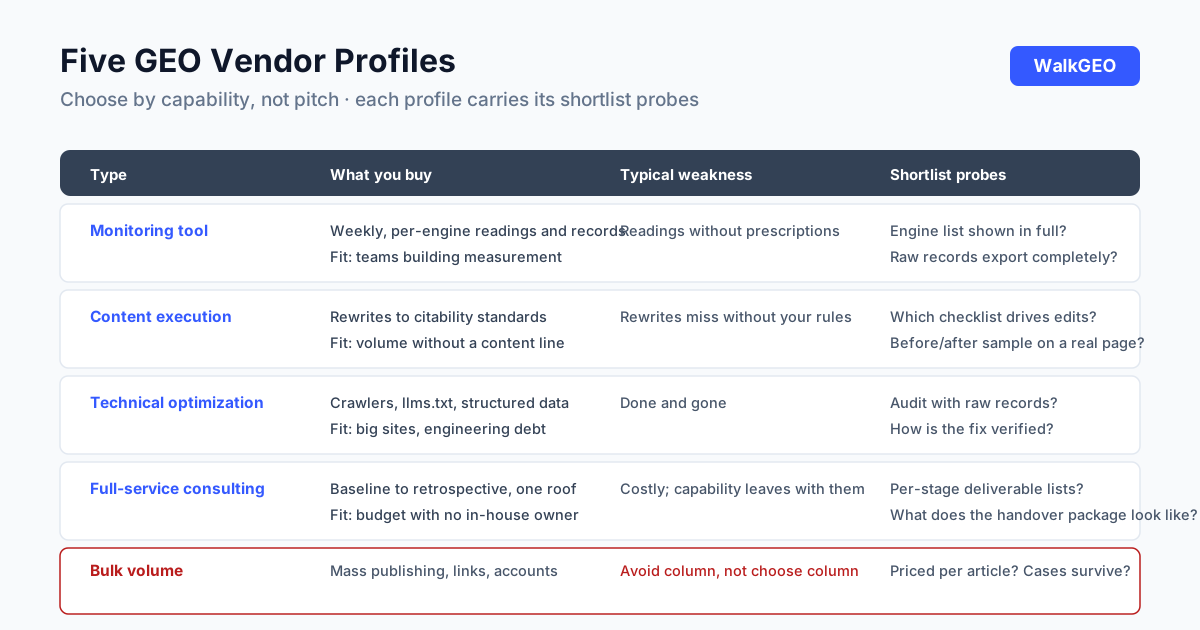
"Proprietary algorithm, guaranteed results in three months." Hear that in a pitch and the type judgment is already done: whoever writes outcomes into promises is selling rhetoric, not capability. The right order is to know what capability you are buying before discussing price; the wrong type wastes money even when cheap. The five profiles at a glance, expanded one by one below:
| Type | What you buy | Fit stage |
|---|---|---|
| Monitoring tool | Weekly, per-engine readings and records | Building measurement |
| Content execution | Rewrites to citability standards | Volume without a line |
| Technical optimization | Crawlers, llms.txt, structured data | Big sites, engineering debt |
| Full-service consulting | Baseline to retrospective, one roof | Budget, no in-house owner |
| Bulk volume | Mass publishing, links, accounts | Avoid, not an option |
Each carries typical weakness and shortlist probes.
Type one: monitoring tools
What you buy is readings: weekly, per-engine, per-question-set visibility and citation records with screenshots retained automatically. Fit: teams just building measurement who need a baseline and a retest rhythm. Typical weakness: readings without prescriptions; after the numbers, deciding what to change is still yours. Probes: can the engine coverage list be shown in full? Do raw records and screenshots export completely? Is the measurement documented in product docs, or only in the sales pitch?
Type two: content execution
What you buy is capacity: pages rewritten and produced to citability standards, conclusions first, facts sourced, update dates visible. Fit: teams with volume and a technical base but no content line. Typical weakness: without understanding your measurement rules, rewritten pages may not move the numbers. Probes: which checklist drives the rewrite? How is citation change verified after editing? Take a real page of ours and show before and after.
Type three: technical optimization
What you buy is access: crawler allowances, llms.txt, structured data, crawl diagnostics. Fit: large sites with engineering debt; usually closes within one iteration cycle. Typical weakness: done and gone; citability issues in the content layer are not their ticket. Probes: does the audit report come with raw records? What verification method follows the fix?
Type four: full-service consulting
What you buy is coordination: baseline to content to technical to retrospective under one roof. Fit: teams with budget and no in-house GEO owner. Typical weakness: expensive, and your team learns nothing along the way; when the engagement ends, the capability does not stay with you. Probes: per-stage deliverable lists? Which stages do our own people join? What does the handover package look like at termination?
Type five: bulk volume
What you buy is "quantity": mass publishing, mass links, mass accounts. The recognition signals sit in the FAQ: priced per article, silent on measurement, cases that wobble under questioning. This type is not in the "choose" column; it is in the "avoid" column. Short-term numbers may move; long-term, your brand is the collateral. Mechanics and consequences are itemized in the black-hat checklist.
Combined procurement: main partner plus specialists
Five types is not a single-choice question. The common combination is a monitoring tool as base plus a content-execution line, with technical optimization outsourced per project. One discipline governs combinations: the measurement rules are fixed by the main partner or by you, specialists work to them, and both parties' records must merge into one sheet. Boundary wording follows the data-ownership clause in the ten-clause piece.
Self-review: our own type and its limits
A public self-review, limits included. WalkGEO is a hybrid of monitoring tool and content execution: the product side does measurement (Overview, Issues, Optimize, agents), the content side runs the production line behind this blog. Against the five types, our boundaries, written here: one, we do not do agency operations or off-site posting on behalf of clients; our Zhihu and WeChat presence is our own accounts only. Two, our languages are Chinese and English; other locales are outside our delivery scope. Three, we offer no bulk-volume service of any form, which is not a weakness but a red line. The real weakness extends from the second boundary: teams needing other-language markets we cannot currently serve. Run your own vendors through this same table; a pitch where both sides' boundaries are on the table takes half the time.
Common questions
Can the five vendor types be combined in one procurement?
Yes, and it is the norm: a monitoring tool as the base plus a content-execution partner on the production line, each contributing its strong side. The discipline is written boundaries: who sets the measurement rules, who edits pages, where data lives, so both parties' records merge into one sheet. The main partner sets rules; specialist partners work to them.
How do I recognize a bulk-volume vendor?
Three behavior signals: deliverables priced per article rather than per question coverage; proposals silent on measurement rules and retest records; case studies that wobble under one follow-up about which question set and how many weeks of readings. The mechanics and consequences are itemized in our black-hat checklist; bring the probe list to the pitch.
"First purchase for a small team: which type comes first?"
The cheapest one first: measure your own baseline with free self-checks, costing nothing. The first real budget should go to a monitoring tool, because weekly readings tell you whether the gap is content or technical access. Content execution and technical optimization come second; full-service consulting waits for budget and scale, and inverted order hurts small teams most.
What if a vendor will not disclose methods and records?
Treat the refusal as the answer. Measurement rules, sample records, and retrospective readings are the daily working material of a legitimate vendor, available at shortlist stage. Two explanations exist for not producing them: no method, or a method that cannot see daylight. Both point to the same action: move to the next candidate.
Five profiles in, the next move is not a search box: load your candidates into the same shortlist inputs per the full procurement flow, and run the probe list vendor by vendor. When a monitoring base is what you need, pricing sits where we placed ourselves in the five profiles, and the weekly routine is the rhythm after hand-off. WalkGEO's self-review is written into this piece; compare our boundaries against your needs and the fit takes three minutes to judge, faster than any pitch.
Done reading? Run the same audit on your own site
Sign up, then let the agent scan every page and hand you a prioritized fix list. Your first audit is free.
Run a free site audit