Multilingual GEO for Global Brands: Where to Start
Multilingual GEO starts with rebuilding the target market's questions, local sources, and technical base, not with translating your site. Align the shared facts across both languages first.
You already have a decent English site, with product specs, company background, and warranty terms all translated, yet your name never shows up when you ask about your category in English on ChatGPT or Perplexity. The first step of multilingual GEO is not translating the site again; it is rebuilding the target market's question set, because how people ask, which local sources they trust, and whether both versions state the same facts all have to be redone. We walked through this in order on the en version of walkgeo.com; the timeline below marks one thing to check at every step.
Why does one need sound different across languages?
Multilingual GEO is the practice of making one brand findable, checkable, and citable across language markets, so a local generative engine can work from the same set of facts in each one.
The same buying need rarely gets asked the same way in two languages. A Chinese team might say "how do I get an export site mentioned by AI", while an English buyer asks "how do I get my export site cited in AI answers". You can test this yourself: ask once with a literal translation of the first sentence, then once with the second phrasing, and set the sources in the two answers side by side. No survey figures here; your own question set is enough to check it.
Translation is not the problem; done well, it is accurate. The issue is that an English AI answer must answer the English user's question, which is not the Chinese one. Writing independently adds the layer translation cannot cover, and it is not a switch that guarantees a citation.
Check this: ask one core Chinese question once as a literal translation and once rewritten in natural English, then see whether the answers draw on different sources.
From translation to independent writing, in order
Moving from translation to independent writing was a few changes in order, built on one judgment: the English draft answers English questions, metadata has a single source, and the two files stay comparable field by field.
The earliest setup was the cheapest: write the Chinese piece, translate it, and drop both files in one folder. What you can check: open any zh/en pair and see whether those fields match word for word, or are being synced by memory.
Later the order flipped. The English draft was written on its own from an English question set, with the facts kept consistent. What you can check: pick an en article and see whether it has a one-to-one Chinese source sentence, or is organized around an English question.
Next came the metadata. Every post now has exactly two md files, named <slug>.zh.md and <slug>.en.md, and shared information lives only in the md frontmatter. What you can check: change a publication date once and see whether the page, the sitemap, and llms.txt all move to the same day.
You might ask: does the English draft still get translated? It does, for product specifications and contract clauses that need word-for-word equivalence.
The check lands on the files: open any zh/en pair and count how many fields are shared, then look for a second source carrying the same information.
Three starting steps: action, deliverable, and rework
The start compresses into three steps: build the target market's question set, establish local sources, then add the technical base. The technical base comes last because it holds up the single set of facts the first two steps produce.
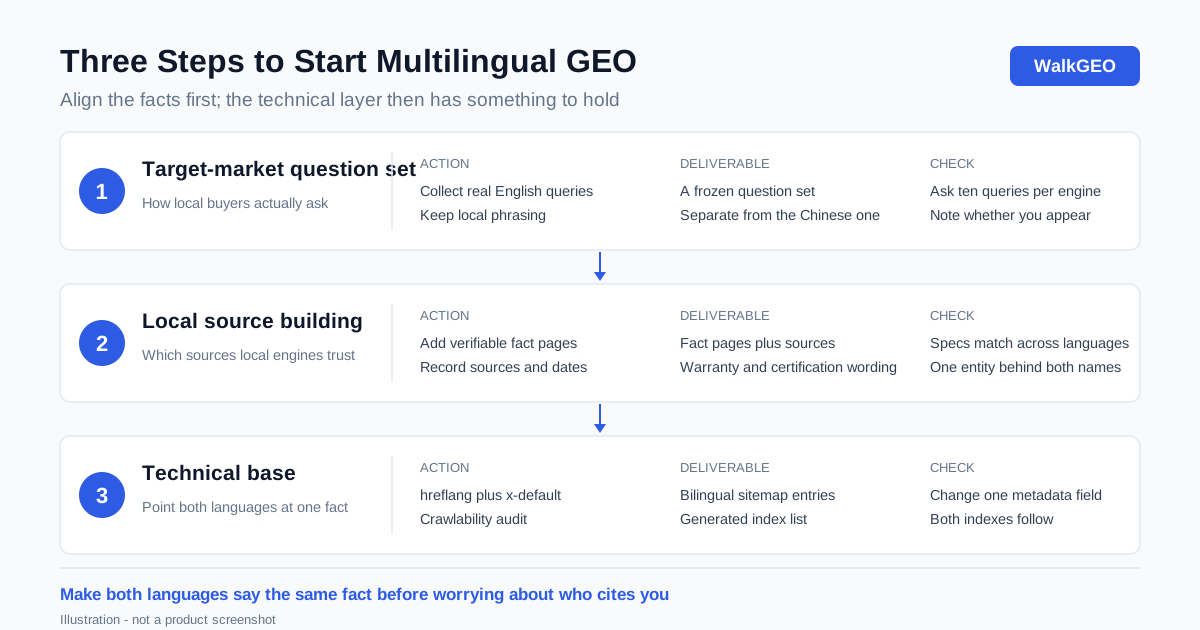
| Action | Deliverable | What you can check | Common rework |
|---|---|---|---|
| Target-market question set | A list of questions written the way local buyers ask, each with the entry point where you will ask it | Take ten to the target-market engines and see whether you appear and who gets cited | Translating Chinese questions into the list, so the phrasing stays Chinese and the round is wasted |
| Local source building | Brand pages, industry directories, and checkable fact pages on local platforms, worded to match your site | Whether company name, certifications, and regions off-site match the site word for word | Publishing only promotional posts with no fact page, or letting off-site wording conflict with the site, which reads as two companies |
| Technical base | hreflang set, URL rules, crawlable pages, and index entries generated automatically | Change one metadata field and see whether both index outputs move; read the body with scripting disabled | Laying down markup before content, or blocking the English pages in robots so the tags are perfect but nothing is fetched |
Rework on step one is the most common. A question set is not a keyword list but the sentences local buyers would say out loud; record each with the specific engine you will ask it on. For step two, a brand page, a directory entry, and a fact page matter only if they describe the same company as your site.
Step three holds things up: hreflang, URL rules, crawlability, and index entries are channels carrying already-aligned facts, so markup finished while the English pages are unfetchable is wasted work.
Before writing content, check whether each of the three steps can produce an actual file as its deliverable, rather than living in a meeting note.
Pick engines by market, not by name
Pick your sampling list by target market, not by engine reputation. A famous engine nobody there uses tells you nothing about that market.
On the China side, keep the default group on its existing rhythm. On the outbound side, add three: ChatGPT, Perplexity, and Google AI Overviews. Each has its own guide: getting cited by ChatGPT, optimizing for Perplexity, and the AI Overviews guide. The combined view lives in multi-engine monitoring, which covers how the "China default group plus three outbound engines" fit onto one sampling table.
Choosing engines is choosing a sample, and there is one test: would a buyer in the target market use it to ask a question like yours. We make no claim here about which engine prefers what content; there is no citable public basis for that. What belongs on the list is actions: the same questions, the same engines, asked weekly, with results logged.
One thing you can check today: write down the engines actually used in your target market as a single line, then compare it with your weekly sampling list.
Do both versions state the same facts?
The same company must not become two companies across the zh and en pages. Certification names, warranty length, regions, and the company name, once worded differently, fail the engine's cross-check.
Drift is rarely deliberate. The Chinese page says it holds a CE certification; the English page says "CE compliant". The Chinese page states a three-year warranty; the English one says "warranty available". Each sentence is fine alone, but together they hand over two sets of facts. How to lay out checkable items is broken down in brand entity consistency; the bilingual form of trust signals is covered in E-E-A-T for AI search. Both rest on one rule: change the language, not the facts.
The company name is the likeliest trouble spot. Full Chinese name, English rendering, short form, and trademark styling, if each page uses a different one, leave an engine unsure they point at one subject. Keep one standard-writing table and have both languages draw from it. Differences in applicable regions belong in explicit fields, not hidden in adjectives; fields can be compared, adjectives cannot.
One check to close on: pick a certification name at random, search for it once in the zh page and once in the en page, and see whether the wording is identical.
The en build: two md files, one builder
On the en version of walkgeo.com, those principles land as one convention plus one builder: the convention governs how the two drafts are written, the builder how far they may drift. This sticks to what exists on the site, with no traffic figures or invented customers.
Every post has two md files, named <slug>.zh.md and <slug>.en.md, and the en article is written in English on its own rather than produced by machine translation. Metadata has a single source in the md frontmatter: slug, topic, date, updated, featured, author, and engines are defined once, there.
You might ask: what if the two md files drift apart as they are edited? That is what the builder is for. scripts/build-blog-manifest.ts compares the shared zh/en fields one by one, and if any of slug, topic, date, updated, featured, author, or engines disagrees, it exits non-zero and blocks the build. readMinutes is a language-level field and may differ: eeat-for-geo is 13 in zh and 9 in en, because the two versions are not the same length. Writing "which fields must match and which may differ" as an executable rule removes the gaps a manual review leaves behind.
The technical side is consolidated the same way. src/seo/page-head.ts emits the zh-CN, en, and x-default trio automatically, with x-default pointing at the Chinese page, and en URLs share a single /en prefix. Sitemap and llms.txt blog entries come from that same manifest, so both drafts enter the index list together and nobody registers one by hand. The outbound side already has three guides in get-cited-chatgpt, perplexity-optimize, and ai-overviews-guide, plus the "China default group plus three outbound engines" view in multi-engine-monitoring.
What this means for you is a decision about what to do first. Do not rush to write the first English draft, and do not go shopping for tools yet. Start by listing the shared zh/en fields into a machine-checkable list: which must match word for word, which may differ, and which outputs should move when one field changes. Content comes after the list.
The check sits on that same list: change any shared field, see whether the builder blocks it and whether the index follows, and only call the foundation solid when both pass.
Verify by retesting, not one screenshot
There is only one way to verify: the same questions, across several engines, retested weekly, with the entry point and the date logged. Not being mentioned today and not being mentioned all week are two different things.
How to fix the question set is covered in prompt set design: hold a stable batch of questions in the buyer's own words. For a first pass, the AI mention check tells you whether you appear at all right now; which sentences are worth having extracted is itemized in how to write citable content. With those three in place, sampling has a stable input.
Give the log four columns: question, engine, entry point, and date, plus two results: whether you were mentioned, and which page was cited. The entry point must be specific, whether web or in-app, logged in or not. Work weekly, not hourly: asking several times a day only magnifies noise. Fix one day, one batch of questions, one batch of engines, one row a week, and after two or three weeks read whether mentions grow and whether the cited page moves from the homepage to a product page.
Retesting tells you whether this approach is moving in the right direction in your chosen market. It promises no citation and does not count an absence as failure. If you are not mentioned once, check whether the question set sounds local and off-site sources match the site first.
Reduce it to one action: make a table with columns for question, engine, entry point, date, whether you were mentioned, and the cited page; fill one row a week and do not change the columns midway.
Common questions
Is multilingual GEO just translating your Chinese articles into English?
Start with the target market's question set, not with a translation. Translation handles language conversion; how local buyers ask, which sources local engines trust, and whether both versions state the same facts all have to be rebuilt separately. Write ten English questions, run each past the engines your target market uses, see whether you appear, then decide what to write.
Why doesn't literally translated English content show up in English AI answers?
Literal translation keeps Chinese phrasing and Chinese examples. English buyers ask with different words and different comparison targets, so those anchor points are missing. That says nothing about translation quality; it only means the page answers a different question.
Which fields must match exactly across the two language versions?
Two versions have to match word for word on the shared identifying fields: slug, topic, date, updated, featured, author, and the engine list. Reading time is a language-level field and may differ, so a longer Chinese piece and a shorter English one are both fine. Manual comparison misses things; let the builder check field by field and block on any mismatch.
Do hreflang and sitemap need to be maintained by hand for both languages?
Nothing on the technical side needs a second manual entry. The page head emits zh-CN, en, and x-default automatically, with x-default pointing at the Chinese page, and English URLs share a single /en prefix. Sitemap and llms.txt blog entries come from the same manifest, so both drafts enter the index together. What you can check: change one metadata field and see whether both index outputs move.
How do I tell whether multilingual GEO is working?
Retesting beats a single screenshot. Take one fixed set of English questions and one fixed entry point, ask them across the target-market engines each week, and log the date, the entry point, whether you were mentioned, and which page got cited. Read the trend over two or three weeks rather than a single day. One answer without you in it is not a failure.
Take one concrete next step today: write ten questions in the target market's own words, ask each across the three engines you selected, log the entry point and the date, and ask again on the same day next week. Only once the sample covers two or three weeks and manual retesting outruns your time does tooling take over the weekly readings; that hand-off is what pricing and the weekly routine are for, and reaching for tools before the first half is done just collects misaligned facts faster. List first, write content second, talk about tools last, and WalkGEO followed that same order ourselves.
Done reading? Run the same audit on your own site
Sign up, then let the agent scan every page and hand you a prioritized fix list. Your first audit is free.
Run a free site audit