How to get your site cited by Kimi
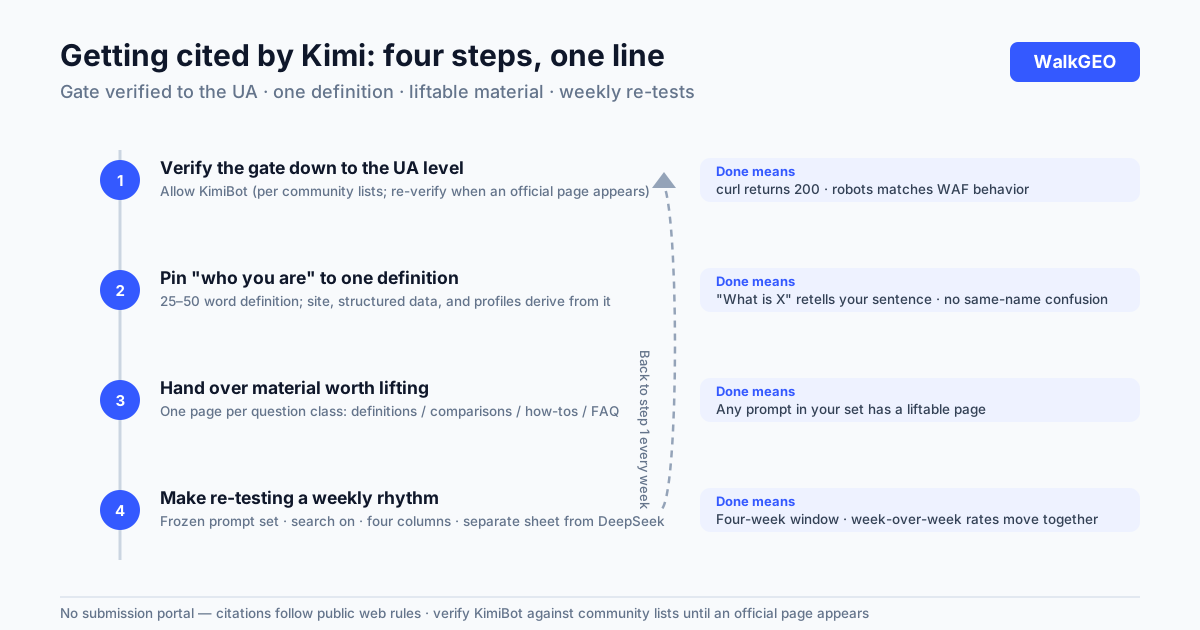
Four steps to get cited by Kimi: verify the KimiBot crawler gate, pin one definition sentence, hand over liftable material, re-test weekly. No submission portal — citations follow public web rules.
How do you get Kimi to cite your site? No shortcut exists, but the path is short: open the gate for its crawler, pin your brand to one definition sentence, hand over material worth lifting verbatim, then re-test weekly and read the trend. Kimi — Moonshot AI's assistant, launched in 2023 at kimi.com — has no submission portal; citations run on public web rules. This piece walks the four steps, each with a completion standard, and closes with why our own monitoring list keeps Kimi in the second batch.
Twenty minutes first: is Kimi not reading you, or reading without naming you?
Before changing anything, split the symptom — the two diagnoses take opposite prescriptions. Ask Kimi one verbatim customer question with search enabled, then check three things: does the answer name you at all; does it list your page as a source; are your facts retold correctly.
Not reading you — that's a gate and indexing problem. Your pages aren't in its retrieval field; check robots.txt, CDN rules, and indexing status in that order, ten minutes to a verdict. Reading you without naming you — that's a material problem. The page is visible but nothing on it is worth lifting in one piece, or the versions it reads disagree with each other so it skips you. Wrong facts are the third case, and the root is still material: it's retelling someone else's stale version. Diagnose wrong, and every fix after this lands on a wall.
A fourth outcome deserves logging too: the answer names a competitor and cites their source. Don't stew over it — that cited page is your benchmark. Open it, see what earned the citation (a parameter table? a comparison? an FAQ?), and log it in your re-test sheet; the full gap-attribution flow is in when AI recommends your competitors. Whatever the outcome, keep the twenty-minute record — it's your baseline, and two weeks later that sheet will read more honestly than any impression.
The four steps
Step 1: verify the gate down to the UA level
The checkable handle for Kimi's crawl channel is a crawler name: KimiBot. Evidence boundary first — the name comes from third-party crawler directories and community lists such as ai.robots.txt; as of November 2026 we could not find a public crawler policy page on Moonshot's official site. So work in two layers: allow the UA per the community list now, and re-verify character by character once an official page appears — a mistyped UA equals no rule, the discipline unpacked in our robots.txt audit.
Two completion standards: your robots.txt declaration for the AI-crawler group matches what your CDN/WAF actually does; and a curl fetch of a core page returns 200 with readable content. The allow/block strategy follows the same tradeoff as elsewhere — training and retrieval are decided separately, per UA group, never all-or-nothing.
Step 2: pin "who you are" to one definition
Entity verification is cross-source comparison; the more unique your stated version, the cheaper the check. Write a 25–50 word definition sentence — who you are, what you do, for whom — and place it on the homepage, the about page, and the Organization structured data. Every out-of-site profile derives from that sentence, unchanged. Bind your Chinese and English names to the same entity in this step too: two names telling two stories undermine each other's verification.
Completion standard: ask Kimi "what is X" using the category word from your definition — its retelling matches your sentence. Then ask your brand name — it doesn't file you under a same-name entity.
Step 3: hand over material worth lifting
Long context is Kimi's label — the official site currently leads with a million-token-class window, and its user base skews professional. For the material layer that means deep content holds a positional edge: one thorough piece covering parameters, boundaries, and use cases sits closer to what it lifts than ten shallow posts. That's a placement judgment drawn from product shape, not a promise — the ground truth stays the same: specific, consistent, verifiable.
Give every class of customer question one page, mapped in one table:
| Question class | Matching material | The material must carry |
|---|---|---|
| Category ("what is X") | Definition page | A 25–50 word answer capsule + one boundary sentence (who it fits, who it doesn't) |
| Comparison ("how does it compare") | Parameter table page | Tabulated parameters, not adjectives |
| Operations ("how do I set it up") | Step document | A step sequence liftable in one passage |
| Purchase ("what does it cost, how to choose") | FAQ page | Direct answers, one question per block |
Put the answer capsule in the opening paragraph — 25 to 50 words, complete enough to be lifted whole; follow it with the boundary sentence, then concrete parameters. Comparison pages get tables, not adjectives — "faster, steadier, smarter" can't be lifted; a parameter table lifts whole. Depth lives in parameters and boundaries, not adjectives — which happens to match how Kimi's users read.
Step 4: make re-testing a weekly rhythm
Freeze the prompt set (customer verbatims, a few per class), ask Kimi the same questions at the same weekly time with search on, and log four columns: mentioned yes/no, in what role, which source got cited, facts right or wrong. Keep Kimi's re-test records in a separate sheet from DeepSeek's and Doubao's — engines tested separately, recorded separately; mixed sheets kill attribution. Four weeks make one observation window; read mention and citation rates week-over-week, never from single answers.
Common traps: symptom, cause, fix
Symptom one: two weeks of edits, Kimi's answer doesn't move. The edits probably landed on pages your re-test prompts never cover, or the re-crawl hasn't happened yet. Fix: return to the prompt set and confirm every prompt has a page answering it; run a site: check on core pages — pages still "discovered, not indexed" can't be cited yet.
Symptom two: rules written from secondhand UA strings. Community lists also go stale or wrong; copy without cross-checking and you may block the wrong bot. Fix: any UA entering robots.txt gets verified against two independent sources first, official pages win when they appear — the operating detail is in the robots.txt audit.
Symptom three: retold wrong facts, so you appeal to Kimi. No appeal channel exists; a wrong answer comes from the material it read. Fix: locate the source page carrying the error, update the wording, wait for the re-crawl — correction outranks citation, because a wrong answer is worse than none. The diagnosis order is in the wrong-brand-info piece.
How to verify it worked
Three layers of evidence, in order. Gate layer: curl shows core pages readable, robots declaration matches actual behavior. Indexing layer: site: shows core pages moving from "discovered, not indexed" to indexed. Citation layer: across a four-week window on the frozen prompt set, mention and citation rates move in the same direction week-over-week. All three close the loop; whichever layer fails tells you where to go back.
One layer of misjudgment to call out early: passing the indexing layer doesn't mean the citation layer follows. Indexing is the qualifier; citation is the final — and the judges differ — the first scores gates and crawling, the second scores material and entity. Indexed but never named? Go back to steps two and three for the definition and the material; don't keep spinning at the gate layer. The full action-by-action timetable is in the GEO timeline piece.
Should Kimi be on your monitoring list?
Our first engine list didn't include Kimi — the first batch was the domestic four (DeepSeek, Doubao, Qwen, Tencent Yuanbao), decided by customer usage, not by Kimi's importance. One question set decides whether to add any engine: do your customers ask about your category there? Does your prompt set have prompts for it to answer? Is its entrance volume worth a dedicated prompt list? Can your placement keep up with the content ecosystem it leans on? Two yeses out of four, add it.
Adding is grouping, prompting, and a separate sheet — not a new playbook: engines whose retrieval sits near traditional search go in one group, with their own re-test records. For us, Kimi sits in a "waiting for a trigger" position — the day a customer segment's prompts show up on Kimi, it moves onto the monitoring list. Run the same four questions for your own list; that beats reshuffling engines with every trend.
FAQ
Will Kimi cite a brand-new website?
Yes, if the material qualifies. Kimi picks sources by the same standard as most generative engines: specific, consistent, verifiable. A new site with a clear definition, concrete parameters, and a real scope can enter answers — but indexing lags, so re-test weekly instead of expecting next-day results. Confirm your core pages are search-indexed with a site: query before talking about citations.
Is there a paid "Kimi indexing submission" service?
No. Kimi has no webmaster-style submission portal; crawling and citation run on public web rules — crawler access declared, pages openly readable, entities verifiable. Services selling "Kimi indexing submission" are selling something that was already free. Check the gate, the definition sentence, and your material yourself before paying anyone.
If I allow KimiBot, will it train on my content?
Third-party crawler directories record KimiBot as collecting content that may train Kimi's foundation models — the tradeoff is the same as GPTBot's: decide training and retrieval separately. Want answers but not a corpus? Allow retrieval-class crawlers by UA group and block training ones. Want both? Allow both. The decision lives in robots.txt and network-layer rules with the UA written precisely — not in an all-or-nothing switch.
Kimi states my brand information wrong — what now?
The error comes from material it read; fix the material, not Kimi. Audit entity consistency everywhere — site bio, product naming, structured data, third-party profiles — update the source page that carries the wrong fact, and wait for the next re-crawl. The full diagnosis is in our companion piece on fixing wrong AI brand information.
How long until Kimi cites my site?
Split it by action: gate and entity fixes finish and verify the same day; indexing moves with re-crawl cadence over days to weeks; mention and citation trends need weekly re-tests on a frozen prompt set, usually several weeks to show direction. Set a four-week checkpoint and never judge from a single answer.
There's nothing to buy on this path — only four steps to walk: gate verified to the UA, definition pinned to one sentence, material liftable in passages, re-tests on a weekly cadence. The skeleton matches our DeepSeek and Doubao pieces; the ecosystem and verification details differ. Rank your engine list with the four questions, not with the trend cycle. WalkGEO's monitoring list and methodology are public, with the product and pricing as the entry point.
Done reading? Run the same audit on your own site
Sign up, then let the agent scan every page and hand you a prioritized fix list. Your first audit is free.
Run a free site audit