Brand Entity Consistency: Stop AI Confusing You with Someone Else
AI mixes your brand with another company when public information never says who is who. Confusion sources, an entity sheet, and on-site plus off-site checklists, with our three-name record.
You ask an AI about your own company and the answer attaches another firm's business to your name, or describes your product as the competitor's. Most of the time this is not "AI doesn't know you". It is public information that never says clearly who is who: name variants, abbreviations scattered everywhere, an old name still hanging somewhere. When the machine cannot find one consistent answer, it guesses by probability, and the guess is the mix-up. Entity consistency is the state where any public information source, when checked for who is who, returns the same set of answers. The treatment is all checklists; run them in order.
Checklist one: where the confusion comes from
Lookalike names. Another company one character or one syllable away, or an older firm holding a similar name. The machine has no prior; whoever's signals are clearer gets believed.
Abbreviation sprawl. One entity, three short names: the site uses A, the social account uses B, the careers page uses C. Every variant is one more candidate entity for the machine.
Stale names. Renamed or re-domained companies leave the old name on directories, old press, partner pages. Engine reads both names, treats them as two subjects, and the information splits.
Unclear parent-child relations. Subsidiary, product line, and parent names appear mixed, with no sentence saying who belongs to whom. Machines cannot tell a product name from a company name, and the classic mix-up starts exactly there.
Check point: list every name your company has ever used (current, former, short, English, product names) on one page. Half an hour, and everything below depends on it.
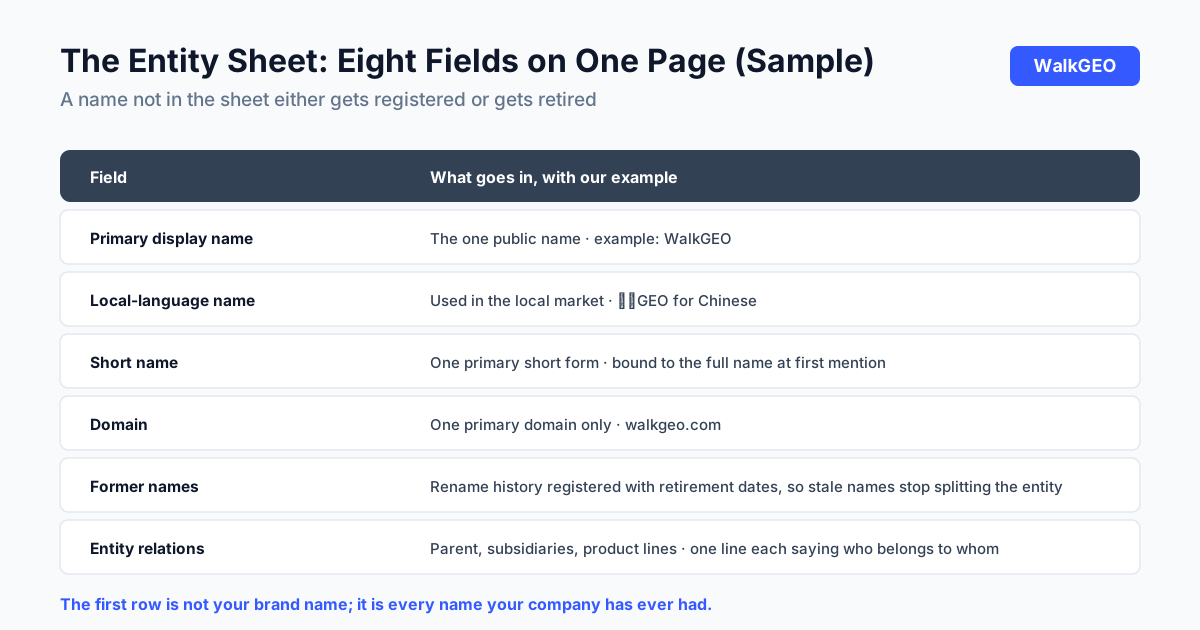
Checklist two: the entity sheet, one page, eight fields
| Field | What goes in | Example (our own entry) |
|---|---|---|
| Primary display name | The one public name | WalkGEO |
| Legal entity name | The registered full name | Registered company name |
| Former names | Rename history, with retirement dates | Pre-rebrand name |
| Short name | One primary short form only | WalkGEO |
| Local-language name | The name used in the local market | 立言GEO (Chinese) |
| Domain | One primary domain only | walkgeo.com |
| Entity relations | Parent, subsidiaries, product lines | One line each, who belongs to whom |
| Standard description | One sentence, reused everywhere | The homepage meta sentence |
The sheet is the anchor of the whole treatment. Anywhere a name is about to be used, check the sheet first. A name not in the sheet either gets registered or gets retired; "we'll improvise one" is not an option. Keep the sheet where anyone can read it and exactly one person can edit.
Check point: after filling eight fields, scan for name collisions and unregistered variants.
Checklist three: on-site, six places to verify
About page and footer: legal name and primary display name aligned. Product pages: one sentence tying each product name to the company. Contact page: entity name matching registered records. Regulatory and credential displays: legal name shown alongside display name, not blended. Structured data and site documentation: name fields matching what humans see. A site-wide search for the former name: replace or annotate every hit.
Check point: register each fix the day it happens; do not batch until month end.
Checklist four: off-site, five places to verify
Encyclopedia entries: company name, founding, business description matching the site. Social account bios: name and one-line description copied from the sheet. Careers pages: entity name and business description checked. Public business registration records: legal name and scope against the sheet. Media and partner reprints: fix wording where possible, at minimum keep a record where not.
Check point: run the off-site round quarterly; encyclopedia entries and reprints drift the most.
Checklist five: the disambiguation page and the retest
When confusion has actually happened, write one page titled "we are not that company": one opening sentence stating the two entities are different; three middle paragraphs of distinguishing evidence (domain, products, timeline, all checkable); a closing link to the authoritative page on your site. Plain tone, no point-scoring against the other firm, facts only.
Then retest with three question types: "What company is X", "What is the relationship between X and Y", "What are X's main products". Ask per engine, record per engine, following the portfolio logic in multi-engine monitoring. One engine getting it right does not count; five agreeing counts. Why machines mix entities up so easily is explained in how AI picks sources.
Check point: weekly retests, frozen questions, four weeks per window.
A lesson from our own entity work
One incident from our own records, because the names outnumbered what we expected. In October we settled the brand name. One hard constraint for WalkGEO was sound-it-out spelling: if listeners cannot spell what they hear, they cannot bind the entity; that constraint eliminated a set of pleasant but unspellable candidates. We registered only walkgeo.com and used the same domain for domestic compliance, deliberately leaving other TLDs unregistered; the trade-off was accepted risk of future squatting in exchange for controlled early costs.
In October we filed for ICP compliance in China and met the second real-world constraint: some regulators reject purely English, unregistered-trademark site names, so the filing name became our Chinese name 立言GEO. At that point one entity had three names living in three places: the filing system says 立言GEO, the Chinese site says 立言GEO, the international site says WalkGEO.
The lesson surfaced only after the filing: without registering each one, nobody would have listed "the same company" as three machine-readable names. One unregistered name is one more gap where a mix-up can start; other people's confusion tends to begin at the name you forgot to write down. The fix was to put all three into the entity sheet, each with its venue and justification, and to require every future name to enter the sheet first.
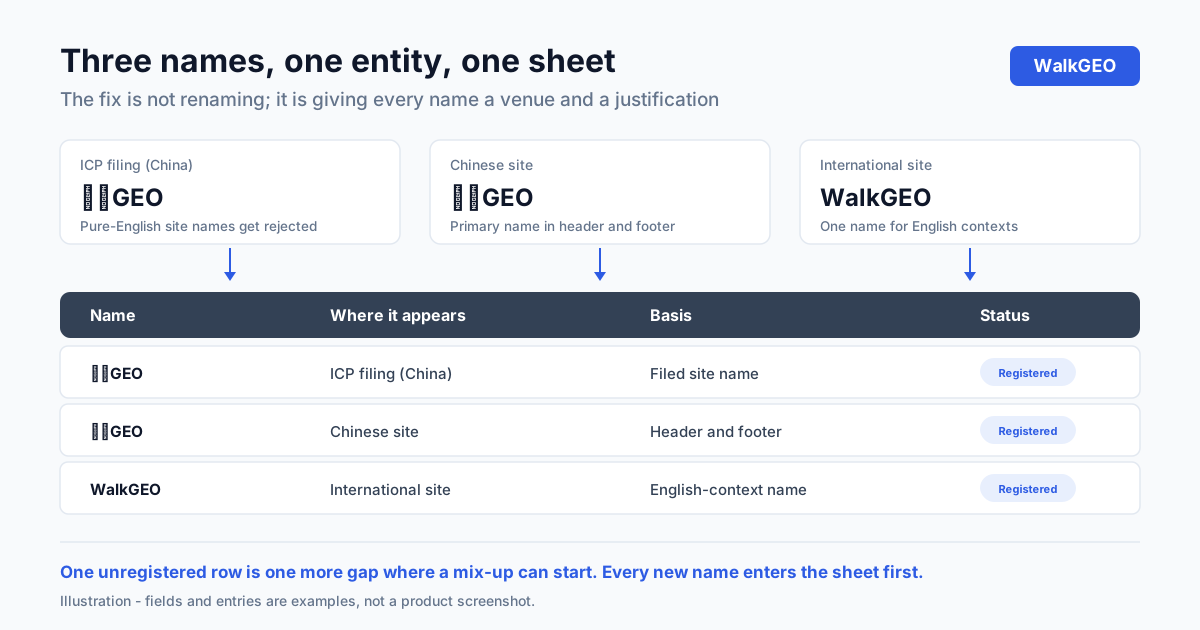
One judgment to take away: the first row of your entity sheet is not your brand name; it is every name your company has ever had.
Common questions
Can I ask an engine to fix a mix-up of my brand?
Engines offer no public correction channel, so fixing the information source beats waiting in line. The confusion lives in the public information layer, and that is where you fix it: build the entity sheet, align names on-site and off-site, then retest with frozen questions across engines. A specific wrong fact follows its own correction path, laid out in our piece on fixing what AI gets wrong about your company.
How long does an entity sheet need maintaining?
Building it takes half a day; maintaining it follows business events. Rename, merger, new product, new domain, any of these landing means the field updates the same day. In quarters with no events, read the whole sheet once and focus on off-site drift. The sheet earns its keep when anyone can find, in five minutes, which name goes where.
What questions should the retest ask?
Start with three: "What company is X" checks introduction consistency, "What is the relationship between X and Y" checks whether the confusion is resolved, "What are X's main products" checks business boundaries. Ask per engine, record per engine, weekly, frozen questions, one four-week window at a time.
Are abbreviations and short names allowed?
Yes, with one primary short name per entity. Bind full name and short name at first mention, then use the short name consistently; off-site accounts and bios follow the same one. Extra variants either get registered in the sheet with their purpose or get retired.
Five checklists in, the treatment has landed: sources mapped, sheet built, site and off-site verified, retest questions fixed. But this is not a one-time exercise; names grow with the business. When was your last full entity check? If there is no answer, the machine will keep guessing the next time someone asks about your company. Build the sheet tonight; fill the first two rows, primary name and domain. The six on-site checks share one mechanism with the byline governance in our author-entity piece. When weekly readings are needed to confirm the confusion is gone, manual sampling runs out first; what tooling takes over is on pricing, and the routine fits into the weekly close-out. WalkGEO's own sheet started from three names; write your first row today and the retesting can start next week.
Done reading? Run the same audit on your own site
Sign up, then let the agent scan every page and hand you a prioritized fix list. Your first audit is free.
Run a free site audit