How to get Tencent Yuanbao to recommend your brand
Yuanbao's recommendations ride Tencent-family retrieval; official-account articles are its first-tier citation source. Four steps — gate, mirroring, placement, re-tests — and ranking after WorkBuddy.
How do you get Tencent Yuanbao to recommend your brand? Read the citation map first: Yuanbao's retrieval grows out of Tencent's content ecosystem, and WeChat official-account articles stand in the first tier — the feature that separates it from DeepSeek and Doubao. The rest is a four-step engineering job: gate check, entity mirroring, echo placement, and a re-test sheet of its own. Completion standards come with each step, plus how we rank Yuanbao now that WorkBuddy exists.
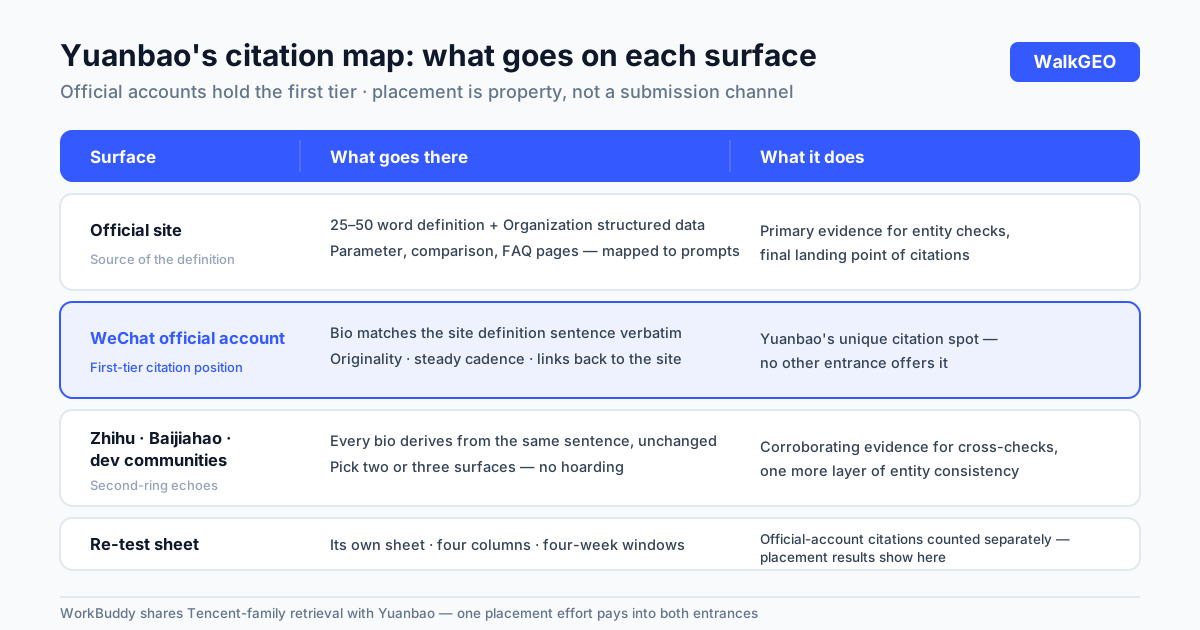
Yuanbao's citation position: official accounts in the first tier
Yuanbao is bound to the WeChat official-account ecosystem, and account articles are its first-tier citation source — a citation position no other entrance offers, which is exactly Yuanbao's unique value. Roughly forty million monthly users (per 36Kr's June 2026 report) plus that ecosystem binding earn it a fixed seat on any domestic engine list. The same Tencent Hunyuan engine also serves WorkBuddy, the newer office-track entrance — the two share a retrieval layer, so placement done once pays into both; the grouping logic is unpacked in the "Yuanbao or WorkBuddy?" section below, and the entrance-versus-engine tradeoff has its own piece.
Verifying this yourself is direct: ask Yuanbao a question from your industry, open the source list under the answer, and let the frequency of official-account articles speak for itself.
The four steps
Step 1: run the gate and indexing check as usual
Yuanbao's citations run on its retrieval layer, and retrieval still sits on public web rules. Check three spots in order — robots.txt declarations for AI crawlers, actual CDN/WAF behavior, core-page indexing — exactly as in the DeepSeek and Doubao pieces. One Yuanbao-specific caution: don't assume that allowing one Tencent entrance's crawler covers the whole Tencent family; configurations may not be shared across entrances. Run the curl test and the indexing check anyway, and skip the shortcuts.
Completion standard: a curl fetch of core pages returns 200 with readable content; site: shows core pages indexed; robots declarations and actual behavior don't conflict.
Step 2: make the site and the official account mirror each other
Entity consistency upgrades to "double mirroring" here, field by field — one table settles it:
| Mirrored spot | Aligned to | Source |
|---|---|---|
| Account name | Contains the brand word, no campaign suffixes | Brand naming standard |
| Account bio | Matches the site definition sentence verbatim | Definition sentence |
| Article author bylines | One uniform byline, no variants | Derived from the definition |
| Menu's company page | Same source as the site's about page | Site about page |
When Tencent-family retrieval verifies your entity, the site and the official account are the two places it sees together — matching versions pass the check; conflicting ones make it either trust the bigger source or skip you. Finish the Chinese-English name binding in the same step: two names telling two stories undermine each other's verification.
Completion standard: the official-account bio matches the site definition sentence verbatim; ask Yuanbao your brand name and its retelling matches the definition, without filing you under a same-name entity.
Step 3: the second ring of echoes beyond the official account
The first tier isn't the only tier. Place the second ring from the standard domestic list — Zhihu for professional Q&A, Baijiahao for syndication, CSDN/Juejin for technical content — pick two or three that fit your category, and derive every bio from the same definition sentence. The official account itself deserves separate care: originality declarations, a steady publishing rhythm, and links back to the site make its weight in the retrieval field real.
The positional advantage is real; a guarantee is not. First-tier placement describes a position, not a promise — placement is property development, not a submission channel. No mechanism grants recommendations for publishing; step four is where publishing gets tested.
Completion standard: at least two rings verifiable with same-source wording; the official account has published within four weeks with at least one link back to the site.
Step 4: Yuanbao gets its own re-test sheet
Frozen prompt set, same weekly time, search on, verbatim questions — log mentioned yes/no, role, cited source, facts right or wrong. The skeleton matches the DeepSeek piece; the difference is the record: Yuanbao keeps a separate sheet, never mixed with Doubao or DeepSeek. Two reasons: mixed sheets kill attribution, and Yuanbao's source structure differs — official-account citations need their own count before you can tell whether the ecosystem placement is working. Four weeks per observation window, read week-over-week.
Two traps specific to Yuanbao
Trap one: treating the official account as a submission portal. The symptom: an account opens, a few articles go up, recommendations are expected within two weeks, and silence turns into doubt about the method. The cause: the account is placement, not a channel — no submission mechanism exists, and those two weeks belonged to step four's re-testing. Fix: operate the account as same-source placement and let the re-test sheet, plus time, verify recommendations.
Trap two: building a new playbook the day WorkBuddy launches. The symptom: separate prompt sets and separate placement for the new entrance, budget doubled. The cause: not asking whose retrieval it rides — WorkBuddy runs on Tencent-family retrieval, the same engine layer as Yuanbao. Fix: group, don't duplicate. One placement effort and one prompt set serve both entrances; keep the re-test sheet merged first and split it only when WorkBuddy's independent usage is real.
Yuanbao or WorkBuddy — which one do you watch?
Both stay on the list, managed as one group. The basis is entrance grouping: Yuanbao and WorkBuddy share Tencent-family retrieval, so placement, entity work, and official-account operations are all shared; they differ only in entrance shape — general Q&A versus office scenarios. So "which one" is the wrong question; the real one is "how much usage does the Tencent Hunyuan group see among your customers." Usage up, both entrances benefit; usage down, both drop in priority.
One independent probe per month covers the judgment: ask both entrances the same prompt set and record how much their source lists overlap. High overlap means the grouping holds — one placement serves both. Overlap trending down means the entrances are diverging, and a sheet split becomes worth considering. The method costs little and beats choosing sides by impression.
How we rank Yuanbao
Yuanbao has been one of the four since our first engine list, and its rank moved once: after the WorkBuddy reporting (36Kr, June 2026), we moved it from the first tier beside Doubao and DeepSeek to right behind them — the reason was usage trend, not removal. Three rules govern the adjusted posture: keep every probing prompt at unchanged frequency; review Yuanbao's and WorkBuddy's independent usage quarterly, restoring the rank if usage recovers; keep investing in official-account placement, because the first-tier citation position is uniquely its own and nothing else replaces it.
The logic underneath: priority follows usage, citation positions follow ecosystems, and the two lines are tracked separately. Even if Yuanbao's usage drops further, the official-account citation position still holds inside Tencent's family — which is exactly why lower priority doesn't mean stopping placement. Rank your own list with the same two lines instead of swinging with every single report.
FAQ
How are Yuanbao and WeChat Search related?
Related but different entrances: Yuanbao is an AI answer entrance, WeChat Search is the search entrance inside WeChat, and both consume official-account content. For a brand, placement done once on the official account pays into both; re-test them separately — their triggering logic and display shapes differ, and mixed data can't be attributed.
Will Yuanbao cite a brand-new website?
Yes, if the material qualifies. Yuanbao picks sources by the same standard as most generative engines: specific, consistent, verifiable. A new site with a clear definition, concrete parameters, and aligned official-account placement can enter answers — indexing lags, so re-test weekly rather than expecting next-day results.
Do I need to submit my site or account to Tencent to get recommended?
No. Yuanbao has no site-submission portal, and opening a WeChat official account is placement, not submission — an aligned bio adds one more same-source evidence point for entity verification. No mechanism grants recommendations for signing up. Anything sold as "Yuanbao indexing submission" is selling what was already free.
Yuanbao states my brand information wrong — what now?
Audit your own material first: is the definition sentence unique, do the official-account bio and site agree, has a legacy name drifted? The error comes from what it read — fix the material, not Tencent. Correction outranks citation; the diagnosis order is in our wrong-brand-info piece.
Yuanbao's user base is shrinking — keep testing it?
Lower the priority, don't remove it. Yuanbao remains a substantial entrance, and the first-tier official-account citation position is uniquely its own. Rank it after Doubao, DeepSeek, and Qwen, review quarterly, and keep WorkBuddy grouped with it — one placement effort, two entrances.
Half of Yuanbao's recommendation position is technical (gate, indexing, entity), half is ecological (official account, second-ring echoes) — the four steps pin both sides, with a re-test sheet of its own. The skeleton matches DeepSeek and Doubao; the Tencent-family differences all live in the ecosystem. WalkGEO includes Yuanbao in its six-engine monitoring range, verifiable on the product and pricing page; the entrance-versus-engine question is unpacked in the Yuanbao/WorkBuddy piece.
Done reading? Run the same audit on your own site
Sign up, then let the agent scan every page and hand you a prioritized fix list. Your first audit is free.
Run a free site audit