Will Bing and Copilot cite my website?
Yes — one crawler (bingbot) feeds both exits, and there's no separate training switch. Four steps: indexing, IndexNow notifications, entity, weekly re-tests, plus our search for a Copilot-only gate.
Will Bing and Copilot cite my website? Yes — and this line's ticket is cheaper than most: get Bing indexing right and Copilot's citation eligibility arrives automatically, because Copilot's answers are grounded in Bing's search index and the two share one crawler, bingbot. The cost is coarse-grained control: this line has no separate training switch. Four steps below — indexing, notification, entity, re-tests — each with a completion standard, opening with the check we ran for a Copilot-only gate, which came back with a surprise.
First, where the citation actually happens. Copilot isn't just a web chat box: it lives in Bing's search page, Windows itself, and Edge's sidebar — overseas users reach it with a casual system-level question. Behind every one of those entrances sits the same Bing index; whether your page is in it, and whether the material is worth lifting, decides whether those scenes include you. The common misjudgment among export teams is dismissing Copilot as "yet another chat tool." It's a system-level entrance for overseas buyers, touched more often than any standalone app.
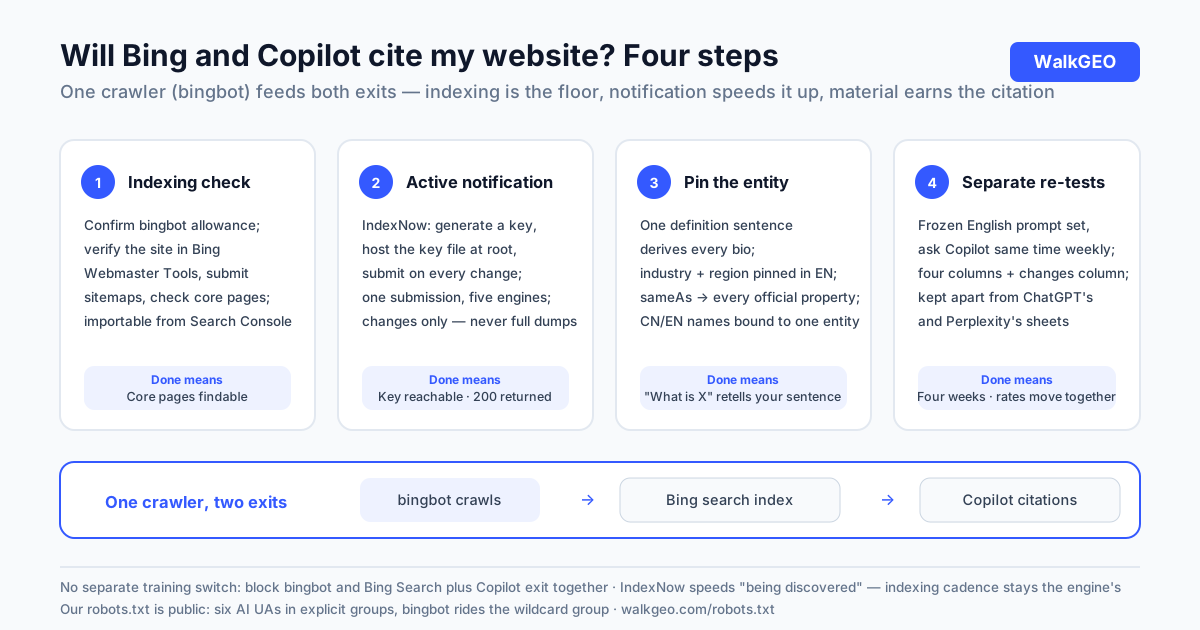
We went looking for a Copilot-only gate. There isn't one.
Before writing this piece we ran a check, and the process is worth reporting as-is. The question was concrete: does Microsoft's line have an independent training crawler the way OpenAI has GPTBot and Google has Google-Extended? If yes, robots.txt could make the training-versus-retrieval decision separately, like everywhere else. The reference material came back: no. Microsoft's primary crawler is bingbot, and training and search share that one entrance; a separate MicrosoftPreview exists for preview snapshots, not training. Third-party crawler references (a complete LLM crawler blocking list among them) likewise mark Microsoft's line as "no independent training UA."
MicrosoftPreview deserves one more line: it generates the snapshots behind share and preview scenes (the thumbnail and summary on a link card), unrelated to training. Whether to allow it depends on your attitude toward preview display — most sites allow it, because it shapes how your links look in chat and social scenes. Verify it the same way as any UA: an explicit robots.txt group, behavior confirmed in logs.
The effect on your practice cuts both ways. The convenient side: no separate Copilot rule group to write — your bingbot policy is your Copilot policy. The side to accept: if you ever want out of Copilot while staying in Bing Search, there's no switch — blocking bingbot exits both. Our robots.txt writes six AI crawler UAs as explicit groups while bingbot rides the wildcard group (User-agent: * Allow); the current file is public at walkgeo.com/robots.txt — traditional search crawlers don't need their own group, the judgment unpacked in the robots.txt audit piece.
Put the engines side by side and Microsoft's position is obvious:
| Engine line | Training crawler | Retrieval / fetch crawlers | Training vs. retrieval decided separately |
|---|---|---|---|
| OpenAI | GPTBot | OAI-SearchBot, ChatGPT-User | Yes |
| Anthropic | ClaudeBot | Claude-User, Claude-SearchBot | Yes (three tokens, decided per token) |
| Google-Extended | Googlebot | Yes | |
| Perplexity | None (officially no training) | PerplexityBot, Perplexity-User | Training needs no decision |
| Microsoft | No independent UA — shares bingbot with search | bingbot | No — rise together, fall together |
The table's value isn't memorization; it's decision-making. Get clear on your real attitude toward "content entering training corpora," then decide which lines run fully open and which get grouped blocks. On Microsoft's line you have no middle option — that itself is selection information.
The four steps
| Step | Action | Done means |
|---|---|---|
| 1 Indexing check | Confirm bingbot allowance; core pages verifiably in Bing's index | Core pages findable via Bing Webmaster Tools or site: |
| 2 Active notification | Adopt IndexNow; submit on every content change | Key file publicly accessible; submissions return 200/202 |
| 3 Pin the entity | One definition sentence derives every bio; CN/EN names bound | English "What is X" retells your sentence |
| 4 Separate re-tests | Weekly on a frozen set, Copilot on its own sheet | Four-week window; mention and citation rates move together |
Step 1's verification entry is Bing Webmaster Tools — Microsoft's webmaster platform, feature-aligned with Search Console: submit sitemaps, check indexing, review crawl frequency, and submit individual URLs by hand. Not registered? Verify your site like you did for Search Console (DNS record or file verification), ten minutes. Already registered? Go straight to the index coverage report. There's even a shortcut: Bing can import sites already verified in Search Console, saving the second verification. The bingbot allowance check matches every other engine — the robots.txt writing is in the audit piece.
Step 3's English-side rules carry over: pin industry and geography into the definition sentence, point sameAs at every official property. Copilot's audience is majority-English, and the English definition sentence is a translation of the Chinese one — a second voice is how entities split.
Step 4's re-tests run on an English prompt set (buyer verbatims, in English), same weekly time, logging mentioned yes/no, role, source, facts right or wrong, plus this week's changes. Keep the sheet apart from ChatGPT's and Perplexity's — three different source structures: ChatGPT runs its own retrieval, Perplexity hangs sources on nearly every answer, and Copilot's citation density is its own thing. Mixed sheets kill attribution; this line has now appeared in four engine pieces, because it re-proves itself with every engine.
Can you make Bing faster? IndexNow, used properly
Waiting for a re-crawl is passive; IndexNow turns it into active notification. When a page is added, updated, or deleted, you submit the URL to api.indexnow.org, and participating engines discover it faster. The protocol is open and free; participants include Bing, Yandex, Seznam, Naver, and Yep.
The full setup lives on the official getting-started page, and the skeleton is three things: generate a key; host a text file named after that key at your site root (engines use it to verify you own the host); then send one request with the URL and key to the submission endpoint on each content change. Major CMSs have ready plugins; self-built sites add one HTTP request to the publish flow — put it next to the deploy script and it never gets forgotten.
Two reminders keep expectations honest. First, IndexNow accelerates "being discovered," not "being indexed" — engines still process at their own pace, and a 200 response only confirms the notification arrived. Second, don't dump your whole URL inventory into it: the protocol's intent is change notification. Submit what changed; bulk-submitting historical URLs ranges from useless to abusive.
How it relates to your sitemap: complementary, not competing. The sitemap hands crawlers a full inventory — the job is "don't miss anything"; IndexNow is change notification — the job is "don't be slow." The positioning we gave sitemaps in the llms.txt piece (earning the crawl) holds on this line too; IndexNow just adds a bell you get to ring. The trio — sitemap, llms.txt, IndexNow — each owns a layer and none steps on another.
Adoption by site type: dynamic sites (CMS, e-commerce, daily publishing) gain the most — a plugin submits on publish; self-built sites add the one request to the release flow; rarely-updated static sites gain little, and Bing Webmaster Tools' manual submissions plus a sitemap are enough. One overlooked bonus: IndexNow is shared across engines — one submission notifies every participant, so the notification chore is done once for five engines. That's why it beats per-platform submission on effort.
Where Bing sits on your engine list
A decision map for ranking it. Export business: Bing/Copilot goes in the same batch as ChatGPT and Perplexity — the three share one English buyer prompt set, the intake cost is marginal, and there's no reason to split the batch. Domestic-only business: Bing's search share and Copilot's reach are off your customers' main channel — rank it behind the domestic four, fund it when budget allows. Cross-border teams in between: look for traffic evidence from bingbot and the Copilot side in your inquiry sources; evidence earns the rank, no evidence lowers it. Ranking always returns to the language and channel of buyer questions — the line that keeps reappearing in these pieces because it's the only logic that never expires.
Rank set, so is the intake order: verify the site in Bing Webmaster Tools first (the official view of indexing and crawling), then adopt IndexNow (change notifications), then add Copilot to the weekly re-test engine list. Three independent moves; done in order, none blocks another.
Three traps, two of them born from "one crawler"
Assuming Copilot has its own switch. The symptom: copying the OpenAI grouping template, you write a "CopilotBot" group for Microsoft's line — no such UA exists, the rule equals nothing written, and you believe you have a defense while nothing is blocked. Fix: this line is bingbot-only; the check at the top of this piece is the answer. The verify-the-UA-first discipline applies here like everywhere else.
Treating "in the index" as "cited." Copilot's eligibility line is Bing's index; whether an answer hangs your page still depends on material — definition sentences, parameter tables, liftable facts. Indexed but never cited? Back to the material layer; don't spin at the gate layer. This misjudgment reappears on every engine line wearing a new costume: indexing settles eligibility, citation settles results, and the two are judged by different panels.
Using IndexNow as an indexing switch. The symptom: submitted, not yet indexed, so you resubmit repeatedly. Notification delivered doesn't mean indexing done — the engine's processing rhythm isn't yours to set, and hammering the same URLs reads as abuse. Fix: submit once, wait for the crawl, log the submission time in the re-test sheet's changes column, and watch that URL's indexing and citation across the four-week window — the notification is your motion, the indexing is the engine's; attribute the two separately.
How to verify it worked
Three layers, in order. Gate layer: your robots.txt bingbot policy matches actual behavior (search the logs for bingbot — crawl frequency and paths; whether it rides the wildcard group or an explicit one, the logs decide); the IndexNow key file is publicly accessible and submissions return 200. Indexing layer: core pages confirmed indexed via Bing Webmaster Tools or site:; for IndexNow-submitted new pages, watch the interval from submission to appearing in the index — that interval is your site's weight ECG. Citation layer: ask Copilot the frozen prompt set weekly, logging mentioned yes/no, role, source, facts right or wrong, plus this week's changes; four-week window, read week-over-week. Copilot answers carry citation markers — screenshot the source lists weekly; that's this line's report card, and any dispute resolves back to the record. The full timetable is in the GEO timeline piece.

FAQ
Are Bing indexing and Copilot citations the same thing?
One index, two exits. Copilot's answers are grounded in Bing's search index, so being in Bing's index is the eligibility line for Copilot citations; eligibility still isn't citation — whether your page hangs in an answer is decided by material quality and entity clarity. The work doesn't conflict: doing Bing indexing well hands you the Copilot ticket at the same time.
What happens if I block bingbot?
Bing Search and Copilot exit together — bingbot is the only primary crawler, and Microsoft's line has no separate training switch like GPTBot or Google-Extended. There is currently no option to leave Copilot while staying in Bing Search; that's the conclusion after cross-checking multiple crawler references, and it's the biggest difference between this line and other engines.
Is IndexNow right for my site?
Best for sites that update often: generate a key, host the key file at your site root, and submit URLs to api.indexnow.org whenever content is added, updated, or deleted — participating engines (Bing, Yandex, Seznam, Naver, Yep) discover it faster. Low-frequency static sites can skip it; manual sitemap and URL submission in Bing Webmaster Tools is enough. Both routes are free.
Does a China-focused business need Bing?
Depends where your buyers ask. Domestic customers' search and AI entrances aren't Bing or Copilot — put the domestic four engines first. Export businesses are the opposite: Bing's share and Copilot's reach in overseas markets can't be ignored, and Bing indexing is the prerequisite work for this line. Priority follows the language and channel of buyer questions, not a tool's fame.
How long until Copilot cites my site?
Split it by action: IndexNow submissions and bingbot allowances finish and verify the same day; indexing moves with crawl cadence over days to weeks; citation trends in Copilot answers need weekly re-tests on a frozen prompt set, several weeks to show direction. Set a four-week checkpoint and never judge from a single answer.
This line's entire peculiarity is "one crawler, two exits, no separate switch": one rule saved, but every tradeoff made whole. The rest matches any engine — indexing as the floor, the entity pinned, material written against buyer questions, re-tests on their own sheet. Overseas buyers reach Copilot with a casual system-level question more often than you'd guess; earn the index ticket first, and let material and time handle the citations. WalkGEO's six-engine monitoring range and public verification entries are on the product and pricing page; the general overseas playbook is in the ChatGPT piece, and another dual-channel sample in the Perplexity piece.
Done reading? Run the same audit on your own site
Sign up, then let the agent scan every page and hand you a prioritized fix list. Your first audit is free.
Run a free site audit