How to get cited by ChatGPT
ChatGPT reaches your site through three channels — corpus, search retrieval, user browsing — each with its own gate. Four steps to open all three, with a real llms.txt/robots conflict we caught.
By the end of this guide you'll be able to do one specific thing: make ChatGPT mention your site and link it in answers — or pinpoint exactly which link in the chain is broken. The method is to open the three channels ChatGPT uses to reach your content, then ship material it can quote without embarrassment. Every step has a completion standard and a verification command, plus a real contradiction we caught on our own site last week.
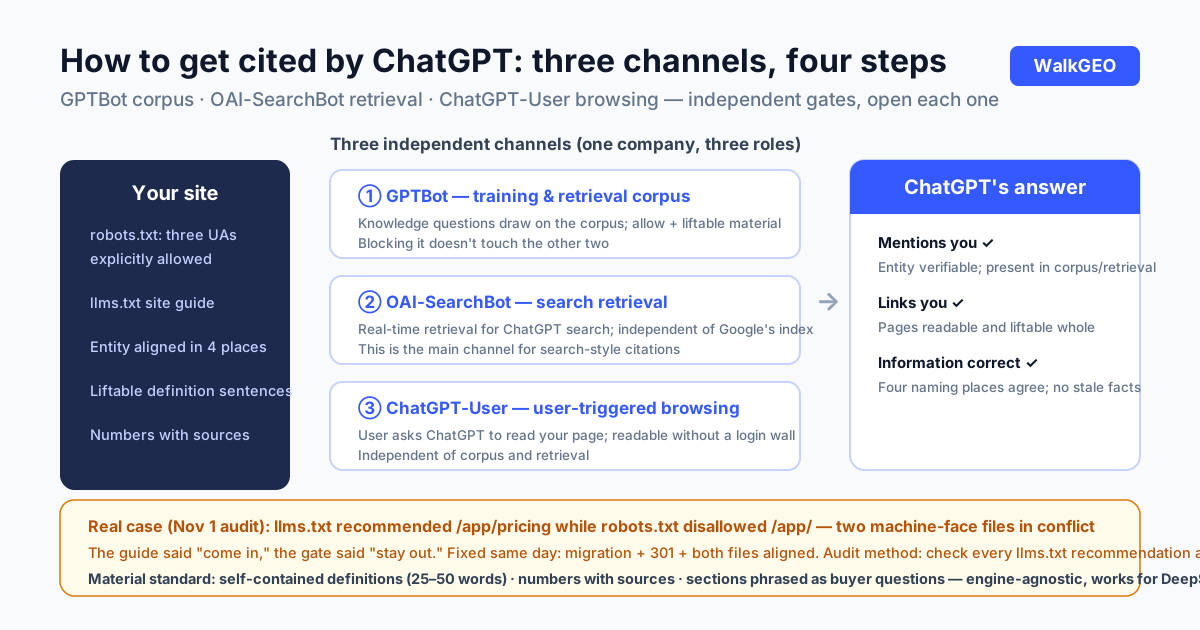
Where does ChatGPT get your content? Three channels, one table
ChatGPT doesn't have "a crawler." It reaches your site through three channels — same company, different user agents, different admission requirements, and different things for you to do:
| Channel | User agent | What it does | What you must do |
|---|---|---|---|
| Training & retrieval corpus | GPTBot | Fetches content into the corpus | Allow in robots.txt + citable material |
| Search retrieval | OAI-SearchBot | Real-time retrieval for ChatGPT search | Allow in robots.txt + indexable pages |
| User-triggered browsing | ChatGPT-User | Fetches a page when a user asks ChatGPT to read it | No login wall, no JS-only rendering |
The channels are independent: blocking GPTBot doesn't affect ChatGPT-User, and allowing OAI-SearchBot doesn't put you in the training corpus. "Getting cited by ChatGPT" means different things in different scenarios — search-style questions cite through the OAI-SearchBot path, knowledge questions may draw on the training corpus, and pasted links go through the third channel. Open all three and every scenario is covered. The full seven-crawler reference table (Claude, Perplexity, Google included) is in our robots.txt audit guide.
Step 1: Allow OpenAI's three crawlers
What: give GPTBot, OAI-SearchBot, and ChatGPT-User each an explicit group in robots.txt, with content paths allowed. Why: this is the shared gate for all three channels — if the declaration layer says no, nothing downstream matters. Done means: one explicit group per UA, and the file is retrievable by curl.
User-agent: GPTBot
Allow: /
Disallow: /app/

User-agent: OAI-SearchBot
Allow: /
Disallow: /app/

User-agent: ChatGPT-User
Allow: /
Disallow: /app/
One connected check is easy to miss: read llms.txt and robots.txt against each other. llms.txt is the site guide you hand to AI engines, recommending the URLs worth reading. If it recommends a path that robots.txt blocks, your two machine-face files are fighting each other — which is exactly what we found on our own site last week.
Case: our two files contradicted each other; we fixed it in a day
On November 1, during a site audit for our pricing page migration, we found this: llms.txt recommended /app/pricing to AI engines, while robots.txt's Disallow: /app/ blocked the entire path. Either file alone looked fine — the guide was responsible, the gate was cautious — but any retrieval-based engine following both would conclude: the guide says come in, the gate says stay out.
The fix shipped the same day: the pricing page moved to an indexable path, the old path became a 301, and llms.txt and robots.txt were restored to agreement through the build. The lesson isn't "we make mistakes" — it's that machine-face files must be audited as a pair: for every URL llms.txt recommends, check its allow status in robots.txt. A ten-entry guide takes under ten minutes. This was our second catch from the same method — on October 31 the paired check found our robots.txt was missing OAI-SearchBot entirely; that story is in the audit guide.
You can verify our file's current state anytime at walkgeo.com/robots.txt — allowed UAs and blocked paths from one logic.
Step 2: Make yourself verifiable
Once channels are open, the engine faces a harder question than fetching: who are you, and can claims about you be checked? The fragments it holds about you — from the corpus, from retrieval — must assemble into one consistent entity before an answer dares cite you and attach your link.
Four places must agree: your homepage and about page naming (company and product), the Organization info in your structured data (name, URL, logo), the site description in llms.txt, and how your brand is written in everything you publish. The more name variants you carry — full name, short name, English name mixed freely — the blurrier the entity and the lower the confidence to cite you. Handing engines a map is llms.txt's job: list your most worth-reading pages by topic so retrieval guesses less. The writing guide is in llms.txt: how to write one.
Done means: ask "what does this company do" and every page answers with the same words; a structured-data validator passes; and no llms.txt recommendation is blocked by robots.txt.
Step 3: Write material ChatGPT can lift
With channels and entity in place, the material decides whether you get cited. What ChatGPT prefers differs from search rankings in one respect: it lifts passages whole, and it can't afford to lift something wrong. Citable material is therefore written as answer capsules:
- Self-contained definition sentences. Every core concept gets one 25–50 word definition that reads complete without context — liftable into an answer without rewriting.
- Numbers with sources. A sourced number can be cited; an unsourced number gets skipped. Your own first-hand data is the best material: real deployment records, real measurement logs.
- Sections organized as questions. Section headings phrased as the questions users actually ask, with the direct answer in the first paragraph under the heading — minimum extraction cost after retrieval hits.
The standard is engine-agnostic — DeepSeek and Doubao reward the same writing; the mechanics are in how AI picks sources. The anti-patterns are equally concrete: pure self-praise with no checkable facts, key information locked inside images and interactive widgets, and three spellings of your company name in one paragraph.
Step 4: Audit with buyer questions
Four question types make up your audit set — the same set you'll re-test weekly later:
| Question type | Example |
|---|---|
| Category | "Is there a tool that tracks brand mentions in AI answers?" |
| Comparison | "GEO or SEO — which should I do first?" |
| Scenario | "How does a new brand get indexed by AI search?" |
| Purchase | "How much does AI visibility monitoring cost?" |
Ask each one in ChatGPT and log three things: were you mentioned, were you linked, was the information correct. Not mentioned → go back to steps 2 and 3. Mentioned with wrong info → fix entity consistency. That's the value of the question set: "how does AI see me" stops being a feeling and becomes rows of attributable records. The fixed-set and weekly re-test framework is in how to measure your brand's AI visibility.
Common pitfalls
| Symptom | Likely cause | Fix |
|---|---|---|
| Google indexing fine, ChatGPT never mentions you | OAI-SearchBot not allowed, or llms.txt fighting robots.txt | Explicit groups for all three UAs; audit the two files as a pair |
| Category mentioned, competitors recommended | Competitors' material is more liftable | Add definition sentences and sourced numbers, answer-capsule style |
| Mentioned, but the info is wrong | Entity inconsistency; stale corpus | Align the four naming places; update the wrong source page |
| Mentioned sometimes, not other times | Single-query jitter read as signal | Weekly re-tests on the fixed set; two same-direction weeks before judging |
| English questions never surface you | No matching English material | Material language follows buyer questions; ship English pages for export markets |
How to verify it worked
Four layers, all self-checkable:
- Gates: three UAs explicitly allowed, curl-readable, no llms.txt recommendation blocked.
- Entity: the four naming places agree; structured data validates.
- Material: every core page carries one liftable definition sentence; key numbers have sources.
- Effects: weekly re-tests of the buyer question set, with mentions and citations logged and attributable.
The effects layer runs on the engine's clock — don't accept single answers as a verdict. The timetable is in how long does GEO take. The first three layers finish today, and verify the same day.
FAQ
How are ChatGPT citations related to Google rankings?
Related but not the same. ChatGPT's search retrieval runs on its own crawler (OAI-SearchBot) and doesn't call Google's index; Googlebot's indexing feeds the AI Overviews path instead. The overlap is real, though: checkable content, a clean entity, and open crawl access serve both. So you don't restart from zero for ChatGPT — but don't expect Google rankings to carry you over automatically.
Do I need to submit my site to OpenAI or pay to be cited?
No. There's no webmaster-style submission portal. Crawling and citation run on public web rules: robots.txt declares access, content is openly readable, the entity is verifiable. Services selling "ChatGPT indexing submission" are selling something that's already free — before paying anyone, check three things yourself: are OpenAI's crawlers allowed, are pages readable without login, and does your site clearly say who you are.
Do non-English sites need an English version to get cited?
It depends what language your buyers ask in. ChatGPT retrieves and cites in both languages, but English questions naturally surface English material more often. If you sell internationally, your buyers' questions are mostly English and the matching pages deserve an English version. If you serve one domestic market, make the domestic material excellent first. The rule: material language follows buyer questions, not the tool.
How long until ChatGPT cites my site?
Split it by action: gate and entity fixes close same-day and verify same-day; search retrieval moves with re-crawl cadence over days to weeks; mention and citation trends take weeks of weekly re-tests against a fixed question set. Don't judge from single answers — set a four-week checkpoint. The full timetable is in "How long does GEO take? A weekly operating rhythm."
ChatGPT mentions my company but the information is wrong — what now?
The error comes from material it read; fix the material, not ChatGPT. Audit entity consistency everywhere: company description, product naming, and organization info in structured data should agree and be explicit. Update the source page that carries the wrong fact, then wait for the next re-crawl. Inconsistent information is the most common root cause of "AI says wrong things about my company."
Getting cited by ChatGPT isn't mysticism — it's three channels plus a material standard. Channels open same-day, entities verify same-day, material written as answer capsules, effects re-tested weekly. We ran this process on ourselves first; the contradiction case above is what the paired audit caught on our own site. If you sell internationally and want English buyers to surface you, walk the four steps end to end. The domestic-engine counterparts live in how to get your site cited by DeepSeek and how to optimize for Google AI Overviews. WalkGEO packages the question set, re-testing, and attribution into the product — start from pricing, or take the five-minute setup in the help center.
Done reading? Run the same audit on your own site
Sign up, then let the agent scan every page and hand you a prioritized fix list. Your first audit is free.
Run a free site audit