How to get your content cited by Qwen (Tongyi Qianwen)
Alibaba's entrances re-skinned three times in a year; the engine is still Qwen. Four steps with completion standards, plus how we group the entrances.
How do you get Tongyi Qianwen to cite your content? The first move isn't editing material — it's knowing who you're dealing with: Alibaba's AI entrances changed three times in a year, but the engine underneath stayed Qwen. Get the material layer right once and every entrance benefits. This piece runs the four steps — gates, entity, material, re-tests — each with a completion standard, and closes with how we group Alibaba's entrances in our own monitoring.
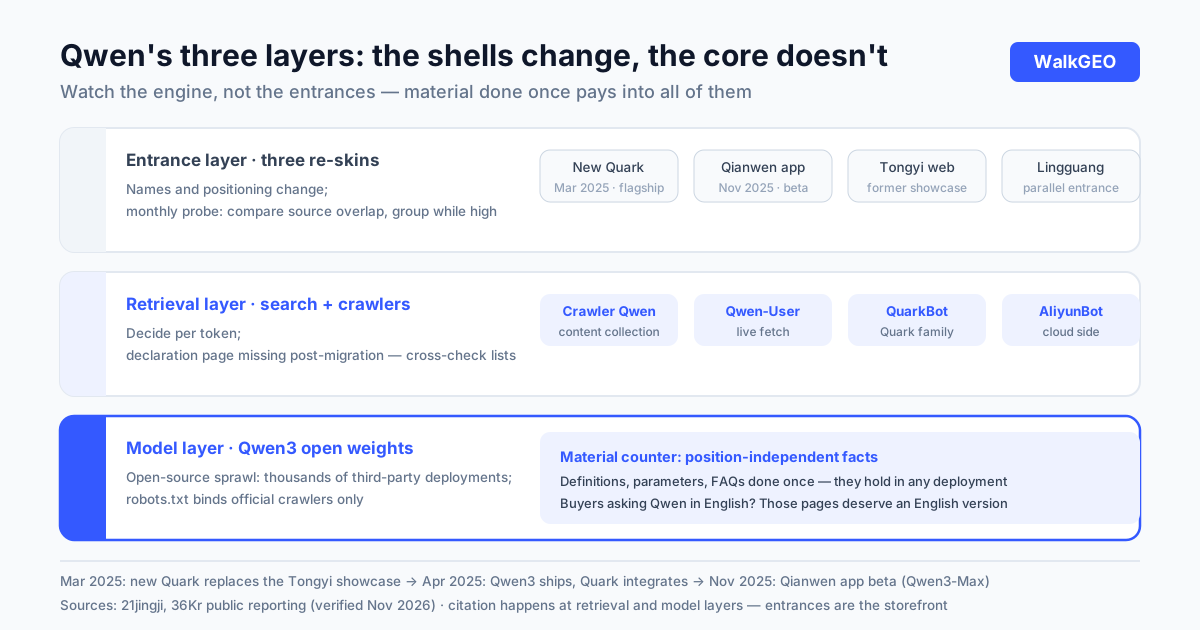
Three entrances in one year, one engine underneath
The timeline says more than any methodology could:
March 2025: Alibaba launches the "new Quark" as its flagship AI application — the "AI super box" — and Quark takes over the showcase role the Tongyi app had been playing for the Qwen model family (21jingji's report at the time was titled, roughly, "Quark wins the succession"). April 2025: Qwen3 ships, and Quark integrates it across the product. November 2025: Alibaba opens the "Qianwen app" beta, aimed squarely at ChatGPT, running Qwen3-Max — upgraded from the Tongyi app and Quark's AI chat assistant, leaving Quark, Qianwen, and Lingguang running in parallel (36Kr tracks the multi-entrance line in full).
Read the three changes together: every one of them is an entrance re-skin — name, app, positioning. The core never moved: the Qwen model family and its retrieval base. For your material, that means one comfortable thing — a definition sentence, parameters, and FAQs done once get cited by Quark and by the Qianwen app alike. Chasing each entrance with its own material rewrite is paying for the re-skins.
The monthly entrance check follows directly: one frozen prompt set, asked once in Quark, once in the Qianwen app, once in the Tongyi web app if you have access. You're not comparing "who mentions me" — you're comparing how much the three source lists overlap. High overlap: the shells share one retrieval, keep one set of material healthy. Overlap widening: entrances are diverging, and the most-diverged one earns separate placement. Once a month for this; the weekly engine re-test stays the main line.
What Qwen reads: the crawlers and the open-source sprawl
At the gate layer, the checkable objects are Alibaba's crawlers. Community lists (ai.robots.txt among them) record four Alibaba tokens: the primary crawler Qwen (collecting public web content for Tongyi Qianwen), the user-triggered fetcher Qwen-User (fetches a page in real time when a user asks — the ChatGPT-User analogue), AliyunBot for cloud-side services, and QuarkBot for the Quark family. Evidence boundary, plainly: the primary crawler's official declaration page (originally tongyi.aliyun.com/bot) has been unreachable since the domain moved to Qianwen; as of November 2026, the tokens rest on cross-checked community lists, and the official page wins word-for-word the day it returns.
Then there's the layer robots.txt can't touch: open-source sprawl. Qwen3 is open-weights, deployed by thousands of third parties — and your public material reaches those contexts too, while robots.txt only binds the official, named crawlers. That's not bad news; it's a judgment call made for you: since you can't gate every deployment, making the public material as citable as possible is the only option that pays.
Write the rules per token: the main crawler and Qwen-User decide whether Tongyi Qianwen can read and fetch your pages live, QuarkBot governs the Quark family, AliyunBot covers Alibaba Cloud services — decide Allow or Disallow for each by your own tradeoffs, never one wildcard rule for all four. Then verify: search your access logs for these tokens and check the crawl frequency and paths. An empty log means one of three things — a mistyped UA, a rule that didn't take, or a site too light to be crawled regularly yet. The first two you fix the same day; the third you grow out of with indexing work.
The four steps
| Step | Action | Done means |
|---|---|---|
| 1 Gates per token | Decide the main crawler and QuarkBot separately; verify UA names verbatim | curl returns 200 on core pages; robots matches WAF behavior |
| 2 Pin the entity | One definition sentence derives every bio; CN/EN names bound | "What is X" retells your sentence; no same-name confusion |
| 3 Four material classes | Definitions, comparison tables, how-tos, FAQs — one page each | Any prompt in your set has a liftable page |
| 4 Separate re-tests | Weekly on a frozen set, sheet kept apart from DeepSeek and Doubao | Four-week window; mention and citation rates move week-over-week |
Step 2's verification deserves both rounds. Round one: ask the category — "what is X" — and the retelling must match your sentence. Round two: ask the relationships — "is X the same company as Y," "which site is X's official one" — this is where same-name and near-name entities surface. Chinese-language contexts run dense with similar names, so keep at least two of the three anchors (industry, region, served customer) in the definition sentence. Round two failing usually means some out-of-site bio drifted from the definition sentence — that's where to look first.
Step 4's sheet takes a fifth column: this week's changes. robots edits, a new comparison page, an updated profile — all go into the week they happened. Answering "which change worked" four weeks later relies on that column, not memory. The monthly entrance-overlap probes go into the same sheet's notes row; two sheets can't explain each other.
The material standard matches our sister pieces with one Qwen-specific addition: the audience spans the Tongyi web app, Quark, the Qianwen app, and countless third-party deployments, so write sentences that hold in every context — facts that don't depend on one app's shape. And for trade audiences: Qwen's open deployments overseas are substantial, so if buyers might ask about you in English, the matching pages deserve an English version. Material language follows buyer questions.
Harder than DeepSeek or Doubao — but only in the variables
Set the three engine pieces side by side: DeepSeek's retrieval sits close to traditional search, the fewest variables; Doubao's variables live in ByteDance's content ecosystem, added by placement; Tongyi's line stacks two layers nobody else has — entrance churn (three shells in a year) and open-source context sprawl (your material lives in the official apps and a thousand third-party deployments at once).
Two practical consequences. First, confidence in re-test conclusions takes longer to earn: entrances are moving, so a single week's swing may be entrance noise — four weeks is the floor, and big decisions deserve eight. Second, write material that's position-independent — no dependence on one app's specific form; fact sentences hold in any deployment. The method is still four steps; the difficulty lives in managing the variables outside the method.
Three traps, all related to the re-skins
Rewriting material for every entrance. The Qianwen app launches a beta, so you draft app-specific copy; Quark redesigns, so you rewrite again. The material layer shatters into versions. Entrances are the re-test's job to sense; the material layer answers to the definition sentence only.
Ignoring the third-party deployment contexts. Judging only from the official apps misses how your material is used across open-source deployments. Treat the official entrances as a representative sample — a sample, not the population; when citations behave oddly, audit the material itself before suspecting an entrance.
Writing rules from single-source UA names. Alibaba's token lists churn on the community side and the official declaration page is missing — copying one source blocks the wrong bot. Cross-check two independent sources, and add one more layer: declaration pages move too. This migration took the verification link down with the domain. Put "re-verify UA names and declaration links" into a quarterly routine, or your rules silently expire.
How we group Alibaba's entrances
In WalkGEO's engine list, Tongyi Qianwen holds a fixed seat as an engine — whatever the entrances do, it represents the Qwen retrieval family. We never opened a separate line item for Quark or the Qianwen app; the practice is a monthly probe of each entrance with the same prompts, logging source overlap. High overlap keeps the grouping; widening overlap means entrances are diverging and separate placement becomes worth discussing. The logic matches the Yuanbao/WorkBuddy grouping — the entrance-versus-engine piece unpacks it fully.
On the sheet it lands as one extra note in the source column: was this answer probed in Quark or the Qianwen app? While overlap is high the column looks redundant; the day the entrances split, it's the only data that proves the sheet should split too. The effort grouping saves goes straight back into the material layer — definition precision, parameter completeness, FAQ coverage — which counts in every shell.
One takeaway for your own list: whether to open a separate Alibaba entrance depends on which shell your customers actually use — Quark's share in trade scenarios, the Qianwen app's growth among new consumers. The engine gets built once; entrances get watched monthly. Keep the two motions separate.
FAQ
Will Qwen cite recently published content?
Yes, if the material qualifies. The Qwen family picks sources by the same standard as most generative engines: specific, consistent, verifiable. New content with a clear definition, concrete parameters, and a real scope can enter answers — indexing lags, so re-test weekly rather than expecting next-day results.
Alibaba has so many entrances — which one do I watch?
Watch the engine, not the entrances. Quark, the Qianwen app, and the Tongyi web app share the Qwen model family and its retrieval base; entrance re-skins don't change the material work — definitions, parameters, and FAQs done once pay into all of them. Entrances get one job: ask the same frozen prompts monthly, log source overlap, and group them while overlap stays high.
If I allow the Qwen crawler, will my content train its models?
Third-party directories record the main crawler as collecting public web content for large models — the tradeoff matches other engines: decide training and retrieval separately, per UA token. Mind the open-source line: Qwen3 is deployed by countless third parties, and your public material reaches those contexts regardless of your robots.txt. That's inherent to open weights, not something an allow rule controls.
Where do I verify Qwen's crawler user-agent names?
Community lists (ai.robots.txt and others) record Alibaba's main tokens: the primary crawler Qwen, the user-triggered fetcher Qwen-User, AliyunBot for cloud services, and QuarkBot for Quark. The official declaration page is unreachable after the domain migration — cross-check two independent sources before writing rules, and defer to the official page word-for-word when it returns. A mistyped UA equals no rule.
How do I test whether Qwen cites me?
Frozen prompt set, same weekly time, search on, verbatim questions — log mentioned yes/no, role, source, facts right or wrong, plus a fifth column for this week's changes. Keep Qwen's sheet separate from DeepSeek's and Doubao's; four weeks per window, read week-over-week. Entrances (Quark, Qianwen app) get a monthly source-overlap probe for grouping decisions.
Qwen's line is unusual only in the churn of its entrances; the material work matches any engine: gates per token, one definition sentence, four material classes, re-tests on their own sheet. Entrances can wait — material can't, because the open-source deployments read your content whether or not you watch the shells. WalkGEO includes Tongyi Qianwen in its six-engine monitoring range, verifiable on the product and pricing page; the entrance logic is in the Yuanbao/WorkBuddy piece, and the four-step skeleton's generic form is in the DeepSeek companion.
Done reading? Run the same audit on your own site
Sign up, then let the agent scan every page and hand you a prioritized fix list. Your first audit is free.
Run a free site audit