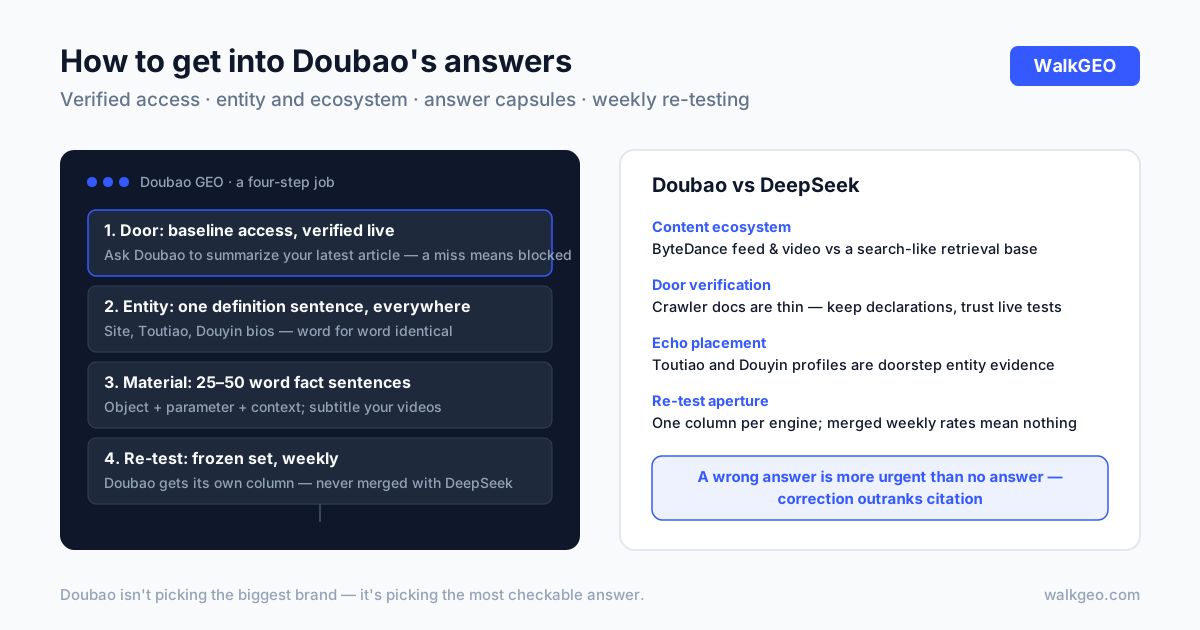
How to get into Doubao's answers
Doubao — ByteDance's AI assistant — can recommend your brand: open the door and verify it live, align your entity across the ByteDance ecosystem, write answer capsules, re-test weekly.
After this guide, Doubao can name your brand and point to a checkable source when answering the questions your customers ask it. Prerequisites: edit access to your website, and a one-sentence definition of your product. The method is four steps — open the door and verify it live, establish the entity, write material the model can lift, re-test weekly. It shares a skeleton with our DeepSeek guide, but Doubao's door and ecosystem are different, so steps 1 and 2 change hands-on.
What you need
| Item | Notes |
|---|---|
| Site edit access | Page content, robots.txt, CDN rules |
| Your out-of-site properties | Existing accounts on Toutiao, Douyin, Zhihu, WeChat — with logins |
| A tracking sheet | Question, mentioned yes/no, role in the answer, who got cited |
| Twenty real questions, minimum | Copied from actual sales and support conversations, not invented |
| Doubao with search enabled | Always on when testing; search-off measures training data, a different experiment |
Doubao GEO is the engineering work of making your brand material retrievable, verifiable, and quotable for Doubao: door open, entity consistent, material liftable, re-testing weekly. Hold onto that definition, because the easiest way to go wrong is conflating it with media buying on Douyin. Paid placement changes exposure; GEO changes whether the answer names you and how. Both may be worth doing — they have different metrics, budgets, and owners, so never merge them into one bucket.
Where Doubao sits in ByteDance's ecosystem
Doubao is ByteDance's AI assistant. Next to DeepSeek, both support web retrieval with visible sources, but the bases differ — and that changes the feel of every step:
| Dimension | Doubao | DeepSeek |
|---|---|---|
| Owner | ByteDance | DeepSeek (depth-first startup) |
| Content ecosystem | ByteDance properties (Toutiao, Douyin, feed & video) | Retrieval base closer to traditional search |
| Door audit | Crawler documentation is thin; verify by live test | Check robots.txt user-agent by user-agent |
| Echo placement | Toutiao and Douyin profiles are entity evidence | Zhihu, WeChat, and other classic echo platforms |
| Re-testing | Separate column, never merged with DeepSeek | One aperture per engine |
Two caveats up front. First, ByteDance's crawler (identified as Bytespider in widespread third-party reporting) has no official documentation page, and third parties have reported aggressive crawling that does not always honor robots.txt — so for this path, write your robots.txt declarations, but don't treat them as verification; step 1 gives you a live test instead. Second, the ecosystem cuts both ways: ByteDance properties enter Doubao's retrieval field more easily, which means the claims on those properties must match your site exactly — consistency reinforces, conflict cancels.
Step 1: Open the door — then verify it live
What: do the baseline access work, then use Doubao's own answers as the test. Why: public crawler documentation for this path is thin; the declaration layer can't tell you the truth, and a live test is cheaper than an audit. Done when: Doubao can accurately summarize one of your recent articles.
Three moves:
1. Run the standard crawl health check
Wildcard allow on content pages, explicit disallow on private routes, site: checks on core pages — this floor benefits every engine, Doubao included. The audit steps are in is your site blocking AI crawlers?
2. Re-check the CDN layer
Cloud WAFs and CDN bot-management tiers may challenge requests without browser fingerprints. Even where crawler rules are unclear, a WAF block ends the conversation — and this layer fails silently, so verify it item by item.
3. Live test: make Doubao read your page
With search enabled, ask: "What does the article 'Title' on yourdomain.com say?" A correct summary with a source link to your domain means the door is open; a miss or a scraped-copy source means fix indexing first. Run your five most important pages and log the results.
The live test converts invisible crawling questions into visible answer differences — read or not read, no guessing. Re-run it monthly; door states drift with CDN rules and engine updates.
Step 2: Make Doubao know who you are
What: turn your brand into an entity that survives cross-source checking, with same-source evidence inside ByteDance's ecosystem. Why: before answering "what is X," the model settles what X points at — and in Doubao's case, ecosystem profiles are high-frequency verification inputs. Done when: one official definition sentence holds identical on your site and across properties.
Three moves:
1. Fix one definition sentence
Object, action, context. Ours: "WalkGEO monitors how brands are mentioned and cited across engines like Doubao, DeepSeek, Qwen, Yuanbao, ChatGPT, and Perplexity." Homepage, about page, every profile — same position, word for word.
2. Place it inside ByteDance properties
Toutiao account bios, Douyin business profiles, video end-cards: definition sentence plus site address. For Doubao these are evidence on the doorstep — consistent claims reinforce each other; conflicting ones get dropped together.
3. Align the rest of the echo
Zhihu, WeChat, and directory descriptions all derive from the same sentence. Doubao doesn't verify only inside ByteDance's garden; site-wide consistency is what carries conviction.
One-minute self-test: ask Doubao your brand name, search on, and read how it introduces you. Accurate — the entity holds. Wrong or evasive — correct before you chase citations, because a wrong answer is more urgent than no answer. The full gate-by-gate diagnosis lives in why AI doesn't mention your brand.
Step 3: Write sentences Doubao can lift whole
What: rewrite core pages to the answer-capsule standard, then adapt for feed and video properties. Why: the unit of citation is the sentence — models adopt statements that stand alone — and ecosystem properties add a format gate of their own. Done when: every core page carries at least one complete 25–50 word factual sentence.
A qualified capsule has three parts: object, concrete parameter or scope, context.
- Wrong: "We have years of experience providing one-stop solutions." — zero information in any answer.
- Right: "Founded in 2019, serving 200 B2B customers, focused on manufacturing after-sales workflows." — answers "how big is this company" on its own.
Rewrite in this order: definition paragraphs of the homepage and product pages first, then one deep article written against a real customer question — definition, parameters, comparison table, FAQ in one place. Then adapt for the ecosystem: Toutiao articles carry the same structure with a lighter tone, and Douyin videos put parameter sentences on screen as subtitles — a video without subtitles usually keeps its facts out of the retrieval field. Mark FAQ sections with FAQPage structured data, matching the page word for word. The full citability standard is in step 3 of how to get your site cited by DeepSeek; it carries over.
Step 4: Freeze the question set, re-test weekly
What: lock twenty real questions, ask them to Doubao at the same time every week, record four columns. Why: an unfrozen aperture measures nothing, and Doubao's answer pipeline is separate from DeepSeek's — separate records are the only way the weekly comparison means anything. Done when: four consecutive weeks, same questions, per-engine columns.
One row looks like: "how do small teams track follow-ups | Doubao: not mentioned | — | sources: two third-party listicles | competitor description inaccurate; we lack a matching comparison page." Don't touch the wording for four weeks — rephrasing until you get mentioned is self-deception, not optimization. The same frozen set can run against Yuanbao and Qwen in parallel columns; just never merge engines into one rate. The full protocol is in how to measure brand AI visibility.
Common traps
| Symptom | Cause | Fix |
|---|---|---|
| Doubao knows your category, not your brand | Category words plentiful, entity sentence missing | Back to step 2 — place the definition everywhere |
| Douyin views but no Doubao mentions | No subtitles; parameter sentences never entered retrieval | Key sentences on screen; facts in the bio |
| Tested once, rephrased, tested again | Aperture drift | Freeze the set for four weeks; record, don't adjust |
| Every platform has its own bio | Many hands, no wording owner | Store the definition once; all properties reference it |
| Doubao's competitor description is wrong | A coverage gap, not a technical fault | Back to step 3 — study what the cited pages look like |
Case: how we monitor Doubao
The four steps are the order we actually executed on our own site and now run continuously through our own product — not a flowchart derived from documentation. Three verifiable pieces:
- The question set came before the tooling. We accumulated questions from real customer conversations first, then decided what to monitor — every Issue tracks one prompt, Priority decides what gets fixed this week, and an Issue carries its context straight into optimization or a new draft. The flow is the one in our help center's Issues guide.
- The door state is logged. Our robots.txt has no dedicated ByteDance crawler entry: the wildcard group allows content pages, private routes are explicitly denied. While writing this article we ran the step-1 live test across our core pages and logged the results in the monitoring sheet — declarations kept, verification by live test, exactly as this article prescribes.
- Entity binding enforced site-wide. Our Chinese name and WalkGEO are bound as one entity in structured data; bios across ByteDance properties and every other platform descend from the same definition sentence, and every Chinese page uses one form of the name.
- Optimization with a checkable precedent. Our optimization pipeline took an existing page from a composite GEO score of 63.5 to 85 — the process is recorded in our help center's content optimization guide.
An honest boundary: we won't quote "Doubao mention rate grew by X%" — our weekly series hasn't accumulated enough comparable observations to publish, and printing a number anyway would be fabrication. When the data isn't ready, leave the number out. That is part of this article's method too.
FAQ
Will Doubao cite a brand-new website?
Yes, if the material qualifies. Doubao picks sources by the same standard as other generative engines: specific, consistent, verifiable. A new site with a clear definition, concrete parameters, and aligned profiles across the content ecosystem can enter answers — but indexing lags, so re-test weekly instead of expecting next-day results.
Do Toutiao or Douyin accounts help with Doubao citations?
They help positionally, with no guarantee. Doubao sits inside ByteDance's content ecosystem, so feed and video properties are likelier to enter its retrieval field. Carrying the same definition sentence into your Toutiao and Douyin profiles adds same-source evidence for entity verification. It is placement logic, not a submission channel — there is no way to "submit your site" to Doubao.
Is Doubao the same playbook as DeepSeek?
The four-step skeleton is the same; the door and the ecosystem differ. Doubao lives in ByteDance's content ecosystem with feed and video platforms as echo points, while DeepSeek's retrieval base sits closer to traditional search. Ask both engines the same frozen set — just record them in separate columns.
How do I test whether Doubao mentions me?
Freeze twenty real questions, ask them to Doubao with search enabled at the same time every week, and record four columns: mentioned yes/no, role in the answer, who got cited, facts right or wrong. Use four weeks as one observation window and read week-over-week rates — never single-session impressions.
What if Doubao gets my brand facts wrong?
Audit your own material first: is the definition sentence unique, are out-of-site profiles descended from it, has a legacy name drifted? Correction outranks citation — a wrong answer is more urgent than no answer. The gate-by-gate diagnosis is in our companion piece on why AI doesn't mention your brand.
Getting into Doubao's answers is engineering, not luck: door verified live, entity standing, material liftable, re-testing honest. The skeleton is shared with DeepSeek, but the ecosystem and the verification method are not — that's exactly why per-engine playbooks exist. Doubao isn't picking the biggest brand; it's picking the source that completes its answer most checkably, which is good news for small teams that write real material. WalkGEO runs probing, attribution, optimization, and re-testing across Doubao, DeepSeek, Qwen, and Yuanbao as one weekly loop — see pricing, or start with the five-minute setup in our help center.
Done reading? Run the same audit on your own site
Sign up, then let the agent scan every page and hand you a prioritized fix list. Your first audit is free.
Run a free site audit