E-E-A-T for AI Search: Four Things Generative Engines Look For
When AI skips your site, the problem is rarely content; the trust signals are not machine-checkable. E-E-A-T in GEO form: a checkable action per dimension, plus our author-page rebuild story.
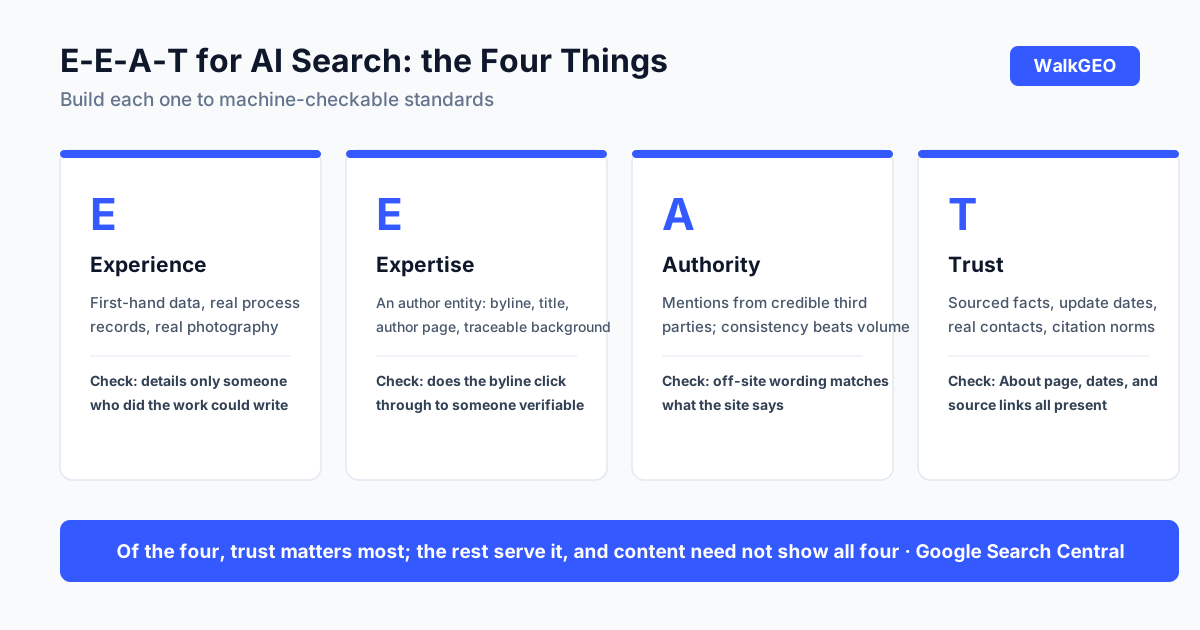
E-E-A-T stands for experience, expertise, authoritativeness, and trustworthiness, and Google's documentation describes it as the mix of factors its systems use to identify content worth trusting, with trust singled out as the most important of the four. GEO changes the shape of the problem: when a generative engine picks sources to cite, it is picking for exactly these machine-checkable trust signals. When AI doesn't cite your site, the content is rarely the problem; the signals are not sitting where a machine can verify them. This piece walks the four dimensions into concrete actions, then shows the full record of our own author-page rebuild.
All four, on one table
| Dimension | Meaning in search | Machine-checkable form in GEO | What you can verify |
|---|---|---|---|
| Experience | First-hand use and lived practice | Original data, process records, real photography | Does the page hold details only someone who did the work could write |
| Expertise | Author credentials | An author entity: byline, title, author page, traceable background | Is there a byline, and does clicking through check out |
| Authoritativeness | External recognition | Mentions and citations from credible third parties | Off-site traces consistent with what your site says |
| Trustworthiness | Accuracy, safety, honesty | Sourced facts, update dates, real contact points, citation norms | Are the About page, dates, and source links all in place |
One sentence from Google's page on helpful, reliable, people-first content is worth memorizing: of the four aspects, trust is the most important, the others contribute to trust, and content doesn't necessarily have to demonstrate all of them. That is a burden-lifting judgment; you don't need to spread effort evenly across four dimensions. But GEO redefines "doing it well" as something both readers and machines can verify, so every dimension you do invest in has to be built to machine-checkable standards.
Experience: first-hand material has no substitute
The internet has a surplus of paraphrase, and a generative engine needs no more of it; paraphrasing is what the engine itself does. What stays scarce is first-hand material, because first-hand material carries its own verification path: original data comes with a method, a real process comes with a timeline, real photographs come with originals. These fragments also carry an engineering advantage: competitors cannot copy them, which makes them natural candidates the moment an engine chooses what to quote. The writing-level mechanics are covered item by item in our citability checklist.
Our engine-guide articles offer a working sample: crawler behavior is stated only from official documentation with the checking date noted, and where official words are missing we write plainly that no public statement was found. That habit of dating your verification is itself an experience signal; readers can see how fresh the material is, and what the machine extracts is a fact carrying its own timestamp.
The author entity: making "who wrote this" verifiable
Anonymous content could survive the search era, but it pays a tax in the AI era. A generative engine needs a bindable entity to carry trust, and an article that cannot answer "who wrote this" leaves every fact in it suspended mid-air. An author entity is not a business card; it is a set of verifiable anchors: a real name, a title consistent with the company, an author page listing domain and background, an entry point to the About page. Google states the boundary plainly: fabricating creator profiles with AI-generated headshots, made-up names, or false credentials is a form of deception, and deception makes a page untrustworthy to both users and automated quality systems. The bar for an author entity was never how polished the packaging looks; it is whether it survives being checked.
Authority: the logic of third parties speaking for you
Authority is never self-declared. Saying "industry-leading" a hundred times on your own site is worth less than one credible mention from somewhere else, and GEO magnifies the inequality: when an engine cross-checks a brand, it looks for traces beyond your site, and an empty or astroturfed off-site footprint fails the cross-check. For the Chinese market, the verifiable grounds are platforms such as Zhihu for professional answers, WeChat public accounts for industry writing, trade media coverage, and factual pages like job listings and business registration records. Volume matters less than consistency: off-site wording that matches your site corroborates one entity, while conflicting wording manufactures the impression of two companies. That treatment has its own article on brand entity consistency.
One official reminder is a hard constraint for some industries: for YMYL topics that can significantly affect health, financial stability, or safety, systems give more weight to content with strong E-E-A-T. Teams publishing medical or financial content have no detour around authority; quoting regulators and established consensus at the source is the shortest path available.
Trustworthiness: put the checkable details on the table
Trust is the only one of the four fully inside your control; it depends on no third party, only on whether you are willing to surface the details. Walk the list: an About page that says who the company is; an update date on every piece of content, revised on substantive changes rather than refreshed for show; data cited with source and year; contact information that actually works; key factual claims linked to primary sources anyone can open. Google groups these self-checks under the questions Who, How, and Why: who created the content (bylines and author information), how it was produced (process disclosure, including any AI involvement), and why it was created (for people or for rankings). Each question lands on something a machine can verify, and together they form the shortest possible trust checklist for a page.
Can stacking credentials buy trust?
No, and over-stacking reads as negative. Screenshots of certificates filling a sidebar do not constitute expertise, because certificates attest to the standing of the subject, not the quality of the content. Self-praise adjectives are a separate negative signal: "most authoritative" and "number one everywhere" raise suspicion in human readers, and what a model extracts from them is an empty evaluative phrase that cannot support an answer. The machine-checkable form of trust is verifiability: one number with its source beats three lines of adjectives, one table with a checking date beats a screen of certification badges. If the problem has already happened and AI is stating your information wrongly, that is a different path with its own fix, covered in correcting what AI gets wrong; this piece is about prevention, and the two work as a pair.
How we rebuilt our own author page
We got authorship wrong ourselves first, and the record is worth keeping complete. In early November we moved the blog byline from a team name to the founder's personal name. What actually landed was not a copy change but the construction of an author entity, and the before-and-after tells the story.
The problem before was not the absence of a byline; it was that the byline pointed at a team name with no page behind it. "WalkGEO operations team" was a signature readers could not click into and machines could not bind to an entity, so every fact on the blog hung from a subject nobody could verify. After the rebuild, the structure runs like this. Author data is defined in one place, with three fields only: name, title, bio; the article byline, the structured data, and the author box all read from it, so a change in one place propagates everywhere and nothing drifts apart. The byline reads "Tim Li · Founder, WalkGEO", binding the person to the title and the company; from any article, a reader can verify that the person exists, holds the stated role, and writes within one domain. The structured data moved from an Organization type to a Person type, with the Person carrying worksFor pointing at the organization entity, so the person and the company are one machine-readable fact. And the bio states a verifiable claim instead of a slogan: the deployment and measurement walkthroughs come from first-hand practice on our own site. The sentence contains no adjectives; its claim can be cross-checked against dozens of articles on the site, which is exactly the shape trust is supposed to take.
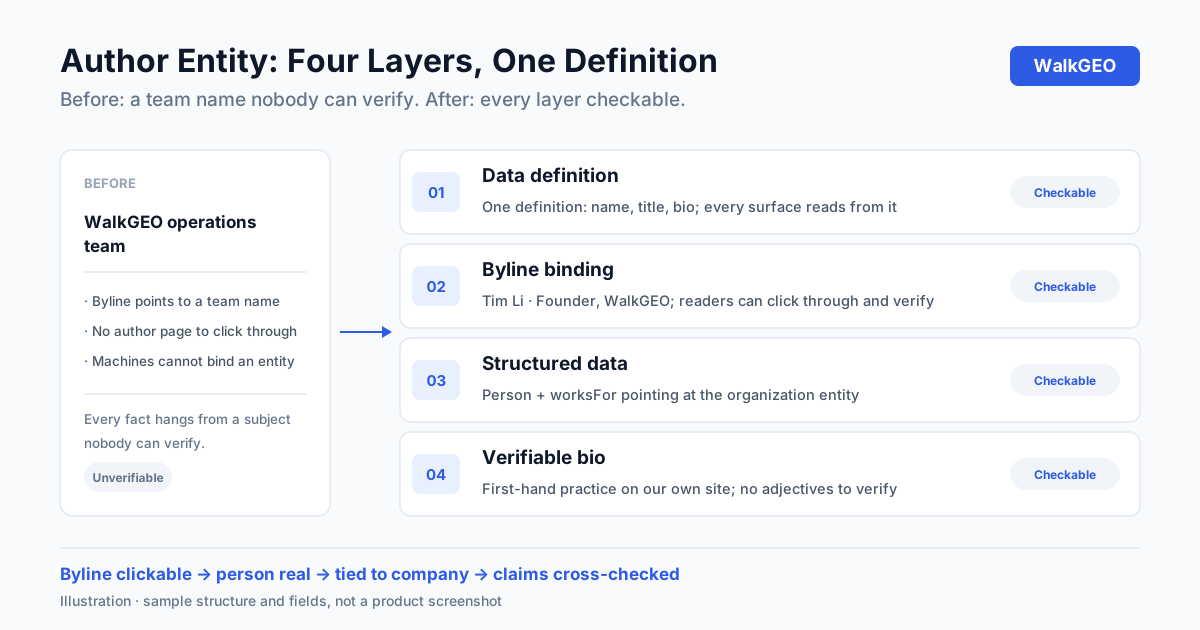
The simplified version is yours to run today: put a real byline on every article; route it to a page that lists at least a title and a domain; write one paragraph of process disclosure in the content itself. The author page may stay rough; the chain behind it must be real.
Common questions
Is E-E-A-T a ranking factor?
Google's own page is blunt: it is not a specific ranking factor, but systems use a mix of factors to identify E-E-A-T in content, and they give more weight to strong-signal content on YMYL topics such as health and financial safety. For GEO work, treat it as a checklist you audit your content against, not a switch you can rush to flip.
Do generative engines have their own E-E-A-T score?
No engine has published one. Any tool claiming to output "your E-E-A-T score" is quantifying the unquantifiable, because no public standard sits behind the number. What you can check are features: verifiable bylines, sourced facts, visible update dates, consistent off-site descriptions. Those features overlap heavily with what E-E-A-T describes; what engines actually weigh when picking sources is covered in our piece on how AI picks sources.
My site has no third-party mentions yet. What about authority?
Build it from zero, and keep the order straight. Authority depends on other people vouching for you and runs on a monthly clock; experience, expertise, and trust are fully in your hands and can start today. Get the byline, the sourcing, and the update dates right first, then grow off-site traces slowly with consistency ahead of volume. When third parties do mention you, they will cite the very facts you put on the table first.
Our company has no personal brand. Who signs the content?
Team authorship is legitimate and workable, provided it is specific: who maintains it, what their background is, what domain they cover, not a vague department name. The one red line Google states outright: author profiles assembled from AI headshots, invented names, or fake credentials are deception and a low-quality signal. Real names and real backgrounds are the floor; the strength of a personal brand is only an efficiency variable.
E-E-A-T has edges, and stating them is more useful than inflating its reach. It cannot fix crawlers being blocked, which is a technical access problem; it cannot fix muddled on-page facts, which belongs to the citability rewrite; it cannot fix entity confusion, which belongs to entity-consistency work. What it owns is the last stretch: once crawlers get in, facts hold up, and the name binds cleanly, it is what tips the machine toward your source rather than another. After the checkable work is done, you need weekly readings to see whether anything moved, and manual sampling runs out of bandwidth there; that hand-off is what pricing and the weekly routine are for. WalkGEO finished the first half ourselves before handing the second half to tooling.
Done reading? Run the same audit on your own site
Sign up, then let the agent scan every page and hand you a prioritized fix list. Your first audit is free.
Run a free site audit