How to get your site cited by DeepSeek
Getting cited by DeepSeek is a four-step engineering job: allow AI crawlers, bind your brand entity, write 25–50 word answer capsules, and re-test weekly on a frozen question set.
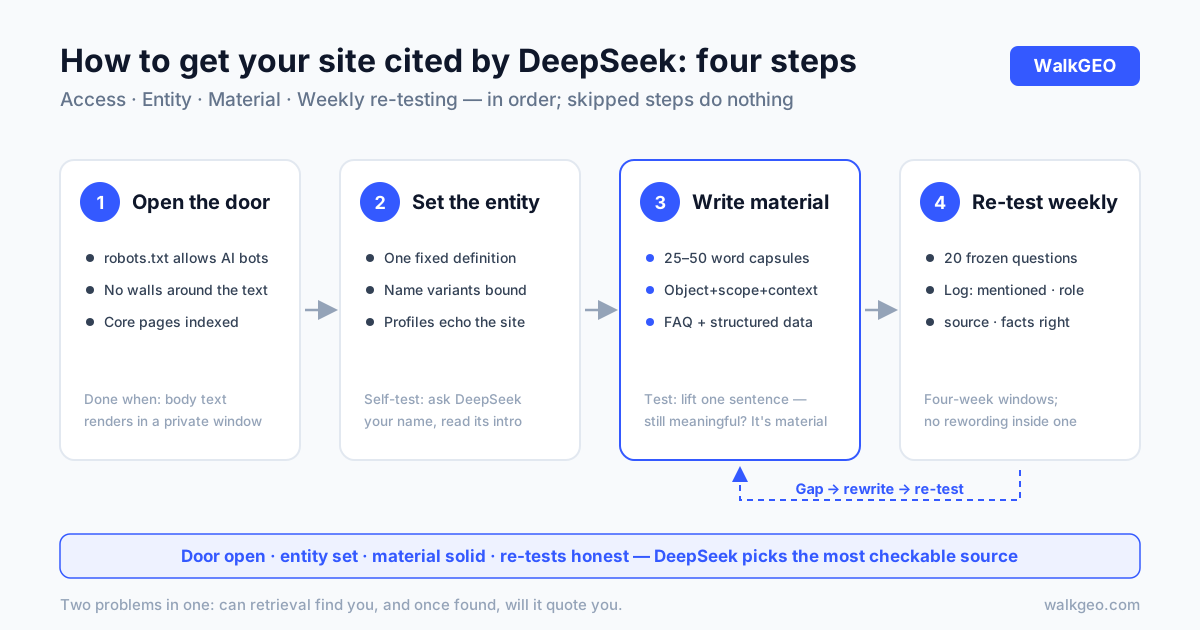
Follow this guide and DeepSeek will name your brand and link your site when answering the questions your customers actually ask. Prerequisites are modest: access to your website and robots.txt, and a product you can define in one sentence. The method is four steps — open the door, establish the entity, write citable material, re-test weekly against a frozen question set. The order matters; skipping steps is how fixes end up doing nothing.
What you need
| Item | Notes |
|---|---|
| Site edit access | Page content, robots.txt, CDN rules — get this from IT or whoever runs the site |
| A tracking sheet | Four columns: question, mentioned yes/no, role in the answer, who got cited |
| Twenty real questions, minimum | Copied from actual sales and support conversations, not invented at a desk |
| DeepSeek with search enabled | Always on when testing — with search off, the model answers from training data only, which is a different experiment |
First, understand where DeepSeek citations come from. Its answers draw on two sources: training data and real-time retrieval. With search enabled, answers carry a source list — those sources are what it retrieved on the spot. "Being cited by DeepSeek" therefore splits into two problems: can real-time retrieval find you (a door-and-material problem), and having found you, does it want to quote you (a specificity-and-consistency problem). The four steps map onto exactly these two.
The split has a practical corollary: new content enters answers through real-time retrieval, while baseline knowledge — who you are, what you do — settles into the slow lane of training data. Publish page fixes and wait for retrieval to catch up, but write your definition early, because it has the longest pipeline.
Step 1: Open the door
What: confirm AI crawlers can get in and read. Why: real-time retrieval runs on crawled pages and search infrastructure; with the door shut, everything downstream is wasted motion. Done when: mainstream AI crawler user agents are unblocked and your core pages render their body text in a private browser window.
Three checks:
- robots.txt, explicitly. Open
yourdomain.com/robots.txtand confirm that user agents like GPTBot, ClaudeBot, PerplexityBot, and Google-Extended are not disallowed. CDNs and firewalls blocking "unknown user agents" by default is a classic silent failure — check for it once, deliberately. - No walls around the text. Open core pages in a private window: the body should be readable without login, without clicks, without waiting on scripts. Most crawlers do not execute heavy JavaScript; unrendered content does not exist.
- Search indexing is healthy. Run
site:yourdomain.comfor your core pages. Anything missing goes back through your search console with a sitemap submission.
Our own robots.txt is written explicitly: AI crawlers are allowed on content pages, application routes stay blocked. Allow and block should be decisions you made, not defaults somebody else shipped.
Step 2: Make DeepSeek know who you are
What: turn your brand into an entity that survives cross-source checking. Why: before answering "what is X," the model has to settle what X points at — if it can't, it skips you. Done when: one official definition sentence exists and holds consistent inside and outside your site.
Three moves:
- Fix one definition sentence. Object, action, context. Ours: "WalkGEO monitors how brands are mentioned and cited across engines like ChatGPT, Perplexity, Google AI Overviews, DeepSeek, and Doubao." Same sentence on the homepage, the about page, and your profiles — word for word.
- Bind your name variants. If customers ask under one name and your materials use another, the thread breaks. Abbreviations, legacy names, and localized names get tied to the same entity in structured data, then used identically everywhere.
- Align the echo. Social profiles, directories, and careers pages should describe the company in words descended from the same definition sentence. When DeepSeek checks who this company is, consistent sources reinforce each other; conflicting ones get dropped together.
Here's a one-minute self-test for this step: ask DeepSeek your brand name, search enabled, and read how it introduces you. Accurate — the entity is holding. Wrong or evasive — your signals conflict or your material is missing, and a wrong answer is more urgent than no answer.
For a China-facing audience this matters doubly: retrieval hits Chinese-language material often, which means more chances to cross-check — and more chances to catch conflicts. English content still matters for overseas reach; the Chinese material just has to be self-consistent first. The full entity audit lives in our companion piece, why AI doesn't mention your brand.
Step 3: Write sentences DeepSeek can lift whole
What: rewrite your key pages to the answer-capsule standard. Why: the unit of citation is not the page, it's the sentence — models adopt statements that stand on their own. Done when: every core page carries at least one complete 25–50 word factual sentence.
A qualified capsule has three parts: object, concrete parameter or scope, context.
- Wrong: "We have years of experience providing one-stop solutions." — zero information in any answer.
- Right: "Founded in 2019, serving 200 B2B customers, focused on manufacturing after-sales workflows." — the model can quote it to answer "how big is this company."
Rewrite in this order: the definition paragraphs of the homepage and product pages first, then one deep article written against a real customer question — 3,200+ Chinese characters or the equivalent, because a definition, parameters, a comparison table, and an FAQ don't fit in anything shorter. Placement matters too: definitions in the first screen, parameters in tables, FAQ at the end. Models weigh structural positions far more than mid-page prose. The full citability standard is in what GEO is. And the working test: lift any sentence out of the paragraph. If a reader with no context learns something, it's material. If not, it's a slogan.
Mark the FAQ with FAQPage structured data: search displays the pairs as rich results while DeepSeek's retrieval reads the same pairs as machine-ready direct answers. One artifact, two channels.
Step 4: Freeze the question set, re-test weekly
What: lock twenty real questions, ask them to DeepSeek at the same time every week, record four columns. Why: unfrozen testing measures nothing — change the wording and the data stops comparing. Done when: four consecutive weeks on the same question set.
Record four fields: mentioned or not (the base rate), in what role (top pick, one option, a counterexample, absent — four positions with completely different value), who got cited (your site, a third-party review, a competitor), whether the facts were right (wrong beats absent in urgency). One row looks like: "how do small teams track follow-ups | not mentioned | — | sources: two third-party listicles | competitor description inaccurate; we lack a matching comparison page." That last cell is next week's to-do.
Do not touch the wording for four weeks. The most common way this discipline dies is rephrasing until the answer improves — that's not optimization, it's self-deception. The full measurement protocol is in how to measure brand AI visibility.
Common traps
| Symptom | Cause | Fix |
|---|---|---|
| Tested, not mentioned, gave up | Search mode was off; the model answered from training data | Confirm search is on before every run; note it in the sheet |
| Checked results the day after a fix | Indexing and answer sampling both lag | Re-test weekly; daily swings are noise |
| Chinese queries return English results | Asking Chinese-context questions in English | Ask in the customer's own words and language |
| Every page has its own definition | Many hands, no owner for the wording | Store the definition once; reference it everywhere |
| Sources cite competitors, never you | A coverage gap, not a technical fault | Back to step 3 — study what the cited competitor pages look like |
How you know it worked
Three numbers, checked weekly, never vibes:
- Mention rate — the share of your frozen questions whose answers name you. Get from zero to present first.
- Citation rate — the share where you're named in the text with a source link to your site. Slower than mentions, worth more.
- Share of voice — your mentions against competitors' across the same set. That's the relative answer.
All three only mean something with the aperture frozen: same questions, same engine, same cadence. Treat four weeks as one observation window. Engineering fixes (steps 1–2) take effect on the next crawl; material fixes (step 3) wait for the model to re-retrieve and re-verify.
Case: making walkgeo.com checkable
The four steps aren't theory we derived — they're the order we actually worked through on our own site. Four verifiable pieces:
- Chinese content written native. Every Chinese article on our blog is written as an original, not translated from English — 3,200+ characters with definition, parameters, comparison, and FAQ. Translated-feeling material loses on checkability before substance even enters the picture.
- Entity binding enforced site-wide. Our Chinese name and WalkGEO are bound as one entity in structured data; every page uses the same form, and out-of-site profiles trace back to the same definition.
- The door, managed explicitly. robots.txt lists four AI crawlers by name with allow rules; llms.txt registers every key page as a site manual. New articles must be added to it manually — that step is on the release checklist, because the manual doesn't update itself.
- We drink our own coffee. The frozen question set in step 4 runs through our own product: every Issue tracks one prompt, Priority decides what gets fixed this week, and an Issue carries its context straight into optimization or a new draft. The flow is the one documented in our help center's Issues guide.
One checkable precedent: our optimization pipeline took an existing page from a composite GEO score of 63.5 to 85 — the process is recorded in our help center's content optimization guide. What we won't do in this article is quote "DeepSeek citations grew by X%" — our weekly series hasn't accumulated enough comparable weeks to publish, and printing a number anyway would be fabrication. That's part of this article's method too: when the data isn't ready, leave the number out.
FAQ
Will DeepSeek cite a brand-new website?
Yes, if the material qualifies. Generative engines don't select by domain authority alone — they want specific, consistent, verifiable. A new site with a clear definition, concrete parameters, and a real scope can enter answers. Mind the indexing lag, though: re-test weekly rather than expecting next-day results.
Do I need to submit my site to DeepSeek somewhere?
No special channel exists. Get the search foundation right — sitemap submitted, core pages indexed, AI crawlers allowed in robots.txt — and the real-time retrieval path finds you on its own. A periodic site: check on your core pages is enough to stay sure.
Is Chinese content enough, or do we need English too?
If your customers ask in Chinese, Chinese material is the main battlefield — get it solid first. English serves overseas expansion, which is a different campaign. When you run both, bind the names: your Chinese and English identities must point at one entity, or the two sides undermine each other's cross-checking.
Is Doubao the same playbook?
The four steps generalize; the re-testing differs by engine. Doubao's content ecosystem leans toward feeds and short video, so the echo platforms differ, while DeepSeek's retrieval base sits closer to traditional search. You can ask both engines the same frozen set — just record them separately.
How long until the citation shows up?
Engineering fixes (crawl access, indexing) take effect on the next crawl — weeks at most. Material fixes wait for the model to re-retrieve and re-verify; use four weeks as the observation window. The verdict is not "it feels better" but the week-over-week movement of mention and citation rates on a frozen question set.
DeepSeek citations are not a lottery. Door open, entity standing, material solid, re-testing honest — after that it's the patience of a weekly close. The engine isn't picking the biggest brand; it's picking the source that completes its answer most checkably. For teams that write real material, that's good news. WalkGEO runs probing, attribution, optimization, and re-testing as one weekly loop — see pricing, or start with the five-minute setup in our help center.
Done reading? Run the same audit on your own site
Sign up, then let the agent scan every page and hand you a prioritized fix list. Your first audit is free.
Run a free site audit