How to get cited by Perplexity
Two crawlers, opposite rules: PerplexityBot honors robots.txt into the index; Perplexity-User fetches live and ignores it. Four steps, completion standards, and our second-batch intake.
How do you get Perplexity to cite your site? Clear one thing up first: you're not facing one crawler — you're facing two, with opposite rules. PerplexityBot builds the index and honors robots.txt; Perplexity-User fetches pages live on behalf of a user and, per Perplexity's own documentation, generally doesn't follow robots.txt. The allow/block strategy must be made separately for each — that's what separates Perplexity from every other engine. Four steps below, each with a completion standard, plus how we slotted Perplexity into our overseas second batch.
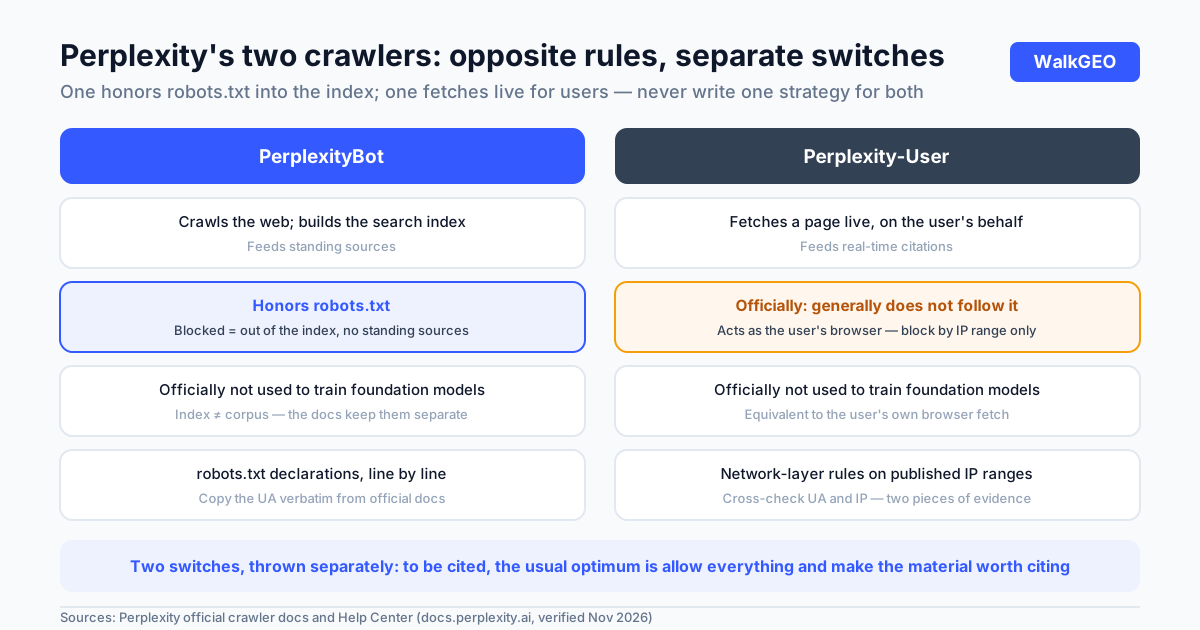
First, tell the two Perplexities apart
| PerplexityBot | Perplexity-User | |
|---|---|---|
| What it does | Crawls the web; builds and maintains Perplexity's search index | Fetches a specific page in real time, on behalf of the user asking |
| robots.txt | Honors it — blocked means out of the index | Officially does not follow it — it acts as the user's own browser |
| Used for training | Officially no — not used to train foundation models | Officially no — not used to train foundation models |
| How to control | robots.txt declarations | Network-layer rules on the officially published IP ranges |
| Citation shape it feeds | Standing sources — your page hangs in answers steadily | Real-time citations — fetched and cited on the spot |
One sentence carries this table: your visibility on Perplexity is controlled by two switches, not one. Allow only PerplexityBot and you're indexed with standing citations, but the long-tail pages a user asks about can't be fetched live. Block only Perplexity-User's IPs and live citations die while the index stays. Two switches, two strategies — never write them as one rule.
Four postures result from combining the switches, each with a use case. Full allow (index plus live fetches) is the optimum for nearly every content site and export business. Full block (robots against the Bot, IPs against the User) suits sites whose content should never surface in AI answers — at the cost of being sealed off from the channel. Block-the-Bot-only is rare: you've left the index but live fetches continue, collecting scattered one-off visits. Block-the-User-only is rarer still — typically servers sensitive to real-time fetch traffic that still want to stay indexed. Decide which posture you want before touching robots.txt or the firewall, in that order.
What you can block, and what you can't
PerplexityBot is a standard web crawler: it declares a UA, honors robots.txt, comes and goes by public rules — blocking it works exactly like blocking GPTBot. The part worth underlining is the official statement of purpose: PerplexityBot is not used to train foundation models; it crawls to build the search index. So the "feeding the training corpus" worry is at its lightest on this line — indexing is not corpus, and the official docs keep the two separate.
Perplexity-User is the other animal: it moves only when a user's question needs a specific page, officially positioned as "fetching on the user's behalf," which is why it declares independence from robots.txt — same logic as ChatGPT-User. You can't block it with robots.txt; the network layer with the published IP ranges is the only lever. Whether to pull it is a business call: blocked, Perplexity can't fetch your page when a user asks, and real-time citations go to zero; unblocked, it behaves like the user's own browser. For sites that want to be cited, the answer is usually obvious.
The IP-range check has a concrete form: the official docs publish UA strings and IP ranges as JSON for both crawlers. Firewall rules use the IP ranges; behavior verification uses the UA in your access logs — two pieces of evidence crossing before you can claim to know your visitor. UA without IP gets spoofed; IP without UA sweeps real users into the rule. Crossing both is the minimum complete check, and it belongs in a quarterly routine, staggered from your annual robots review.
The four steps
| Step | Action | Done means |
|---|---|---|
| 1 Dual-channel gates | Allow PerplexityBot in robots.txt; confirm IP rules don't strangle Perplexity-User | curl with the bot's UA returns 200; core pages verifiably in the index |
| 2 Pin the entity | One definition sentence derives site and off-site bios; CN/EN names bound | English "What is X" retells your sentence; no same-name confusion |
| 3 English material | Definition pages, parameter tables, how-tos, FAQs — English first | Any prompt in your English set has a liftable page |
| 4 Separate re-tests | Weekly on a frozen English set, sheet kept apart from ChatGPT's | Four-week window; mention and citation rates move week-over-week |
Step 1's verification entry point is the official crawler documentation — UA strings, purposes, and IP ranges all live there; copy the official text into your rules, never a third-party paraphrase. After allowing, verify in the logs: PerplexityBot's crawl cadence and Perplexity-User's on-demand fetches are both visible. Invisible means back to the rules.
Step 2 has an English-specific trap: abbreviations, Ltd/Inc suffixes, and regional variants (same-name companies registered in different countries) all dilute the entity. Pin industry and geography into the English definition sentence, and point the Organization structured data's sameAs at every official property — site, socials, LinkedIn — leaving extra same-source anchors for engine verification. Verify in two rounds: English "What is X" against the definition, then "Is X the same as Y" for the same-name cut. Both pass, the entity is pinned.
Step 4's re-tests run on an English prompt set — the buyer-verbatim form — at the same weekly time, logging mentioned yes/no, role, source, facts right or wrong, plus this week's changes. Keep the sheet apart from ChatGPT's: the source structures differ, and because nearly every Perplexity answer carries a source list, citation rate here is measured differently than anywhere else.
That measurement has one more split worth making: count standing citations and real-time citations separately. Pages recurring across weeks in source lists are index-channel output; a page appearing one week out of nowhere was most likely fetched live by Perplexity-User. The two mean different things — standing citations say the indexed material qualifies; real-time citations say the page survives being fetched on the spot. When one stalls, the layer to check differs: standing stalls point at index and material; real-time stalls point at the fetch channel and page readability. Merged into one average, attribution blurs.
English material is the main battlefield
Perplexity's base is the English-speaking world, and the language structure of your material sets the retrieval rate. The principle holds: material language follows buyer questions. For international and export businesses, the English version is not a translation task — it's a rebuild. English buyers ask different shapes of questions (comparisons, parameters, compliance, logistics), so the English material is written against an English prompt set, not machine-translated from the Chinese pages. The first step for a Chinese-language site going overseas is in the ChatGPT citation piece — the language judgment applies as-is.
Where does an English prompt set come from? Three sources, in priority order: original sentences from overseas customers' sales emails, verbatim questions from English-language support tickets, and the English form of your Chinese prompt set — where the third one means re-expressing Chinese buyers' concerns as English buyers would ask them, not machine translation. Thirty items aren't needed on day one; ten real sentences beat a hundred imagined ones, and the set grows with re-testing.
The reverse reminder holds too: domestic-only businesses shouldn't rush here. Perplexity isn't your priority battlefield — get the four domestic engines' material solid first, and add English when buyers' language actually demands it. Priority on both sides is decided by customer questions, not by a tool's fame.
How to verify it worked
Three layers, in order. Gate layer: curl with PerplexityBot's UA returns 200 on core pages, and both channels show up in the access logs. Index layer: ask Perplexity your brand or category directly — its recall of indexed content surfaces fast. Citation layer: across a four-week window on the frozen English set, your pages appear in the Sources lists and mention rates move week-over-week. Perplexity attaches a source list to nearly every answer — the most transparent citation surface of any engine. That list is your report card; screenshot it weekly, and any dispute resolves back to the record.
One misjudgment to call out early: being indexed doesn't mean being cited. Indexing is the qualifier; citation is judged on material — answers only lift pages worth lifting. Indexed but never cited? Back to step three for the English capsules and parameter tables; don't keep spinning at the gate layer. The action-by-action timetable is in the GEO timeline piece.
And one split for the re-test sheet: track brand-word prompts ("what about X?") separately from category-word prompts ("best X for Y"). Brand-word citations say entity binding holds; category-word citations say your material has entered the candidate pool — their growth rates measure steps two and three respectively. One blended average hides which layer is broken.
Why we put Perplexity in the overseas second batch
WalkGEO's engine set started with the domestic four; the overseas second batch took ChatGPT and Perplexity together — the sequence followed the buyers' language, triggered the day English-form buyer questions started appearing in the prompt set. Three things happened at Perplexity intake: robots.txt was checked verbatim against the official docs (the same audit caught a missing allowance on another channel — a separate story); the Chinese prompt set was rewritten as English buyer verbatims — not translated, re-asked the way English buyers would; and Perplexity got its own re-test sheet, because the source-list structure differs.
The most valuable thing this intake taught: Perplexity has the most transparent source lists of any engine — who got cited, on which page, right under the answer. That made it our fastest instrument for checking whether a material change landed. The takeaway for your own program: run Perplexity and ChatGPT in the same overseas batch, off the same English prompt set, and the differences between their source lists will tell you which page shapes each engine loves to cite.
FAQ
How are Perplexity citations related to Google indexing?
Two independent lines. PerplexityBot builds and maintains Perplexity's own index with its own crawling (per the official docs) — it doesn't call Google's index; Google indexing feeds Google's AI features. The overlap is real: checkable content, a clear entity, and open crawl access serve both sides — so you don't restart from zero for Perplexity, but don't expect Google rankings to carry you over.
What happens if I block PerplexityBot in robots.txt?
Your pages leave Perplexity's search index — the official docs say that after a Disallow, all or part of your site's text content won't be indexed, so your pages stop appearing as standing sources. The other channel is unaffected: Perplexity-User fetches pages live on behalf of users and generally ignores robots.txt; blocking it takes IP-range measures at the network layer, and the cost is losing real-time citations too.
How do I keep Perplexity from accessing my site entirely?
Both switches: robots.txt blocks PerplexityBot from the index, and network-layer rules on the officially published IP ranges stop Perplexity-User's live fetches. That's the all-or-nothing tradeoff — afterward, Perplexity answers will carry neither your standing sources nor real-time citations. For most sites that want to be cited, the better posture is the reverse: allow everything and make the material worth citing.
Does my site need an English version for Perplexity?
It depends what language your buyers ask in. Perplexity's user base asks mostly in English, so English material has a naturally higher retrieval rate. For international and export businesses, the matching pages deserve an English version. The principle: material language follows buyer questions — if your customers are domestic-only, make the domestic material solid first.
How long until Perplexity cites my site?
Split it by action: gates and allowances finish and verify the same day; indexing moves with PerplexityBot's re-crawl cadence over days to weeks; citation trends need weekly re-tests on a frozen prompt set, several weeks to show direction. Set a four-week checkpoint and never conclude from a single answer.
Perplexity's entire peculiarity lives in one thing: two crawlers, two sets of rules. PerplexityBot enters the index by the book; Perplexity-User fetches live and skips the book — two switches, thrown separately. The rest matches any engine: pin the entity, write English material against buyer questions, run re-tests on their own sheet. It's also the most transparent feedback loop of the six — every source list is a visible scorecard. WalkGEO includes Perplexity in its six-engine monitoring range, verifiable on the product and pricing page; the general overseas playbook is in the ChatGPT piece, and entity-error diagnosis in the wrong-brand-info piece.
Done reading? Run the same audit on your own site
Sign up, then let the agent scan every page and hand you a prioritized fix list. Your first audit is free.
Run a free site audit