Should You Label AI-Generated Content? Rules and Risks
Certain AI-generated content needs an AIGC label; an ordinary company blog post usually does not. Separate who is regulated from who publishes, then check a pre-publish grid against the official text.
Under current rules, certain AI-generated or synthesized content must carry an AIGC label, but using AI in the process does not automatically trigger that duty; the exact cases come from the official text. Separate two things first: who is a service provider bound by the Measures, and who is a publisher using a dissemination service.
Copy this pre-publish checklist into your workflow
Six rows answer six questions; the right column is all executable checks. Record the basis for each call instead of deciding on the spot whether something counts as AI-generated.
| Cell | What to record | How to check |
|---|---|---|
| Content type | Text, audio, image, video, or virtual scene; does it fall under Article 3 | Judge against Article 3, log the basis |
| Where AI took part | Generation, synthesis, editing, or proofreading only | List steps and the reviewer; not just "we used AI" |
| Explicit label | A text, sound, or graphic hint users clearly perceive | Open as a reader; is it noticeable without a tool |
| Implicit label (metadata) | Generation attribute, provider name or code, content number | Export, read header, confirm production fields |
| Platform declaration | Did you declare and use the labeling function | Check publish-page toggles; keep receipt |
| Record kept | Who took part, who checked, what was retained | Date one traceable record |
What counts as AI-generated or synthesized content?
Start from Article 3: AI-generated or synthesized content means text, images, audio, video, virtual scenes, and similar information generated or synthesized using AI technology. That fixes the object, not the people.
Article 2 applies to network information service providers under the provisions on algorithm recommendation, deep synthesis, and generative AI services. An ordinary company publishing its own articles is usually not one; the bound parties provide the relevant services. Settle the subject first.
The Measures were issued jointly by the Cyberspace Administration of China, the Ministry of Industry and Information Technology, the Ministry of Public Security, and the National Radio and Television Administration: dated 7 March 2025, published 14 March 2025, 14 articles, effective 1 September 2025 under Article 14. Full text: CAC website.
Explicit vs. implicit labels: who is each for?
An explicit label is a text, sound, or graphic hint users clearly perceive; an implicit label is added to file data by technical means and is not readily perceived. One is for people, the other for machines. Test the first as a reader; the second shows up only on export, in the header, or under a detector. Do not substitute one for the other.
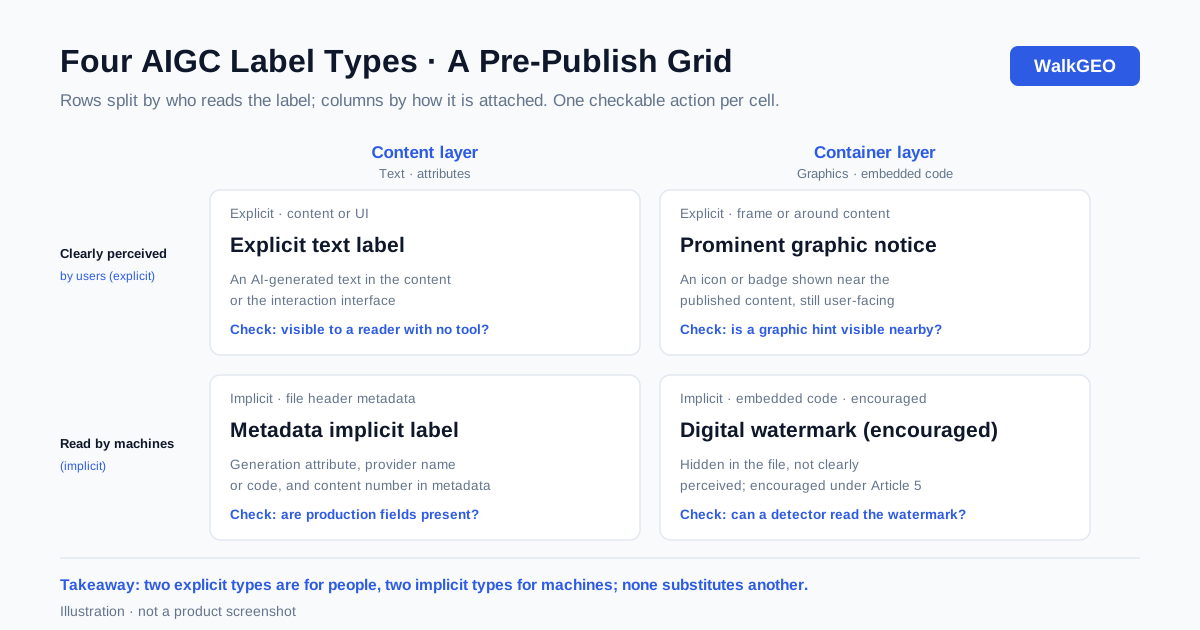
Image alt text is an accessibility description for screen readers and search engines stating what is actually in the picture; a generation-or-synthesis label states whether content was generated by AI and who provided it. They are different things. On 15 November 2026 we checked the full library: 47 bilingual articles, 94 markdown files, 114 image references, and three alt mismatches (a diagram's alt on a signing photo, a closed notebook called "pages of handwritten notes", a photo stranded after the FAQ). We replaced them with accurate descriptions and self-drawn SVGs, and removed unused CREDITS entries.
What that showed: a match between declaration and reality needs a record. Every image here is a hand-written SVG that never passes through a generative image model, and that cannot decide whether the rules apply; tool use and your subject category are separate.
Adding explicit labels: five content forms under Article 4
Article 4 assigns work by form, with a precondition: it applies where the provider's generation service falls under Article 17(1) of the Deep Synthesis Provisions (互联网信息服务深度合成管理规定). For text, audio, images, video, and virtual scenes, add a prominent explicit label; when download, copy, or export is offered, keep a compliant label in the file. Walk the five by where the hint sits: title, body, or interface for text; a cue tone for audio; a badge or on-image text for images; opening, corner, or player for video; entry or interface for virtual scenes. Check the exported file twice, since page hints are often lost on export. See programmatic GEO at scale.
Adding implicit labels: Article 5 and file metadata
Article 5 puts the implicit label in metadata: under Article 16 of the deep-synthesis provisions, add the generation attribute, provider name or code, and content number; digital watermarks are encouraged. Metadata means descriptive information embedded in the file header in a specific encoding format. Export, read the header, confirm those fields; a watermark is encouraged, not a required substitute. Article 8 requires the user agreement to state labeling methods.
The distribution side: four cases under Article 6
Article 6 binds providers of content dissemination services: check the implicit label in file metadata and handle the result by case.
| What the check finds | Handling |
|---|---|
| Metadata clearly marks generated content | Add a prominent notice; add propagation information to metadata |
| User declares it, metadata does not confirm | Add a prominent notice; supplement propagation information |
| No implicit label or declaration, but traces are detected | Add a prominent notice; supplement propagation information |
| None of the above | Provide labeling functions; remind the user to declare proactively |
The first three share one handling; the fourth provides functions and reminds the user to declare. Record the rows. If an outside team publishes for you, put who checks them in the contract and SOW.
The user side: declaration, tampering, and six-month logs
Article 10 binds publishers: a user publishing generated content through a dissemination service should declare it and use the provider's labeling functions; no one may maliciously delete, tamper with, forge, or conceal a label, provide tools or services for it, or harm others' rights through improper labeling.
Article 9 is easy to miss: when a user requests content without an explicit label, the provider may supply it once the user agreement fixes the user's duty and liability, and must keep logs such as recipient information for at least six months. That is a retention floor, not a way around labeling; circumvention is out of scope. Log the declaration receipt, the labeling record, and the retention period.
What does this mean for a company doing GEO?
Platform handling: content entering a dissemination service has its implicit label checked under Article 6; when nothing is confirmed or traces are present, a prominent notice is added and propagation information goes into metadata; deleting, tampering, forging, or concealing a label is prohibited under Article 10, as is providing tools for it. Check declaration items, the labeling function, and the exported file before publishing.
Trust risk is slower and closer to GEO: when a declaration does not match reality or the source is unclear, credibility with readers and retrieval systems erodes. An alt mismatch, an empty byline, and unsourced facts run downhill on the same slope. See how to write citable content and E-E-A-T for AI search; treat a label as part of a trust signal. Mislabeling and helping someone circumvent a label belong in black-hat GEO red flags; no circumvention method is offered here.
The time boundary of this checklist
Regulations and mandatory national standards change, so recheck the table alongside them. The wording here is current as of 15 November 2026; work from the official text, take specific compliance questions to legal counsel, and treat this as no legal advice.
Taking effect the same day is the mandatory standard GB 45438—2025, published 28 February 2025 and effective 1 September 2025, applying to generation and synthesis providers and content dissemination providers (source: National Public Service Platform for Standards Information). Article 11 also requires compliance with relevant laws, regulations, departmental rules, and mandatory standards. Check the clauses in the State Council policy library; only the standard's name, number, dates, and source are given.
Turn "who took part, who checked, what was kept" into a table
Collect the in-house practice into one executable judgment: rather than arguing whether a piece counts as AI-generated, turn who took part, who checked, and what was kept into a table.
Our production is AI-assisted with human review: people check facts and what is actually in the images, and two scripts run before publishing. check-blog-seo.mjs checks the description, keywords, FAQ, image alt text, and internal links; fingerprint.mjs checks the structural fingerprint; a non-zero exit code means no delivery; every piece carries a real byline, Tim Li. Those scripts check publishing quality, not whether the rules apply.
What this means for you: set up three columns, the step AI joined, the checker, and what was retained, then fill in the content type, label, and declaration cells. With a table the boundary can be checked; how to write citable content and how to scope a GEO contract and SOW carry it further.
Common questions
Do I have to label every piece of AI-assisted writing?
Under current rules, labeling applies to AI-generated or synthesized content in the specific circumstances set out in the official text; using AI in the process does not automatically trigger it. Check the original document, not a blanket rule.
Does an ordinary company website count as a regulated "service provider"?
Start by separating two roles. Article 2 applies to network information service providers under the rules on algorithm recommendation, deep synthesis, and generative AI services. An ordinary company publishing articles it wrote itself is usually not one. Article 10, however, requires users publishing generated content through dissemination services to declare it and use the labeling functions offered, so check the platform requirements.
Does image alt text count as a generation-or-synthesis label?
Two different things, not to be conflated. Image alt text is an accessibility description for screen readers and search engines stating what is actually in the picture. A generation-or-synthesis label states whether content was generated by AI and who provided it, explicitly or implicitly. One serves accessibility, the other source disclosure; rewriting alt text is not adding a label.
What happens on platforms if content is unlabeled or mislabeled?
Platforms work through two mechanisms. Under Article 6, a content dissemination service checks the implicit label in metadata and, in several cases, adds a prominent notice around the content and propagation information to the metadata; that is the handling path. The other is a trust risk: a declaration that does not match reality erodes credibility with readers and retrieval systems. What happens depends on platform rules, so do not infer consequences.
Can I treat this overview as legal advice?
For specific compliance questions, talk to your legal counsel; this overview is not legal advice. Regulations and mandatory standards change, so work from the official text and check whether the Measures and GB 45438—2025 have newer versions.
Rules keep changing; this table is a snapshot of one day's check. Go back to the official text, have counsel review anything you are unsure about, and do not treat an overview as a conclusion. Related reading follows the same thread: black-hat GEO red flags covers practices to avoid, and how to write citable content covers matching declarations to reality; one weekly check beats patching labels late. WalkGEO keeps this routine in the weekly check and pricing: cadence and tooling. Settle the boundary against the official text first, then decide which stretch you hand to tooling.
Done reading? Run the same audit on your own site
Sign up, then let the agent scan every page and hand you a prioritized fix list. Your first audit is free.
Run a free site audit