Brand sentiment in AI answers: praised or panned?
Brand sentiment in AI answers is checkable: a five-column review sheet grading sentiment and sourcedness, four combinations, four actions. Plus how we added the fifth column to our own tracking log.
Brand sentiment in AI answers; praised or panned: isn't a vibe. It's a table you can verify cell by cell. Product first: a five-column review sheet, ready to copy; then the grading rules, then the split that matters most; praise and criticism each divide into sourced and unsourced, four combinations, four actions. Running through it all: a real patch to our own tracking log, whose four grading marks had no sentiment column at all.
The product: five columns
| Column | What it records | Notes point to |
|---|---|---|
| Excerpt | 1–2 sentences verbatim | Basis for grading and traceability |
| Sentiment | Positive / negative / neutral / mixed | Rules next section |
| Sourced? | Sourced / unsourced | The split that changes everything |
| Fact check | Which claims true, which wrong | Errors go to the correction list |
| Action | One of four | "No action" is also an action |
The design principle in one line: grade sentiment and evidence separately. Sentiment alone turns unsourced praise into a victory; evidence alone misses mood's quiet effect on procurement. Side by side, sentiment holds up.
Using the sheet takes three steps. One: during the weekly re-test, paste the answer's original sentences into the excerpt column: no extra time; you're reading the answers anyway. Two: grade both columns on the spot, ten seconds a row. Three: at the weekly close-out, sweep the action column; items in the unsourced and negative cells become to-dos. Total maintenance is five minutes a week. The only barrier to adoption isn't cost; it's not closing the tab the first time your brand shows up negative and unsourced.
Grading sentiment without bias
Grade the answer text, not your feelings. Four grades by rule: flatly favorable or recommending, positive; naming a specific problem, flaw, or risk, negative; factual with no judgment ("X was founded in year Y"), neutral; approval and reservation in one passage ("X suits small teams, but the advanced tier costs extra"), mixed.
Mixed is the most common grade and the most informative: never force it into a binary. "Suits small teams" isn't positive if your target is enterprise; it's a positioning signal. The grader's standing question: what does this passage sound like in the buyer's ear, not in mine.
When unsure: grade mixed, paste the excerpt, decide again next re-test. The failure mode grading must prevent is hearing what you hoped to hear as what was said. The excerpt column is the vaccine; original text in hand, any grade can be re-audited later.
Calibration sentences for each grade. Positive: "X's spec page is thorough: you can compare vendors directly." Negative: "X's new version dropped the legacy feature; long-time users should note it." Neutral: "X was launched by team Y in year Z." Mixed: "X's entry price is reasonable, but advanced features are paid add-ons." The one to read twice is mixed: highest information density, least fun to read, most worth reading word by word.
Teams with two or more graders add one ritual: five rows cross-audited monthly, big disagreements noted. Grader consistency has no instrument; sampling is the instrument. Solo graders drift too; re-read last month's grades every other month and the drift shows itself.
Sourced or not: praise and blame each split in two
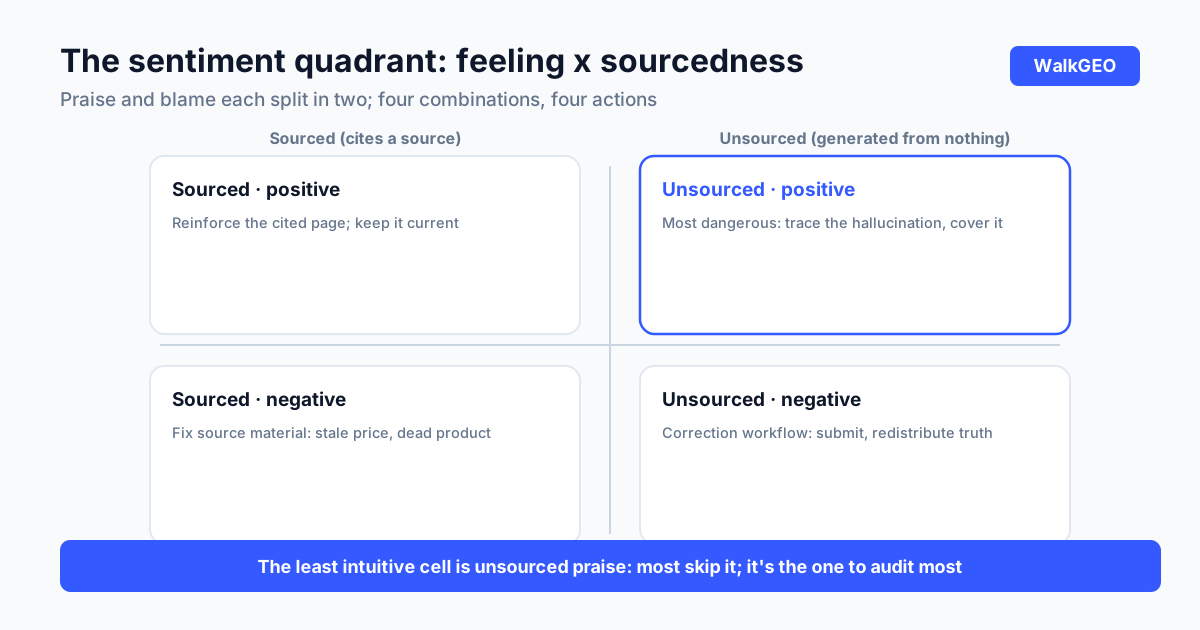
Sourced means the claim traces to a source: your page, community threads, a review site. Unsourced means the answer contains claims no source carries: hallucination or stale training memory. Crossing the two axes with praise and blame gives four combinations, each with its own action. Quick reference: sourced-positive, reinforce the cited content; sourced-negative, fix the source material; unsourced-positive, trace the hallucination and cover it; unsourced-negative, run the correction workflow.
Sourced positive: the engine cites your page while praising you. Material won. Action: keep the cited page current; don't let the credential expire.
Sourced negative: the engine cites bad reviews, old prices, or discontinued products. A material problem. Action: fix the source; update the price, add a note page for the discontinued line, write the misunderstanding into the FAQ.
Unsourced positive: the engine invents strengths you never claimed. The most dangerous cell. It means the model's memory of you has already drifted: unsourced praise today, unsourced criticism tomorrow. Trace what it thinks you are, and cover the errors with correct material. Never build on hallucinated rainbows. The mechanics come in two kinds: stale training impressions (your product as it was two years ago) and on-the-spot confabulation (industry-generic capabilities pinned on you). Both get the same medicine: feed correct material; confabulations additionally go through correction submissions. Left alone, the cost compounds; the model's wrong memory of you gets re-transcribed by its own later answers. A concrete example to close this cell: the engine says "X supports on-prem deployment" and you have no such product line. Every day that praise circulates, sales faces an expectation they must deny on the spot; deny it often enough and both the engine and the buyers grow confused about who you are. That's why unsourced positives get audited more often than negatives.
Unsourced negative: the engine invents things you never did. This is entity correction territory: submit corrections, distribute correct versions; a correction workflow, not a material workflow. The touchstone for routing, one sentence: can the wrong claim be fixed on your own site? Yes; material flow. No: correction flow. Routed wrong, both fixes run slow.
The least intuitive cell is unsourced positive: most teams skip "praise". Skip it, and the next hallucination washes away the work done on the other three.
Our log's missing fifth column
The running case is our own grading log. Until this piece, the log carried four marks (absent, named, cited, rival-linked) plus three role grades covering whether and how you were mentioned, recorded cleanly; whether the mention was praise or a dig, recorded nowhere. The blind spot: visibility could rise, roles could upgrade, and the sentiment of the same answers could quietly worsen; the four marks were blind to exactly that.
The trigger for the patch was mundane. One weekly re-test, the same question flipped from recommending us to recommending a competitor with us mentioned in passing. The four marks correctly logged a role downgrade: but the reservation that had slipped into the tone fit no existing column. What no column holds gets carried into the weekly meeting verbally, and verbal traffic doesn't survive a month.
Three design trade-offs, stated in full. One: four grades, not two; a binary would landfill the valuable mixed information; not six-plus: human grading destabilizes past four. Four is the sweet spot. Two: sourced/unsourced as its own column, never merged into the sentiment grade; merging makes "unsourced positive", the cell needing the most vigilance, statistically invisible. Three: the excerpt column is mandatory: grades without verbatim text become unauditable within a month, to others and to yourself. All three point at one principle, inherited from the measurement framework: every field answers exactly one question.
The effect showed immediately: the same question's answers cited us more often while the sentiment grade slid from positive to mixed; the engine had started citing our spec page, carrying a third party's "priced high" remark along with it. Without the fifth column, the rising trend hid that signal. With it, the signal became one concrete material action: add a price-context paragraph to the spec page. Mixed grades aren't bad news here: they're the by-product of answers getting more comprehensive, uncomfortable but fixable by paying the material debt, not by PR. That's the sentiment column's value: it never rewrites the trend; it rewrites your reading of the trend. And analysis-wise, read sentiment and visibility separately, never cross-ranked: high visibility with mixed sentiment is a material debt; low visibility with good sentiment is thin material. Two diseases, two prescriptions; cross-ranking prescribes the wrong one.
Reporting: background, never KPI
Sentiment enters the monthly report as one line: "Window 14 records: positive 6, mixed 6, negative 2; negatives all sourced (stale price), routed to material actions." One line, four pieces of information, no follow-up questions needed. It stays background, never the headline: absolute sentiment figures ride on sampling fluctuation, and a single window's numbers say nothing about direction.
The harder line: never make sentiment a KPI. Sentiment is gameable; encourage employees and friendly customers to ask engines, manufacture positive answers, and the KPI turns into score-farming that pollutes your own monitoring baseline. The data exists for discovery and attribution: negative share rising two windows in a row triggers material and correction actions, not blame. Accountability points at actions, not emotions. Action routing follows the ownership lanes: sourced negatives to marketing for material fixes, unsourced negatives to PR for corrections, grading and excerpts to ops. Nobody carries brand sentiment alone: it's an intersection laid across the four work types, again.
One sheet, five fields, recorded alongside the weekly re-test. The sentiment column's final home is the same page as the citation tracking log: visibility says whether you were in the room; sentiment says what your face looked like while you were. Together, the AI-answer version of your brand is complete. Grading discipline mirrors the free self-check's traps; rephrasing until you hear what you want, testing only brand terms, testing eight times a day: all three are fatal in sentiment grading too, and the excerpt column is the vaccine against all of them. WalkGEO's monitoring line ships sentiment as a record field; pricing has the entry. Your brand's most recent appearance in an AI answer: praise or dig, sourced or not: can you answer that now? Not knowing is fine. Not knowing and not wanting to test is what this sheet exists to stop.
FAQ
Is it good news when AI praises my brand?
Not necessarily. Praise splits in two: sourced praise, backed by a citation to your page, and unsourced praise the model generated from nothing. Sourced praise is material winning and compounds; unsourced praise is hallucination or stale memory; and a model that invents praise today can invent criticism tomorrow. Check the source first; for unsourced praise, trace what it got wrong about you.
How do I grade sentiment without bias?
Grade the answer text, not your feelings. Four grades: positive (flatly favorable or recommending), negative (names a specific problem), neutral (factual, no judgment), mixed (approval and reservation in one passage). Mixed is the most common and the most informative: never force it into praise or blame. When unsure, grade mixed, paste the excerpt, and re-decide at the next re-test.
AI is saying bad things about me. What's step one?
Judge sourced versus unsourced, then route. Sourced negativity (it cited your bad reviews, old prices, discontinued products) is a material problem; fix the source. Unsourced negativity (it invented something you never did) belongs to the correction workflow: an entity problem. The two actions are completely different; conflating them wastes effort on one front while the real fire burns on the other. Step zero, always: paste the excerpt first; grades without verbatim text can't be re-audited.
Should sentiment be a KPI?
No. Sentiment is a gameable metric: encourage employees and friends to ask engines and manufacture positive answers, and the KPI becomes a score-farming game that also pollutes your own baseline. Sentiment data exists for discovery and attribution, not appraisal: one background line in the monthly report, never anyone's performance sheet. Negative share rising two windows in a row triggers material and correction actions, not blame.
Done reading? Run the same audit on your own site
Sign up, then let the agent scan every page and hand you a prioritized fix list. Your first audit is free.
Run a free site audit