10 Best GEO Tools in 2026 (By Category)
Ten GEO tools worth vetting in 2026, grouped by category not rank: five monitoring platforms, two suite modules, plus service, open-source, and free entries — each with a verification step.
Ask "what GEO tools exist" in 2026 and most answers are roundups that never show how they checked. This one runs the other way: ten tools, grouped by category instead of ranked, with every entry's engine list taken from the vendor's own site during November 2026 — plus a "check this first" step for each. Where we sit inside the list, we say so. At the end, a same-name domain trap we fell into while building the list, and why it matters to anyone who quotes roundups.
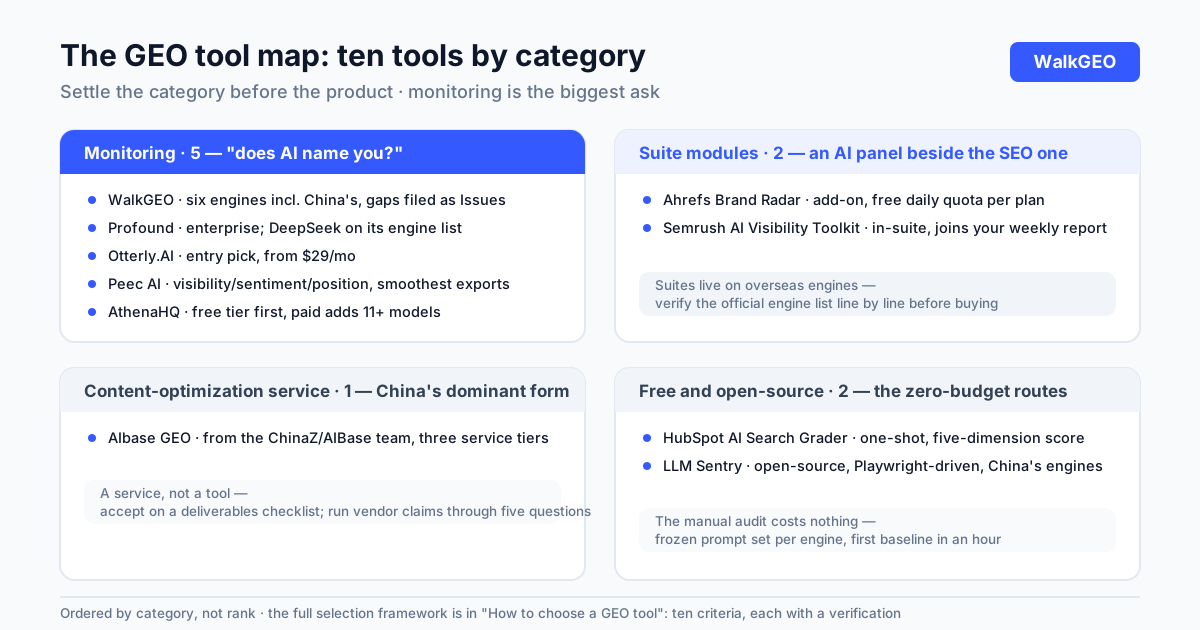
The full ten, up front
| # | Tool | Category | What it watches | Engine emphasis | Check this first |
|---|---|---|---|---|---|
| 1 | WalkGEO | Monitoring | Mentions, citations, share of voice; gap issues | DeepSeek, Doubao, Qwen, Yuanbao + ChatGPT, Perplexity | Engine list on pricing page |
| 2 | Profound | Monitoring | AI search visibility, prompt volumes, agent citations | Overseas mainline; DeepSeek listed | Methodology doc, exit terms |
| 3 | Otterly.AI | Monitoring | Prompt tracking, AI search analytics | Seven overseas platforms | Trial vs. manual records |
| 4 | Peec AI | Monitoring | Visibility/sentiment/position, source analysis | ChatGPT, Perplexity, Gemini, AI Mode | Export data by hand once |
| 5 | AthenaHQ | Monitoring | Visibility tracking + optimization suggestions | Overseas mainline; paid adds DeepSeek et al. | Free-tier credits fit a run? |
| 6 | Ahrefs Brand Radar | Suite module | Prompt tracking + visibility index | AI Overviews, AI Mode, ChatGPT et al. + Claude | Free quota vs. your plan |
| 7 | Semrush AI Visibility Toolkit | Suite module | AI mentions and competitor analysis | Overseas-focused | Engine list, item by item |
| 8 | AIbase GEO | Content-optimization service | Content generation + media placement + monitoring | China platforms (15+ per its site) | Deliverables, item by item |
| 9 | LLM Sentry | Open-source build | Self-built probing: mentions, sources, share | DeepSeek, Doubao, Bocha | License and upkeep cost |
| 10 | HubSpot AI Search Grader | Free grader | One-shot snapshot: five-dimension score | GPT, Perplexity, Gemini | Treat as baseline, not trend |
How to read the table: the category column maps to the four-way split from how to choose a GEO tool — settle which category you're buying before comparing products inside it. Picking the wrong category wastes everything after it. Monitoring gets the deepest section here because it's the category most people are asking about.
Monitoring: the five that watch "does AI name you"
Monitoring tools solve "can't see." The pattern is the same across all five: freeze a set of real buyer questions, probe several engines in batch, and compile weekly mention rate, citation rate, and share of voice — turning "I feel like AI mentions us more lately" into comparable numbers. The metric definitions live in how to measure brand AI visibility; below, five tools by market and budget.
WalkGEO: monitoring you can point at China's engines
Disclosure first: this is our product. The reason it makes the list is engine coverage — DeepSeek, Doubao, Qwen, Tencent Yuanbao, ChatGPT, and Perplexity, so domestic and overseas engines sit in the same probing range, which is still uncommon in this market. Prompt sets are custom, probing runs weekly in batch, Overview shows week-over-week mention, citation, and share trends, and every gap becomes an Issue tagged by type and priority, connected to Optimize and the content workflow. Pricing is public: Pro at ¥99/month, Business at ¥299/month (November 2026), monthly cancelable, reports exportable. Verify it yourself: the engine list on the pricing page and the weekly routine in the help center are both public — run your own check.
Profound: enterprise AI search analytics
The head of the market for enterprise budgets. Its site lists ChatGPT, Perplexity, Claude, Gemini, Microsoft Copilot, DeepSeek, and Google AI Overviews, claims a third of the Fortune 100 as customers, and carries SOC 2. Notably, DeepSeek is in the listed coverage — rare among international tools — which makes Profound worth a separate look for businesses straddling both markets. Before signing: demand the methodology document (how the prompt set is built, what the denominators are) and read the exit terms; enterprise procurement is where both landmines get buried.
Otterly.AI: the entry point for starter budgets
The easiest on-ramp: its site lists seven platforms — ChatGPT, Perplexity, Google AI Overviews, Google AI Mode, Gemini, Microsoft Copilot, and Claude — with pricing from $29/month (vendor site, November 2026) and a free trial. Fits small teams whose manual audit already works and who want their first paid, continuous tracking. Check first: run your own prompt set in the trial and compare against your manual records for error size.
Peec AI: the balanced mid-market pick
A German team serving marketing teams and agencies: ChatGPT, Perplexity, Gemini, and Google AI Mode coverage, tagged prompt tracking, visibility-sentiment-position metrics, competitor benchmarking, and source analysis. The data-exit gate passes impressively — CSV export, a Looker Studio connector, API, and MCP (vendor site). The site claims 4,000+ brands and agencies. Check first: bring your own prompt set into the trial and see whether its visibility numbers reconcile with your manual counts.
AthenaHQ: graduate from a free tier
An AEO/GEO platform in one: the base tier covers ChatGPT, Perplexity, Gemini, AI Overviews, and Copilot; paid tiers add Google AI Mode, Claude, Grok, DeepSeek, Meta AI, and Mistral — 11+ models per its site. Pricing includes a free tier (Essential, with credit) and Starter from $295/month (vendor site, November 2026). Fits teams that want to prove the workflow on free credits before upgrading. Check first: whether the free tier's credits carry one full run of your prompt set — if not, shrink the set before discussing an upgrade.
One more in this lane: Scrunch (scrunch.com) leans toward agent traffic and enterprise channels, with SOC 2 Type II. The list holds ten; Scrunch is worth a look alongside them.
Suite modules: let your SEO budget cover AI on the way
These two aren't standalone products — they're AI-visibility modules grown inside traditional SEO suites. The fit is for teams already living in those suites: one more dashboard next to the old one, near-zero learning cost.
Ahrefs Brand Radar is a paid add-on with two shapes: Custom Prompts tracking (from $50/month, covering AI Overviews, AI Mode, ChatGPT, Perplexity, Gemini, and Copilot, plus Claude) and the AI Visibility Index (built on 531M+ real prompts, from $199/month). Every paid Ahrefs plan also includes a small daily quota of free prompt checks — five a day on Lite (vendor site, November 2026). For teams with an Ahrefs workflow, this is the cheapest route to coverage.
Semrush AI Visibility Toolkit is likewise inside the suite: per Semrush's own pages, it tracks brand mentions across ChatGPT, Google AI, and other AI platforms and analyzes competitors, sharing an account with your existing keyword and content tools. Fits teams folding an AI panel into an existing SEO weekly report.
The shared trait: AI data lives next to SEO data. That saves an account — and hides a trap, because the suites' home ground is overseas engines. Domestic engines are usually outside the probing range; check the official engine list line by line before buying.
In China, the dominant form is service, not tool
One finding from building this list: in the Chinese market, most products wearing the "GEO" label are services — retainer operations priced in person-days or months — and pure software tools are fewer. That's not a criticism; teams that "can't execute" are exactly who services are for. But you must know whether you're buying data or buying labor, because the acceptance criteria differ completely — the split is unpacked in what GEO pricing covers.
One service stands out enough to name: AIbase GEO, from Xiamen Xianglian Technology — the company behind ChinaZ.com and AIBase, in the webmaster-tools business since 2005. Its tiers split by brand terms, product terms, and service terms, the site claims coverage of 15+ platforms including DeepSeek, Doubao, Qwen, Tencent Yuanbao, and Kimi, with content generation and media placement bundled in. Two cautions: it's a service, not a tool, so acceptance runs on a deliverables checklist; and its site advertises claims like "average mention rate up 300%" — no one can guarantee an outcome governed by engine rhythms, so run any promise through the five questions from the pricing piece.
Free routes: a one-shot grader, a manual audit, one open-source build
Free routes answer "I want to know today whether AI mentions me." There are two, and a third for engineers.
The one-shot grader is HubSpot AI Search Grader: enter a brand name and get a composite score in minutes across five dimensions — sentiment, presence quality, brand recognition, share of voice, and market competition, out of 100 — cross-checked across GPT, Perplexity, and Gemini (vendor site). It's a first external baseline, but a snapshot only; continuous tracking requires HubSpot's paid AEO product ($50/month).
The second route is the manual audit: freeze a prompt set, ask each engine verbatim, log raw answers, brands named, and cited sources — a baseline in about an hour. The full procedure is in how to check your AI visibility for free.
LLM Sentry: the open-source route
An open-source project on GitHub (daijinma/geo_marketing): Playwright-driven browser automation that queries DeepSeek, Doubao, and Bocha, records brand mentions, traces cited sources, and computes share of voice. Domestic engines, transparent code, and data you control — three real draws for engineering teams. The cost is upkeep: when an engine's page changes, your scripts follow. Two cautions — the repository carries no license file yet, so ask the author before commercial reuse; and probing cadence plus re-test discipline are yours to enforce.
How this list was made: a same-name trap
The method first: we gathered twenty-plus candidates from search results, competitor pages, and community threads, then opened each vendor's site to check three things — positioning, engine list, pricing page. The first pass cut a third, mostly pages selling retainer services under a "tool" label. The ten that stayed all pass the same bar: positioning matches the product, engine coverage is published, and a price page or trial entry exists.
One cut is worth writing down. When we got to Profound, profound.com opened onto a company selling industry research reports — PDFs priced by chapter, nothing to do with AI search. The AI-visibility startup actually lives at tryprofound.com. Two entities, one name: one sells market reports, the other sells AI monitoring. Copy a roundup's links and descriptions without checking, and you misfile the entities. It's the same mechanism as when AI gets your company's info wrong: same-name entities produce conflicting sources, and skipped verification mislabels them. GEO keeps insisting on entity consistency — apparently the rule applies to whoever writes the roundup, too.
The second lesson hid in categories: several pages saying "monitoring" opened onto agency services. The category column in the table isn't decoration — step one of evaluating any candidate is confirming whether you're looking at software, a service, or a method.
Our own product is in the list (WalkGEO). Self-nomination carries a conflict of interest, handled the same way as the checklist piece: every verification entry is public — the pricing page, the help center, the published weekly routine — so verify rather than take our description on faith.
FAQ
What GEO tools are there?
Sort them by the problem you're solving, and four categories cover the market: monitoring tools (cross-engine tracking of brand mentions, citations, and gaps — WalkGEO, Profound, Peec AI, Otterly.AI, AthenaHQ), AI modules inside SEO suites (Ahrefs Brand Radar, Semrush AI Visibility Toolkit), content-optimization services (the dominant form in China, such as AIbase GEO), and self-serve options (HubSpot AI Search Grader's free check, the open-source LLM Sentry, or a manual audit method). Match the category to your problem first, the product second.
Is this "10 best" list a ranking?
No. The ten tools are grouped by category and ordered within each group by typical use case — that ordering is not a rank. The thing most tool roundups drop is the verification method: engine coverage, methodology, and pricing pages change with each vendor's site. This article is a November 2026 snapshot; re-check each entry the day you read it.
Which monitoring tool fits a China-focused business?
Match engine coverage to the engines your customers use: DeepSeek, Doubao, Qwen, and Tencent Yuanbao domestically, plus ChatGPT and Perplexity for overseas. Most international tools focus on overseas engines — verify each vendor's published engine list before shortlisting. WalkGEO covers all six above; for international tools that claim domestic-engine probing (Profound lists DeepSeek), verify that capability separately rather than trusting a roundup's paraphrase.
What can I do with a zero budget?
Three routes cost nothing: a manual audit (probe each engine with a frozen prompt set, log mentions and sources, build a baseline in an hour); a one-shot grader such as HubSpot AI Search Grader (a first external baseline, but a snapshot only); and, for engineering teams, building on the open-source LLM Sentry project. Free routes fix "can't see"; continuous tracking still needs a tool — audit first to diagnose, then pay for tracking.
Roundups expire; verification methods don't. Engine coverage, methodology, pricing — defer to each vendor's site the day you read this. This piece is a November 2026 snapshot; re-run every "check this first" yourself. For the full selection framework — ten criteria each with its own verification — see how to choose a GEO tool: this article answers "what exists," that one answers "how to pick."
Done reading? Run the same audit on your own site
Sign up, then let the agent scan every page and hand you a prioritized fix list. Your first audit is free.
Run a free site audit