Why AI doesn't mention your brand
AI not mentioning your brand is rarely bias — it's one of four gates: entity, crawler access, citable material, question set. Diagnose in order and most causes surface within an hour.
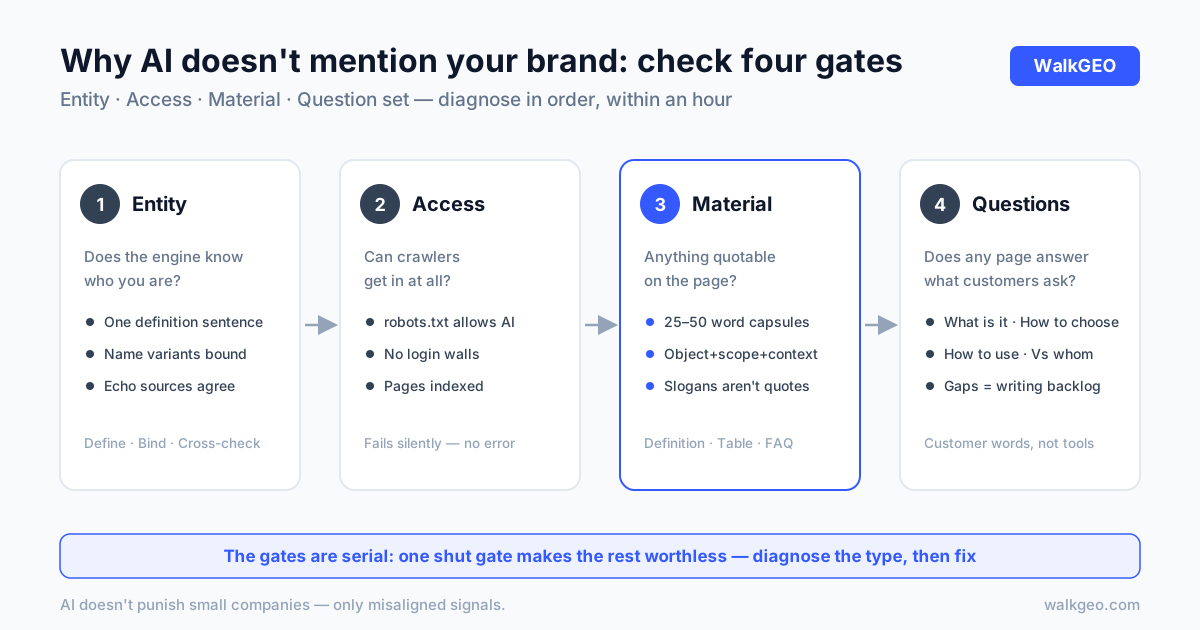
When AI engines don't mention your brand, the cause is almost never bias. It's a gate. Four gates, to be precise: the engine doesn't know who you are (entity), can't fetch your pages (access), finds nothing quotable on them (material), or you're testing questions your content was never written to answer (question set). Check the four gates in order and you can diagnose most cases within an hour — which beats publishing ten more posts and hoping.
First, figure out which kind of "invisible" you are
"Not showing up in AI answers" is four different diseases. Mixing up the causes is the number one reason fixes don't work. Match your symptom first:
| Symptom | Cause | First check |
|---|---|---|
| Ask your brand name, get nothing | No entity — the engine doesn't know you exist | Search your brand name; can the crawler reach and parse your homepage? |
| Competitors get named, you don't | A coverage gap, not a technical fault | Find which pages get cited when competitors are named; do you have equivalents? |
| You're named, but described wrongly | Conflicting entity data across sources | Check whether your name, domain, and product names are consistent everywhere |
| You're in the source list, never in the text | Material is fine, entity binding is weak | Check whether the page has one clear "who we are" definition sentence |
| You're named in the text, sourced elsewhere | The model knows you but can't find citable pages on your site | Compare the cited page's claims with what your own site says |
Only the second row is a genuine strength gap. The other four are engineering problems, and they fix much faster. Diagnose the type before touching anything.
Gate one: the engine doesn't know who you are
An entity is your brand's registration card inside a model. Before a generative engine can answer "what is X," it has to settle what X points at and what it does. No card, no answer. Three checks settle this:
- Does your homepage carry a definition? Open it and find the "who we are" sentence. A qualified definition has three parts — object, action, context. For example: "WalkGEO monitors how brands are mentioned and cited across engines like ChatGPT, Perplexity, Google AI Overviews, DeepSeek, and Doubao." A slogan ("one-stop solution provider") is worth nothing here; the model cannot cite it to answer "what does this company do."
- Are your name variants bound together? If customers ask about you under one name and your materials use another, the thread breaks. Abbreviations, legacy product names, and localized names should be tied to the same entity in structured data and kept identical across pages.
- Do third-party sources agree with you? Your site, your social profiles, your directory listings, your careers page — when they describe the company, do they use the same words? Models cross-check facts across sources. Consistent entities reinforce each other; conflicting ones get skipped, because the model would rather omit you than guess.
The pass condition is simple: search your official definition sentence. Outside your own site, at least one independent platform should state something compatible.
Gate two: the door never opened
This gate is the sneakiest because it fails silently — the crawler leaves, and nothing on your side logs an error. Three places to inspect:
- Is robots.txt blocking AI crawlers? Open
yourdomain.com/robots.txtand check whether user agents like GPTBot, ClaudeBot, PerplexityBot, or Google-Extended are disallowed. CDNs and firewalls that block "unknown user agents" by default are a classic silent failure. - Is your content behind a login wall or client-side rendering? Open your key pages in a private browser window. If the body text needs a login or only appears after scripts run, most crawlers see an empty shell.
- Are the pages indexed at all? The real-time retrieval path of generative engines rides on search infrastructure. If your core pages can't be found in a
site:search, fix indexing first — submit a sitemap, check crawl errors in your search console — before worrying about AI answers.
Gate fixes are the cheapest: often one line of configuration. Our own robots.txt is written explicitly — AI crawlers are allowed on content pages while application routes stay closed. Allow or block should be a decision the site owner made, not a default somebody else shipped.
Gate three: pages exist, material doesn't
The door is open, the engine arrived — and there was nothing it could lift. The test comes from what separates GEO from SEO: the answer capsule, a self-contained statement of roughly 25 to 50 words that survives being quoted out of context. Run your key pages through it:
- "We have decades of experience serving customers" — zero information in any answer. The model can't use it.
- "Founded in 2019, serving 200 B2B customers, focused on X workflows" — object, time, number, context. Directly quotable.
Depth pays here: our Chinese content targets a minimum of 3,200 characters because a definition, parameters, a comparison, and an FAQ don't fit in anything shorter. That is not an invitation to pad — watered paragraphs are exactly as uncitable as slogans. Every article also needs one real case section: verifiable detail about work you actually did. Nothing persuades a model — or a reader — like specifics.
The tell of a material problem is a page that reads smoothly but yields nothing when you lift any single sentence out. The fix is rarely a rewrite; it's consolidation: pull scattered facts into a definition, a parameter list, a comparison table, an FAQ. The selection criteria behind this are in how AI picks sources.
Two cheap upgrades earn their keep everywhere: mark your FAQ with FAQPage structured data — search displays it as rich results while models read the same question-answer pairs as machine-readable input — and collapse scattered parameters into comparison tables. Tables are the friendliest extraction format there is: aligned rows and columns are far easier to verify than prose.
Gate four: your questions and your content don't overlap
When the first three gates are open and you're still invisible, the cause is almost always a set mismatch: the questions customers actually ask, and the questions your content answers, are two different sets. A CRM vendor that has published fifty release notes will not appear for "how do small teams track follow-ups" — no page was ever written against that question.
Closing the gap takes one step: list the real questions sales and support hear (twenty at minimum), ask each one to your target engines, then check whether any page on your site answers it directly. The misses are your gap list, and it beats any keyword tool because it's written in the customer's own words.
Structure the list in four buckets and coverage takes care of itself: what is it (category awareness: "what is X", "X vs Y"), how to choose (decision: "how to pick X", "what does X cost"), how to use (operations: "how to set up X", "why doesn't X work"), compared to whom ("X versus [competitor]"). At least three questions per bucket, and keep asking until the answers stop naming you — that's your writing backlog, already prioritized.
The gates are serial: entity → access → material → question set. A break anywhere upstream makes everything downstream worthless, so diagnose in this order and fix in this order too.
Case: our own site manual had missing pages
A real gap of ours. WalkGEO ships an llms.txt — a Markdown site manual that tells AI crawlers which pages matter. Ours lists the homepage, the help center, the pricing page, and every blog article. The mechanism is a link registry we maintain in code; the file is generated at build time.
The weak point was "we maintain it": publishing a new article does not update the manual automatically — someone has to add the entry by hand, and a hand-maintained list fails silently. The page exists, is fetchable, and simply never appears in the manual. We missed one registration ourselves (an internal content registry surfaced the miss first, and we fixed both together); since then, "add it to llms.txt" is a line in the release checklist, next to images, build, and QA. The lesson generalizes: most AI visibility gaps are not things you did wrong — they are steps nobody reminded you to do. Entity not bound, crawler not allowed, material not written, manual not updated. None of them announce themselves. That's why the audit runs against a checklist, not against a feeling.
The one-hour audit, in order
- Access check (10 minutes). Read your robots.txt; open key pages in a private window. Pass: AI crawler user agents unblocked, body visible without login.
- Entity check (15 minutes). Search your brand name; verify the homepage definition, name binding, and cross-platform consistency. Pass: you can copy out one qualified definition sentence.
- Material check (15 minutes). For each key page, lift one sentence and test whether it stands alone. Pass: at least one answer capsule per page.
- Question-set check (20 minutes). Ask each real customer question to your target engines and match against your content. Pass: a written gap list where every item maps to a page to write or rewrite.
Then fix by diagnosis: missing entity → definition sentence plus structured data; blocked door → robots.txt and CDN rules; weak material → answer-capsule rewrites; set mismatch → write against the gap list. After fixing, don't rush to conclusions — indexing and answer sampling both lag. Freeze the same question set and re-test weekly; only the trend counts.
If you already run monitoring, plug the audit results into the workflow: every Issue tracks one prompt's performance, Priority tells you what to fix first, and you can carry an issue's context straight into optimization or a new draft. The flow is in our help center's Issues guide.
FAQ
Why does AI know my competitors but not me?
The gap is usually material, not scale. When a competitor gets named, some page gets cited — a parameter table, a comparison, an FAQ. You likely have no equivalent. Find the cited page, meet the same citability standard with your own version, and skip the generic content push.
My site is indexed by Google — doesn't that guarantee AI visibility?
Indexing opens the door; it doesn't earn the citation. Generative engines select among candidates by their own standard: specific, consistent, verifiable. Sites that are indexed yet never named usually lack definition sentences and citable material — not index coverage.
How do I quickly tell which gate is blocking me?
Ask four questions in order: can AI crawlers get in (robots.txt)? Does the engine know who I am (definition sentence)? Is there a fact on the page it could lift verbatim (material)? Does any page answer the questions I'm testing (question set)? Four questions, and the culprit is nearly always isolated.
How long until a fix shows up?
Indexing and answer sampling both lag, so re-test the same frozen question set weekly; daily swings are noise. Engineering fixes (crawler access, llms.txt) take effect on the next crawl; material fixes wait until the model re-retrieves and re-verifies. Think in weeks.
"AI can't find me" is not a mystery. It's at least one of four gates left shut. The engines don't punish small companies — they punish misaligned signals. Get the entity, the door, the material, and the question set aligned, and an engine has no reason to skip a source that would complete its answer. WalkGEO runs probing, gap attribution, optimization, and re-testing as one weekly loop — see pricing if you'd rather skip the manual audit, or start with the five-minute setup in our help center.
Done reading? Run the same audit on your own site
Sign up, then let the agent scan every page and hand you a prioritized fix list. Your first audit is free.
Run a free site audit