Who owns AI visibility? Marketing, SEO, PR, and engineering
Nobody owns AI visibility by default. Split it four ways: content, machines, monitoring, corrections, with handoffs in process. Two commonly missed roles, and a lesson from one small change.
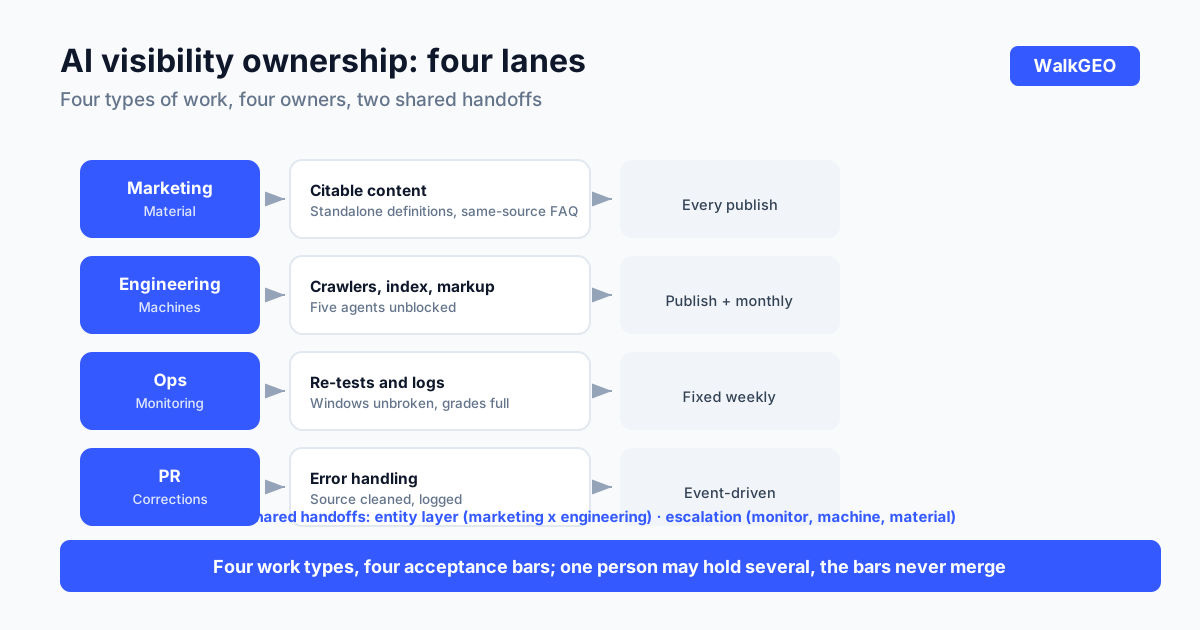
Who owns AI visibility? Nobody by default. The answer splits four ways by work type; content and material to marketing, the machine layer to engineering, monitoring and measurement to operations, brand corrections to PR: with handoffs written into process rather than left to goodwill. It's the intersection of four departments, the property of none. This piece gives the table, the two roles most often left off it, and a real lesson from one "small change" that pulled in three.
The Monday-meeting question nobody answers
A meeting you'll eventually chair or sit through. Ops opens: "Last week's re-test: the category answers featured the competitor again, and this time they cited a new comparison page they shipped." Two seconds of silence. Marketing says the content calendar is full. SEO says indexing and rankings are fine. PR says no brand negativity came in. All three are correct, and none of them catches it: the problem sits in nobody's existing remit.
That scene is AI visibility's organizational property. It spans content production, site technology, ecosystem reach, and reputation repair, and every single role's toolbox covers one corner. The competitor won with a comparison page: material layer, marketing's job. Whether your pages even entered the engine's index; machine layer, engineering's job. The "last week" came from re-testing: monitoring layer. Whether to engage the source citing you; corrections, PR's job. Four questions, four owners; with the split written down, the next such meeting starts with "gate or material?" instead of two seconds of silence.
The question surfaces only now because the old map drew boundaries by channel: search to SEO, media to PR, content to marketing, none overlapping. Generative engines welded the channels together: one answer simultaneously reflects material quality (marketing), crawlability (engineering), ecosystem weight (PR's properties), and re-test data (ops). The product-level boundary disappeared while the responsibility chart stayed on the old map. The ownership argument isn't politics; it's a stale map.
Four types of work, one table
Split the day-to-day into four types, each with an owner, an acceptance bar, and a cadence:
| Work type | Owner | Acceptance bar | Cadence |
|---|---|---|---|
| Material: citable content production | Marketing / content | New pages carry standalone definitions; FAQ and markup same-source | Every publish |
| Machines: crawlers, indexing, markup | Engineering | Five agents unblocked; core pages indexable | With publish + monthly check |
| Monitoring: question-set re-tests and logs | Ops | Four-week windows unbroken; grades complete | Fixed weekly hour |
| Corrections: error handling and property outreach | PR | Source cleaned; third-party submissions logged | Event-driven |
The table's design principle is singular: the four types have different acceptance bars, and bundling them under one title guarantees one gets squeezed out. Marketing is judged on content cadence, engineering on configuration and builds, ops on data discipline, PR on disposition outcomes; four rhythms on one desk means none done well. The table's first purpose isn't assigning people; it's pinning the acceptance bars. One person can hold several types; the bars cannot merge.
Each type also has a classic misplacement worth listing. Material outsourced to writers with no entity background: fluent copy that can't survive verification. Machines handed to the site vendor: response measured in weeks, crawler issues expire in the queue. Monitoring assigned to an intern's "when there's time": the four-week window has never once completed. Corrections defaulted to "whoever sees it handles it": so nobody does. Check your org against these; two or more hits means fix ownership before optimizing anything.
The two roles most often missing
First, engineering. Most AI-visibility initiatives start on the marketing side, and the responsibility chart begins with content; engineering gets remembered when "we need an article published". But every machine-layer item is engineering work: firewall rules for unfamiliar crawler agents, whether markup generates after deploys, whether indexing survives a migration. These problems are invisible from the content side, fail silently, and surface as cross-department mysteries like "AI can't find us at all". Evidence from our own records: the first crawler-block incident wasn't discovered by the content team: a deployment check caught it, engineering was in the room, and the problem ended that day.
Second, support. Where do the question set's sentences come from? Customers' own words. Support and sales hold the highest-quality corpus: they know how buyers phrase things, which words they use, in what situations they ask. Teams whose charts omit support have question sets written from imagination; and the visibility they measure is imagined too. Support's line on the chart is one sentence long: each month, drop the recurring customer phrasings into a shared document. One line of cost for a truthful measurement base.
Using the corpus has its own hygiene: strip company names and private details, keep the phrasing skeleton; cluster similar phrasings and take the most complete one per cluster into the set. Ops pulls clusters monthly; marketing consults them at quarterly audits. Two roles, one corpus, and the measurement stays anchored.
Handoffs written into process
The seams between the four types are where incidents breed, and two seams must be formalized. The first is the entity layer: brand spelling and claim wording are co-owned by marketing and engineering, with any change synced to the other side. Wording drift never comes from one side: marketing rewrites copy, engineering's markup stays behind, and the mismatch is born. The second is the escalation path: monitoring finds "not mentioned", step one checks the machine layer (engineering confirms the gate), step two checks the material layer (marketing maps the gap), step three considers countermeasures. The order is fixed for a reason established in the diagnosis piece: a "not mentioned" taken while the gate is shut is a gate problem, and checking the gate first eliminates every misdiagnosis.
Give the path deadlines: machine issues answered same-day by engineering, material issues scheduled by marketing, corrections dispositioned by PR on a stated timeline. Deadlines needn't be harsh; they must exist, or cross-department questions slide into the "everyone is waiting" state.
A third seam gets missed most often: data and tool ownership. Who holds the monitoring account, where does the data live, who keeps it when a member leaves; absent from the chart, these become open cases at the worst time. Our convention is simple: ops holds the tool's primary account, engineering holds read-only on the technical layer, data exports are archived monthly. Written ownership matters more than which tool.
One "small change", three roles
A lesson from our own history, in lesson form. Changing the blog byline from a team name to a person's name sounds like editing one text field. The final change list spanned: the article page's author markup (engineering changed the generation logic), the footer and about-page bylines (content), the site description in llms.txt (ops), plus the structured data moving from Organization type to Person: back to engineering. One "rename", four roles in the room.
The lesson isn't that renames are annoying. It's that ownership blind spots are invisible until they trip you: when the change was proposed, nobody could list the affected surfaces; four people claimed pieces before the list was whole. Since then our change checklist carries one line: any edit touching brand name, author, or date fields gets a default sweep across markup, page surfaces, and site description, written into the publishing flow.
Your version: take your team's last "thought it was small" change and count how many surfaces it actually touched and how many hands it passed through. That number is your real handoff surface. If the answer isn't "one role, end to end", the table is worth posting.
The sweep template is three lines, ready to copy: markup layer; do structured-data and head fields follow the change; page layer: footer, about, and byline displays unified; site layer; llms.txt and site descriptions synced. Each line claimed by its role, checked off when done. Not clever: but it drags "thought it was small" changes out of the blind spot, and the blind spot is the entire risk of cross-team work.
FAQ
What if a small team can't staff four roles?
The split is over work, not headcount; one person holding several is normal. What matters is that all four types have a name attached, written separately even for the same person, because the four have different acceptance bars. Bundle them into one line ("owns AI visibility") and the machine work will always lose to the content work.
Isn't the SEO team the natural owner?
One of the pillars, not the whole. SEO's technical base (crawl, index, markup) transfers directly, but in-ecosystem reach, brand corrections, and monitoring discipline aren't in classic SEO's remit. Let SEO carry it alone and the usual outcome is a solid machine layer, strong material, and nobody on ecosystem or reputation. Excluding SEO is equally wrong; they know the base layer best.
What process should corrections follow?
Three steps: locate which property holds the error's source, fix the fact at the source, then submit corrections or place correct versions where you can't edit. Corrections run on two timelines: own properties same-day, third parties in weeks. Log every disposition; a recurring error means the source was never fully cleaned. The full property-by-property method is in the correction piece.
What resources should leadership assign to this?
Three things: a fixed weekly re-test block (not a headcount, an untouchable two hours); an engineering response channel for crawler and markup issues answered same-day; and a written expectation of the data's limits. Miss the first and monitoring is theater; miss the second and machine issues hang; miss the third and misaligned expectations hurt more than ugly numbers.
Post the table and predict the first week: someone realizes they've been doing two of the four types without knowing the other two were theirs. That moment pays for the table; the work was always happening; what was missing was a name on it. Which name is currently written next to the machine layer on your chart? WalkGEO ships all four types inside its weekly close-out routine, saving the monitoring hours outright: pricing has the entry. Ownership first, tools second; keep that order.
Done reading? Run the same audit on your own site
Sign up, then let the agent scan every page and hand you a prioritized fix list. Your first audit is free.
Run a free site audit