When AI recommends your competitors instead
When AI answers about your brand by recommending competitors, it's usually a coverage gap, not sabotage: classify, attribute what they're cited on, build counterparts, re-test weekly.
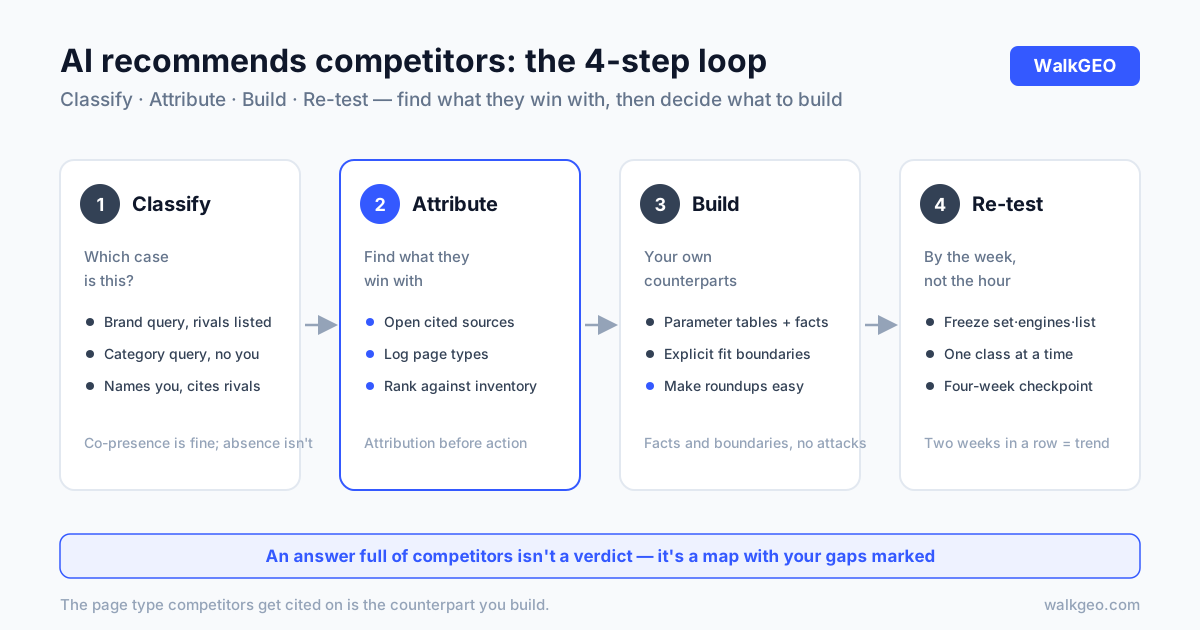
You ask about your own brand and the AI answers with a list of your competitors. Before rewriting anything or suspecting sabotage, read the situation correctly: this is a brand mention gap, and in the overwhelming majority of cases it's a coverage gap — the kind of page competitors get cited on doesn't exist on your site yet. The right order is four steps: classify (which "recommending competitors" is this?), attribute (which pages do they win with?), build your counterparts, re-test weekly. This article takes the four steps apart, and ends with the real story of how we handled our own category-question gaps.
First, classify which "recommending competitors" this is
"AI recommends competitors" is four different symptoms with different causes. Mixing them up is the fastest route to ineffective fixes — treating entity confusion as a coverage problem means four weeks later you have nothing. Match your case first:
| Symptom | Cause | First move |
|---|---|---|
| You ask your brand name; the answer lists "similar products" and you're ranked low or missing | Material and authority gap: the shortlist only includes names it can back | See which page types all the recommended names share |
| You ask a category question; the answer is all competitors, no you | Not even in the candidate pool: gates, indexing, or material missing | Check gates and indexing status first |
| The answer names you but cites competitors' pages | Weak entity binding: it knows your name, can't find your citable page | Check whether your pages carry facts that can be lifted verbatim |
| The answer compares you with competitors — using wrong information | Coverage gap stacked on messy entity info | Fix the entity first, coverage second |
Only the first row is close to a genuine "strength gap"; the rest are engineering. Classify, then act — each step gets a completion standard.
One classification trap worth defusing: sharing the list isn't a bad sign. When you ask about your brand and the answer mentions both you and competitors, you've made it into the "similar products" context — the fight is not about whether the list contains others, but whether you're on it and where you rank. The real alarm is the reverse: you ask about yourself, the answer is all competitors, and you're not mentioned at all. Don't repair "co-presence"; spend the effort on "absence."
Why it recommends them and not you: three mechanisms
A gap in citable material. The page hanging behind every competitor recommendation — a parameter comparison, a "best tools" listicle, a use-case breakdown — usually has no counterpart on your site. Models don't recommend from vibes; they pick from retrieved material that supports the answer. The competitor's comparison page exists, the parameter table exists, third-party roundups have included them — every sentence recommending them has a citation to hang on. Recommending you has nowhere to hang. This "listicle effect" is most visible in evaluation-type questions, and it's worth finding out which roundups your competitors got included in.
You never made the candidate pool. Retrieval-based engines recommend from a pool that comes from search results. If your pages aren't indexed, or rank too low to enter the first screens, they're never in the running. We split that "doors and indexing" layer into four gates in why AI doesn't mention your brand — confirm all four are open before blaming material.
Weak entity binding. The most painful variant: the model knows your name (it can answer "what is X" with your story) but can't cite your page in recommendation contexts — because your pages carry no fact sentences that can be lifted verbatim, or the pages don't agree with who you say you are. The standard for liftable material is in how AI picks sources.
Check the three in order: pool first (are you in it), then entity (is the name bound to pages), then material (is there anything citable). Reversing the order wastes work — the best material can't enter a pool it's locked out of.
Gap attribution: find out what they win with
The answers that recommend competitors contain a ready-made syllabus — the pages they get cited on. Gap attribution is reading that syllabus:
- Open the cited sources. Every time a competitor gets recommended, open the pages hanging in the answer and log them. Two or three page types recurring across ten recommendations — that's what they win with. While logging, complete the competitor roster: official names, common aliases, abbreviations. Official names alone miss half the appearances.
- Record page types, not pages. You're not going to clone an article; you're going to build the same class: parameter tables, scenario fit, roundup inclusion. Types replicate; pages don't.
- Compare against your inventory. For those two or three page types, do you have counterparts? Present but losing — find which required element is missing. Absent — onto the to-write list.
- Prioritize. The page type that shows up most in category answers gets built first — it decides the most citation opportunities.
This is exactly the logic of Issues in our product: each Issue tracks one question's performance, the gap type marks the cause, Priority decides what gets fixed this week, and you carry the Issue's context straight into optimization or writing. The walkthrough lives in the help center's Understanding Issues. Doing it by hand works too — a spreadsheet is enough. What matters is attribution before action.
Building counterparts: what a qualifying comparison looks like
Attribution found the gap; now fill it. For the most common case, the comparison page, four elements make it citable:
- Verifiable facts. Parameters, pricing structure, integration lists — every claim checkable by a third party. Write about competitors only what's publicly checkable; no disparagement. That's a red line and an effectiveness argument at once: models prefer balanced sources, and a page with only one side's stance has less citation value.
- Parameter tables. Aligned rows and columns are the format models extract most readily — far easier to verify than prose. What you have, what they have, laid out plainly.
- Explicit boundaries. Who you're for, who you're not for — recommendations with boundaries are the only ones a model dares cite. A page claiming to fit everyone can't be cited in any specific answer.
- FAQ. Real purchase-decision questions answered in pairs, marked up with FAQPage structured data — one asset serving search rich results and answer extraction at the same time.
"Building counterparts" does not mean copying competitors' pages. Attribution gives you the type and the standard; the content must be your own facts — a copied page fails cross-validation against your entity, and you've written it for nothing.
One finding from attribution deserves its own paragraph: many "recommends competitors" lists aren't written by competitors. "Best X tools" content mostly comes from third-party review sites, industry media, and real users' roundups — competitors just got included. That changes the direction of the work: beyond writing your own comparison pages, make your material easy for a roundup to include — one clear definition sentence, one complete parameter table, one product entry reachable without login. Those are the same things a third-party author looks for when choosing who to include; minimize their cost of citing you and you make next quarter's roundups.
Case: our own category-question gap
Our real story. WalkGEO's first baseline probe summed up to one word: weak. Most of our pages were still sitting at "Discovered – currently not indexed" in Google — search indexing itself was on the way, and the basis for AI citation was weaker still. Not shameful; no baseline is what's shameful. The full first week is recorded in our measurement article.
What matters more for this article's topic is the attribution that followed. With the question set built across four classes — category, comparison, scenario, purchase — we checked it against our existing pages, and the gap was unambiguous: category questions, the kind customers actually ask ("is there a tool that gets my brand mentioned in AI answers," "should we do GEO or SEO first"), had not a single page on our site answering them directly. The absence from answers wasn't a gates problem first — it was no material to cite.
The response was the gap list itself: write against the questions. The blog you're reading now maps onto question-set classes one article at a time — this article answers "AI recommends competitors, now what," the comparison piece answers "GEO vs SEO," the measurement piece answers "how do you measure." Each gap hangs an Issue in monitoring; one article ships, its tracked questions get re-tested, results attributed, next article queued. There's no secret to the process — it's the gap list, digested one line at a time.
The honest boundary, same as always: we're not publishing a number like "competitor recommendations dropped by X%" — we haven't accumulated enough weeks of consistent re-test data for a public comparison, and publishing one now would be fabrication. The day the numbers are ready, they go into a follow-up article. That standard applies to us too.
Three things not to do
Gap attribution hands you the slow road, and there are three fast-looking exits on the way. Take none of them:
- Buy "guaranteed recommendations." There is no submission channel for AI recommendations; what you can buy is either search ads (a different game) or a scam — one model update and the purchased placement evaporates. The test comes from how long GEO takes: any "guaranteed in N days" claim fails the follow-up question "determined by what?"
- Write disparaging comparison pages. Beyond being a red line, it fails on effectiveness: a hit piece is a lone voice in cross-validation — models won't risk citing it — and worse, it adds an aggressive face to your entity's reputation. Compare on facts and boundaries, not on putting the other side down.
- Fake third-party roundups. Building a review site to award yourself may harvest a citation once, but such sites have low entity quality and detectable fabrication — exposed once, the credibility of your whole domain takes the hit.
All three share the same anatomy: an attempt to bypass the material gap, which is the actual disease. Go around it and the disease stays on the books — with a new liability attached.
Re-testing: how you know the fix worked
Shipping content is an action; only re-testing tells you about results:
- Wait for re-crawling before expecting movement. From publish to re-crawl runs days to weeks; testing the next morning measures nothing.
- Weekly re-tests with a frozen protocol. Same questions, same engines, same competitor list — only then do weeks compare. The full discipline is in how to measure your brand's AI visibility.
- Build one class at a time. Ship the parameter table this week and attribute to the parameter table — don't also touch gates in the same week. Mixed changes make movement unattributable and next round a blind flight.
- Four-week checkpoint. Any same-direction movement on the gap's tracked questions across four weeks means it's working; all zeros means audit the question set and material quality. Full time expectations in how long GEO takes.
When AI recommends competitors instead of you, that's not a verdict — it's a map with the gaps marked: the pages competitors get cited on tell you what to build, the question set tells you what to build first. Do the attribution honestly, fill the counterparts, re-test weekly. The citation arrives late, but it arrives. WalkGEO runs classify → attribute → build → re-test as a weekly closeable workflow: Overview for share movement, Issues for this week's gaps, Optimize and content creation for the counterparts. To skip the spreadsheet, look at product and pricing; for the weekly operating rhythm, see the help center's routine.
FAQ
When I ask about my brand, AI recommends competitors. Are they doing something to me?
Usually not — it's a coverage gap. In "similar products" contexts, AI recommends the ones it retrieved with qualifying material; if your citable material falls short, you don't make the candidate pool and it has to recommend others. Run gap attribution first and decide what to build from evidence, not from a "competitors are out to get me" guess.
Is there a way to get AI to recommend me directly?
There is no "submit a recommendation" channel, and bought placement doesn't survive one model update. What works is decomposing citation into verifiable steps — gates open, entity clear, citable material in place, each gap answered by a matching page — then weekly re-tests to watch the trend. No shortcuts on the path, but every step is checkable.
Is it worth writing a comparison page between us and our competitors?
Yes, if it's verifiable. Parameter tables, use-case fit, and explicit boundaries (who you're for and who you're not) are exactly the material models like to cite; disparaging copy backfires — models prefer balanced sources, so a one-sided page has less citation value. Write about competitors only what is publicly checkable.
How long until I see a change after filling the gap?
After material goes live, wait for re-crawling (days to weeks), then start weekly re-tests: same questions, same engines, same competitor list — two consecutive weeks in the same direction makes a trend. Set a four-week checkpoint; any movement on the tracked questions means it's working. All zeros means audit your question set and material quality.
Done reading? Run the same audit on your own site
Sign up, then let the agent scan every page and hand you a prioritized fix list. Your first audit is free.
Run a free site audit