GEO, SEO, and Paid Search: How They Work Together
The three channels are not substitutes; they hold different journey positions. Awareness, research, and conversion mapped to leading channels, budget by objective, and our all-organic sample.
A marketing lead recently asked a telling question: budget is tight, the SEO team says AI answers are intercepting traffic and wants more investment, a GEO vendor says traditional SEO is obsolete and the money should move, and the agency is still selling search ad packages. All three sound reasonable and all three contradict each other. The contradiction is fake: the three were never substitutes. They hold different positions on the user journey, and once the division of labor is visible, the budget argument mostly dissolves.
One table: three journey stages, three main channels
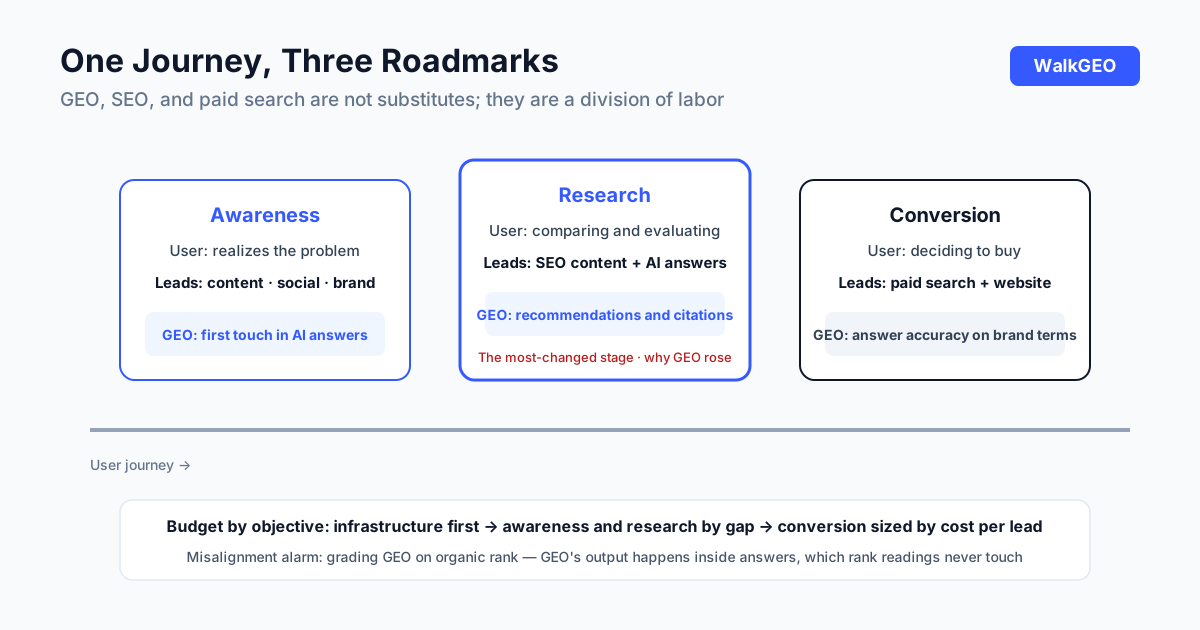
| Stage | What the user is doing | Leading channels | GEO's role |
|---|---|---|---|
| Awareness | Realizing the problem exists | Content, social, brand | First touch inside AI answers |
| Research | Comparing and evaluating | SEO content + AI answers | Recommendations and citations in answers |
| Conversion | Deciding to buy | Paid search + website | Answer accuracy on brand queries |
The research stage changed most in two years: the starting point for comparison moved en masse from result pages into AI answers, which is why GEO rose. But migration is not elimination. After the answer names candidates, users still search, still open sites, still read reviews; SEO's hand-off between research and conversion was never skipped, only re-entered.
How GEO and SEO amplify each other
The definitional side lives in GEO versus SEO; here are three operating-level amplifications. The shared technical base: crawling, indexing, page quality, and structured data built for SEO are consumed by GEO as-is, one machine, two outputs. The content lines feed each other: keywords and phrasings validated by SEO are raw material for GEO question sets, and answer gaps observed in GEO become new SEO topics. And the signals corroborate: movements in rank and in answer citations often run the same direction, so a wobble in one channel's readings helps locate the cause in the other. Teams that isolate the two lines collect none of these.
Paid search's position in the AI era
Paid search was not obsoleted; its post got more focused. With research traffic diverted into answers, bid value concentrates at the conversion end: brand-term defense, high-intent interception, retargeting reach. That framing is a logical deduction from channel roles; specific ad formats evolve with each platform's commercialization, and the information date follows official releases, which this piece does not chase. The intersection with GEO worth watching: when a user remembers a brand from an AI answer and searches it a moment later, the paid slot and the organic slot together decide the landing experience, a three-channel rendezvous at the journey's end.
Budget: allocated by objective, not by channel loyalty
The right order puts objectives first. Answer which stage this quarter should push, then fund by stage: awareness flows to content and brand, research to the SEO and GEO content lines, conversion to paid search and landing pages. A workable starting split: shared infrastructure funded fully first, since the technical base and content line serve all three channels and cutting it leaks in three places at once; awareness and research covered by gap; the conversion end sized by cost per lead, expanded only when the math is clear. One hidden layer deserves its own note: rhythm alignment. Paid search moves daily, SEO in months, GEO by observation window; pull the three review cycles onto one quarterly beat and management finally sees one comparable table. A real hand-off scene makes the point: the highest-converting terms in a paid search report are usually the next questions a GEO set should add and ready-made topics for new SEO articles. One report feeds two lines, a courtesy that only appears after the rhythms align. Quarterly data reviews settle the allocation; channel-loyalty budget fights can retire.
The common misalignment: grading GEO on SEO's KPI
Shared budget invites shared KPIs, and that is where the misalignment lives. Grading GEO on organic rank is the classic case: GEO's output happens inside answers, which rank readings never touch. Each channel answers for its own metrics, SEO for rank and organic traffic, GEO for mentions and citations with definitions from our metrics piece, paid search for cost per lead, and all three answer for the journey-level objective together. The attribution boundary stays on the table too: most of AI's influence happens inside answers, and the uncounted is not the nonexistent, a rule set down in our referrals piece.
Our own split: an all-organic sample
Turn the lens on ourselves, an extreme sample running entirely on organic. Paid search: nothing spent, stated plainly. SEO: organic traffic watched from the Search Console backend, with the blog's long tail doing the carrying. GEO: citation observation runs weekly, the other half of the production line behind what you are reading. One person holds all three, because our journey structure is simple: awareness and research run on content, conversion runs on product pages. The lesson is not to copy the setup; it is the sequence. Build the shared base, technical access, content line, record system, until it runs on its own, and channel expansion only then means something. We have not even opened paid search, yet the base already delivers all three amplifications; the day it opens, it will catch brand-query traffic that GEO and SEO planted upstream. The three channels' cooperation is not a slogan for meetings; it is three roadmarks appearing in order along one user path.
Common questions
Will GEO replace SEO?
No. SEO solves foundness, GEO solves correct presentation, and answer generation rests on the crawling and indexing foundation SEO built. Substitute thinking does both poorly.
Does paid search still matter?
Yes, more focused: as answers absorb research traffic, bids concentrate at the conversion end. Formats follow each platform's official releases.
How should the budget split?
By objective: define the stage, fund the channel. Infrastructure first and full, awareness and research by gap, conversion sized by cost per lead, quarterly data reviews.
Who owns GEO, who owns SEO?
Same person in small teams is fine; the bases overlap. Separate teams share the technical base and content line, each channel answering for its own metrics while all answer for the journey.
One chart, three channels, and the conclusion returns to the opening: not substitutes, a division of labor. Today's move: write your company's three channels as one line each across the journey stages, then check the KPI sheet for the rank-grading-GEO misalignment. Measurement details live in the metrics piece, negotiating leverage in the baseline piece, and the usual boundary: platform dynamics follow official releases, and none of this is ad-spend advice. WalkGEO's own split evolves with the business; when readings complete a window, updates go into later pieces.
Done reading? Run the same audit on your own site
Sign up, then let the agent scan every page and hand you a prioritized fix list. Your first audit is free.
Run a free site audit