Why AI Loves Listicles (and How to Earn That Citation)
Ask "which one is best" and the answer is a list. That is why engines pull from listicles. Five structural requirements, three trust conditions, five writing rules, and our observation log.
Picture yourself in front of a shelf asking "which blender is good". What an AI hands back is not a lecture on how blenders work. It is a list: names, an order, one line of reasoning per item. That is how the question was asked, so that is the shape of the answer. An engine gets this most cheaply from a well-structured listicle, where each entry is a self-contained fragment that drops straight into a reply. Listicles get cited often because of the question's shape, not because engines favor a genre. If you want in, you need to know what the mechanism is made of.
List A: five structural requirements, all five needed
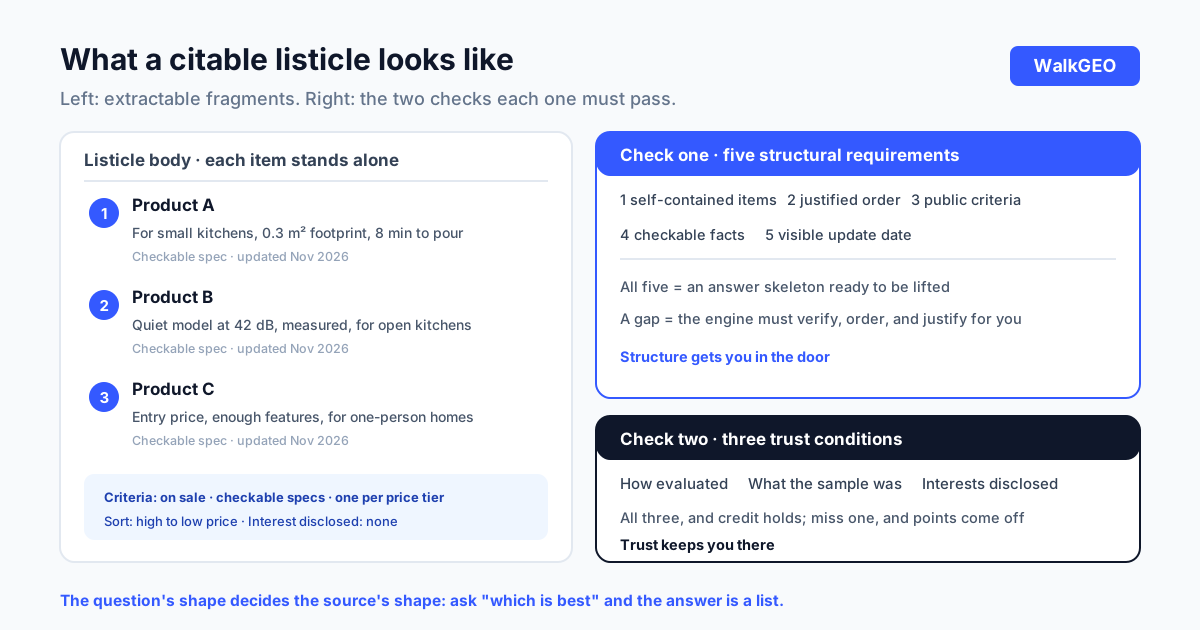
A listicle an AI can extract has five structural requirements: self-contained items, a justified order, published selection criteria, checkable facts, and a visible update date. With all five, an engine sees a ready-made answer skeleton.
- One, each item stands alone. An item is a name plus one checkable reason, readable in isolation. Entries buried in a long paragraph are either skipped entirely or lifted without their reason. Pull one item out and read it by itself; it has to make sense.
- Two, the order has a basis. State the sorting rule: by price, by use case, by test score, pick one and say so. "No particular order" and vague ranking make the engine guess or give up. Order is not decoration; it is the skeleton of the answer.
- Three, selection criteria are public. Why these ten and not others? Write the scope, the time window, and the exclusions. The criteria are the first thing a reader checks for fairness.
- Four, facts are checkable. Put sources or verification dates beside key specs. One number with no traceable origin drags down the credibility of the whole page.
- Five, the update date is visible. Listicles age fast. A single line reading "updated November 2026" decides whether the page is an asset or an expired ad. Without a date, readers and engines have to guess how stale it is.
A complete listicle is a finished product an engine can lift. One with gaps is a rough draft the engine must verify, order, and justify itself. The engine takes the cheaper option every time. The details overlap with the six-point self-check in writing citable content; a listicle just compresses them into an item structure.
List B: three trust conditions for staying cited
Structure is the entry ticket. Whether a listicle keeps getting cited comes down to three things: how it was evaluated, what the sample was, and whether interests are disclosed. All three present, and the credit holds.
- How it was evaluated. The method can be restated: how many units were tested, in which scenarios, and against which scoring dimensions. A review a reader could reproduce is one an engine dares to cite.
- What the sample was. Say how the candidate pool was drawn and whether mainstream options were covered. Pick five obscure products and crown a winner, and the sample collapses under the first check.
- Whether interests are disclosed. State any relationship between the publisher and the listed items. A hidden relationship does not stop existing; it just waits to be found.
In traditional reviewing these are basic professional norms. In the age of AI sourcing they gain a second meaning: an engine judges "can I trust this list" the same way a person does, and the evidence is whether these three things are present. Listicles missing all three are being ranked lower. That is an inference from how source selection works, not a measured result: sources that cannot be verified get pushed down in any retrieval system, which is the mechanism covered in how AI picks sources. Trust is not a moral bonus. It is what keeps the citation.
List C: five writing rules for your own listicle
Turn the list into a working sequence: set the inclusion rule first, then pair every item with a verification point, then handle self-disclosure, then state the sorting basis, and finally stamp the update date.
- Rule one, criteria before entries. Write the rule for who makes the list first: category coverage, publicly checkable official information, things we have actually handled. Put the rule in the body where readers can audit it.
- Rule two, a verification point per item. Give each entry a "check this first" note rather than an award speech, and put a parameter wherever you feel the urge to write an adjective.
- Rule three, disclose self-listed items. When our own product appears, the conflict-of-interest note goes somewhere visible, and the item is judged by the same standard as the rest. Disclosure is a credibility signal; hiding it is the risk.
- Rule four, explain the sort. Group by category instead of inventing a score ranking, and state the basis in one sentence. Refusing to manufacture false precision makes it hold up better.
- Rule five, promise updates. Mark the verification date and the update mechanism so readers know roughly when the next check happens.
This discipline costs more than an ordinary post, and the payoff is not immediate. A listicle is a long-lived asset, and only a structurally sound one survives the several times a year an engine comes back to it. When you write your first roundup in your own field, run it through these five rules one by one. That beats two thousand extra words.
List D: four things that get you into someone else's list
Getting written into another list is not fully in your hands, but you can make yourself easy to add. All four moves point at the same goal: make your facts easy to check, easy to quote, easy to cite.
- Publish current specifications. Put specs, limits, and use cases on a page anyone can reach, not only in sales material. When a roundup author collects information, the object whose facts check out first saves them the most time.
- Be honest about limits. Saying clearly what you cannot do beats a vague promise when someone verifies. An object that admits boundaries reads as trustworthy.
- Keep publishing methods in public. Write your methods, judgments, and mistakes where anyone can read them; that content is itself extractable material. Visible expertise is harder to replace than any listing.
- Keep wording consistent everywhere. Align the key facts across your site, Zhihu, and your WeChat articles so cross-checks do not conflict. Four sources telling four stories makes a collector give up on inclusion.
The shortcuts, buying placement, stuffing votes, inventing an "award from such-and-such top ten", are all off limits. A fabricated award is itself a fake-listicle signal, and the cost of being caught dwarfs one mention. One overlooked entry point: the roundup you write yourself is also citable, so define your own field and scope and apply the same discipline.
The reverse list: four signals of a fake listicle
Some pages wear the face of a listicle and do the work of an ad. Four signals give them away: the publisher ranks first, the reasons are all adjectives, the method is absent, and the same template is duplicated dozens of times.
- The order happens to put the publisher first, with no stated ranking basis;
- Reasons are only "leading", "excellent", "trusted", with no parameters;
- Asking how it was evaluated, how many were tested, or where the sample came from gets no answer;
- Dozens of "top ten" pages are generated from one template across the site.
Two reminders follow: do not let your own listicle drift into this shape, and judge a listicle that showed up in an answer by these same signals. The consequences are broken down item by item in the fake-neutral listicle section of the black-hat self-check.
Observation log: are our own listicles cited?
Here is the honest state. The two listicles on our site, a tool overview and a monitoring-tool roundup, were written to the discipline above. Since they went live we have watched citations weekly, adding list-triggering questions such as "what GEO tools are there" to a fixed question set and recording per engine whether we appear and whether a page is cited.
At this article's deadline, observation covers less than one full window, and the readings are not large enough for a conclusion. So we are publishing no citation-rate figure, and no unsupported percentage. What we can report honestly is the discipline itself: the observation questions are frozen, records use an eight-column sheet, and the conclusion waits for the window to close. That is the value of this case: being cited is an outcome, and an outcome has to wait for the reading. What you can do in advance is put the structural requirements and trust conditions on paper, one by one.
Common questions
Why do AI answers keep quoting "Top 10" listicles?
Because that is how people ask. "Which one is best", "recommend a few", "Top 10" all ask for an answer shaped like a list: names, an order, a reason for each. An engine gets that answer most cheaply from a well-structured listicle, where every item is a self-contained fragment that can be lifted straight into a reply. The shape of the question decides the shape of the source, not an engine preference.
Which listicles get cited, and which do not?
Structurally, the ones with a name, a checkable reason, and stated selection criteria get cited; ranked lists with no reasons, no criteria, and nothing but adjectives do not. On trust, listicles that say how they evaluated, what the sample was, and whether any interest is disclosed build credit; the ones missing all three are losing ground. Structure and trust are both required: structure gets you in the door, trust keeps you there.
Should I include my own product in a listicle I write?
Yes, but disclose it. A line like "Published by WalkGEO; item eight is our own product" reads as more trustworthy than hiding the connection, and disclosure is a baseline requirement for recommendation content. Better still, hold the self-listed item to the same evaluation standard as the others. A hidden disclosure that gets caught wipes out the credibility of the entire piece.
What if we are never included in someone else's listicle?
Make yourself easy to add to the candidate pool: publish specifications, be honest about limits, keep facts checkable, and keep writing in public. People who compile roundups actively collect candidates; they are looking for objects whose facts are complete, not for someone to beg for inclusion. Also write your own roundup in your own field, since that becomes a citable entry point too. Buying placement, stuffing votes, or bribing editors is off the table.
A listicle is the page type most likely to be cited and the one with the highest discipline requirement. Today's move: list the "which one is best" phrasings your audience actually asks, write your own roundup against the five requirements and three trust conditions, and put the self-disclosure somewhere visible. Then add the list-triggering questions to your observation set via checking AI citations and log them weekly with the weekly routine; for tooling, see products and pricing. WalkGEO's two listicles are on the site with all five requirements and three trust conditions to check against, and our observation log will update by window, with conclusions written up once they exist.
Done reading? Run the same audit on your own site
Sign up, then let the agent scan every page and hand you a prioritized fix list. Your first audit is free.
Run a free site audit