Zero-click search: where the traffic went and how GEO makes it up
Only 374 of every 1,000 US Google searches end in a click to the open web (SparkToro, 2024). Where the rest went, and what GEO actually earns back — presence in the answer, not clicks.
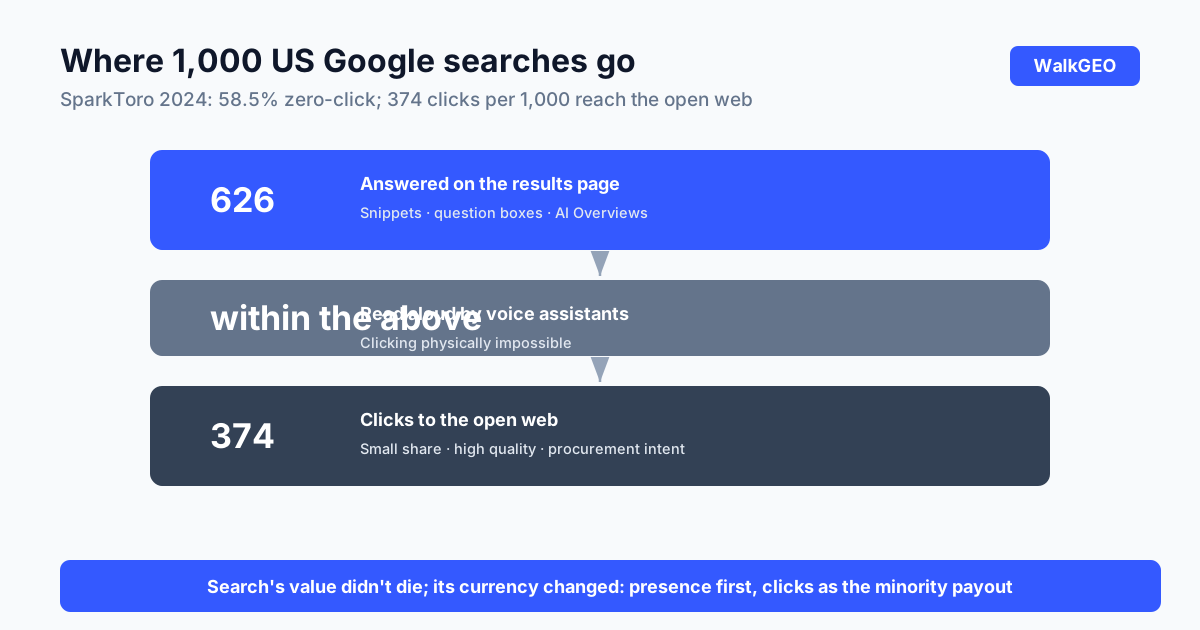
Every 1,000 US Google searches send only 374 clicks to the open web. Where did the other 626 go? The answer was read on the results page itself; featured snippet, expanded question box, AI Overview: the user's problem solved, zero clicks fired. That's the finding of SparkToro's 2024 clickstream study: 58.5% of US Google searches end without a click. Three things follow: where the traffic went, what GEO earns back, and which numbers survive fact-checking.
The data first, with a fact-checking log
Zero-click isn't a feeling; it's checkable. Before writing this piece we ran every candidate source through a verification pass; the log is below, reusable as a standard.
The verification results, three lines:
- Usable: SparkToro's 2024 study, by Rand Fishkin, built on Datos clickstream data. 58.5% of US Google searches end zero-click; 59.7% in the EU; 374 clicks per thousand reach the open web. Method and sample are public, the sample is real user behavior rather than a survey, and the conclusion matches everyday search experience. Use it.
- Usable with an asterisk: Gartner's February 2024 press release, forecasting a 25% drop in traditional search volume by 2026. Note the word forecast: not a measurement, and 2026 retrospectives already note the actual decline didn't reach that number. Cite it with the year and "forecast" attached; predictions are signposts for direction, not milestones.
- Discarded: the "AI search market worth $X billion" figures circulating everywhere. The same claim varies several-fold across reprints, the original source can't be traced, and the numbers don't reconcile. None of them enter this piece. The discard line is itself the discipline: a number either traces to its source or stays out of your writing.
Where the traffic went: the anatomy of one search
Take a typical search apart and the clicks explain themselves. The user searches; the results page answers in place: a featured snippet answers directly, question boxes expand, an AI Overview synthesizes a sourced paragraph. Problem solved, search over, zero clicks. That's the biggest bucket, and SparkToro's 58.5% largely lives here, growing as AI Overview coverage rises.
Second: voice and assistant scenes. The answer is spoken aloud; no results page even appears. The citation is spoken to the user: clicking is physically impossible. Ask your car "which shops nearby are still open", the assistant reads the list, you remember a name. No click happened; the named shops got a real exposure anyway; the most absolute of the three buckets.
Third: finally; the clicks: users who finished the answer unsatisfied, or arrived with procurement intent and want to verify, and tap into the source list. Small in share, high in quality; these people chose you deliberately.
Each bucket earns its own countermeasure: the in-place bucket competes on presence, material into the answer; the voice bucket competes on a clean, pronounceable name and clear entity; the click bucket competes on landing-page readiness, so the hard-won click doesn't land on a page that won't load.
Together the three say one thing: search's value didn't die; its currency changed. Some read zero-click as "search engines stealing traffic": the emotion is understandable, the direction is wrong. Engines improved answer quality so users would hand over more questions; the more users hand over, the more valuable the sources inside the answers become. The platform didn't steal your clicks; it changed the currency it pays you.
GEO earns presence, not clicks
Follow that through and GEO's reward model is clear. Being cited into an answer buys three things.
Presence: you're in the answer, competitors aren't, and the procurement default starts tilting your way. This never appears in any traffic report, yet it's the first link in the decision chain. Two scenes for its weight: a procurement newbie using an AI engine for supplier shortlisting; absent from the answer, you don't even get compared. A CEO asking an AI about their own company and hearing the business described as it was three years ago: the internal meeting is lost before it starts. What presence loses are the opportunities that "haven't started yet", which is why it fails so quietly: only active re-testing notices.
Trust: the engine picking you as a source is a first screening done on the user's behalf. Being cited itself broadcasts "this source checks out"; a layer search rankings never provided.
Minority clicks: those who do click arrive with half-formed procurement questions. A quality example: ask on the landing page "which competitors are you comparing?" and the conversion path shortens a step. Traffic reports will tell you these visitors are few; they won't tell you they're valuable.
The correct question in a zero-click era therefore changes. Not "how do I win the traffic back": an old war that can't be won; but "when the answer gets assembled, am I in the candidate pool?" The second is home ground for citable material: definition sentences, spec pages, FAQs are all assembly material. Sites with complete material get assembled eventually; sites without it are losing even the denominator. And the monitoring metric shifts from clicks to mentions and citations, with AI referral traffic as a supporting signal: its scope and limits covered in the tracking piece.
Boundaries: what hasn't changed
Zero-click isn't the apocalypse; three boundaries keep it honest:
- Keep doing SEO: the technical base (crawlable, indexable, structured) is simultaneously GEO's foundation, and the side benefit is real. The spec pages and FAQs you add for generative engines are also excellent classic-search results; one construction, two beneficiaries, which is what makes a GEO budget approvable.
- Clicks still happen: 374 per thousand isn't zero, and procurement/verification intent clicks are rising in quality. "Traffic shrank" doesn't read as "traffic stopped mattering".
- Gartner's 25% is a forecast already corrected by retrospectives; don't use it to cut SEO budgets. Budgets follow your own monitoring data: each quarter, lay the budget out across the machine, material, and monitoring layers and check which block's numbers haven't moved for two consecutive quarters. Prediction articles give direction; your own ledger gives budget justification.
to clear: zero-click concentrates in informational searches. Procurement and navigational searches still click at solid rates. Which kind your category is shows in what buyers ask: mostly "how does this work" means informational, presence leads; mostly "which is best, what does it cost" means clicks still pay, and you run both lines. The judging material comes free: the ratio of informational to procurement phrasings in your support transcripts is your category's portrait. No guessing required.
The zero-click era's action, compressed: make "being cited" the new KPI and clicks its by-product: never reversed, because people who reverse it chase clicks straight back onto the old map. The first step this week: run a fixed question set against a few AI engines and count how often you appear. The first number will probably be ugly; record it anyway. That's your baseline, and a baseline's job isn't to look good; it's to give the you-of-four-weeks something to compare against. WalkGEO ships mentions and citations as a weekly close-out routine; pricing has the entry. And the fact-checking stubbornness in this article: you're welcome to point it at our numbers too.
FAQ
Does zero-click mean SEO is useless?
No. Clicks still happen, and SEO's technical base (crawlable, indexable, well-structured) is also GEO's foundation. What changed is the reward structure: traffic used to be the main payout; "being cited into the answer" is now a second payout running alongside. Keep doing SEO; just stop treating it as the only monetizable thing.
If users don't click, what's the point of being cited?
Three things: presence (you're in the answer, competitors aren't: the procurement default tilts), trust (the engine chose you as a source, a first round of screening on your behalf), and a small number of high-quality clicks (people who click arrive with formed questions). Citation's return isn't all traffic; measuring it like an ad slot misprices it.
Is the zero-click data reliable?
Depends on the source. SparkToro's 2024 clickstream study (58.5% of US Google searches end without a click) publishes its method and sample; trustworthy. Gartner's February 2024 "search volume drops 25% by 2026" is a forecast, and 2026 retrospectives note the actual decline didn't reach that number; cite it with the year and the word "forecast". Repackaged market-size figures with irreconcilable numbers: never use.
Do small sites still have a chance in a zero-click world?
Yes, and it's in the long tail. Head questions are fenced off by big sites; long-tail specific questions reward material quality: engines pick whichever source is most specific and most verifiable, regardless of domain size. Making ten long-tail answers the most reliable on the internet beats fighting for ten head questions, at an order of magnitude less cost.
Done reading? Run the same audit on your own site
Sign up, then let the agent scan every page and hand you a prioritized fix list. Your first audit is free.
Run a free site audit