Your Website in the AI Era: From Brochure to Source of Truth
Your site has a second job: the reference an engine checks your claims against. A four-page fact-layer skeleton with cell-by-cell notes, plus how we turned our help docs into checkable pages.
The era of treating a website as a brochure is over. A brochure's job is to say what you would like people to believe. A source of truth's job is to hand over things anyone can check line by line: specs, dates, boundaries, sources. When an engine needs to verify a claim about you, your site is the most stable reference, because you control it, it can be traced, and it can be updated. Leave that slot empty and it goes looking elsewhere, where the wording is not yours.
First, the four-page skeleton you can copy
Start with a table that holds the frame. These are not four writing styles; they are four containers for checkable facts. Audit your site against the table once, then fill whichever row is missing or weak.
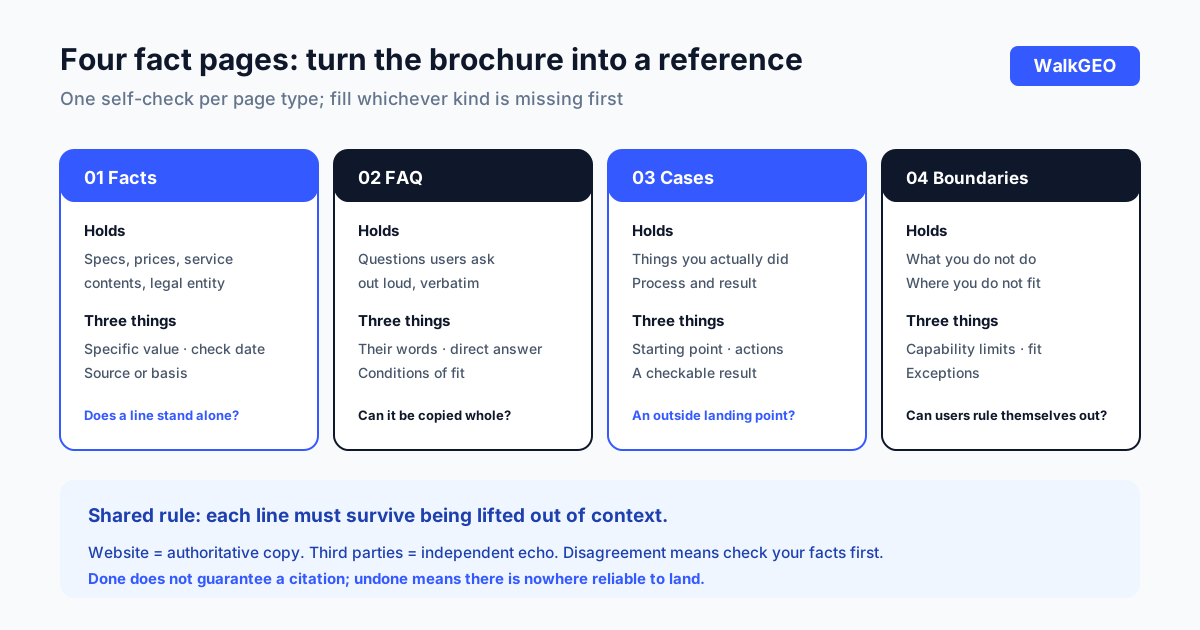
| Page | What it holds | Three things every cell needs | One-line self-check |
|---|---|---|---|
| Facts | Key specs, prices, service contents, legal entity | A specific value, a check date, a source or basis | Lift any line out: does it still stand alone? |
| FAQ | Questions users ask verbatim | The user's own words, a direct answer, conditions | Can the answer be copied whole into a reply? |
| Cases | Things you actually did | Starting point, actions, a checkable result | Is there one landing point an outsider can verify? |
| Boundaries | What you do not do, where you do not fit | Capability limits, fit, exceptions | After reading, can a user tell you are not for them? |
All four share one rule: each line must survive being lifted out of context. If it does not, the page is a brochure no matter how good it looks.
Check point: copy the four rows into a document, mark each "present / absent / present but weak", and start with the bottom row.
Facts page: swap adjectives for checkable values
A facts page holds hard information: product specs, price tiers, what the service includes, who the legal entity is. Every cell needs three things: a specific value, a check date, and a source or basis. Miss any one and the cell reads as a claim awaiting proof, not a usable fact.
There is a cheap swap here: replace adjectives with values. "Fast response" becomes "first reply within 24 hours on working days". "Comprehensive coverage" becomes "supports Chinese and English, four domestic engines". After the swap, readers can check it, engines can cite it, and you know exactly what you promised. Volatile facts like price need extra care: mark the version and date so an obsolete number does not keep speaking for you online.
The facts page has a hidden job too: it supplies the citation source for other pages. Third parties write about you, FAQs answer about you, cases tell your story, and all of them eventually trace back to one authoritative version. That version lives here. It can be short, but it must be complete, accurate, and dated.
Check point: pick the five specs you are asked about most, open each on your site, and see whether a dated, specific value exists.
FAQ page: use the user's words, give an answer that can be moved whole
An FAQ page is not a display of expertise; it catches questions users would ask out loud. Copy real phrasings rather than rewriting them into internal terms. Answer directly in thirty to fifty words, with conditions attached. Done well, the answer can be lifted whole into an AI reply without losing context.
A common mistake turns FAQ into a storage room for marketing lines: every question bends back to "our product is great". Such an answer is either skipped or extracted as bare self-praise, which costs trust. Answer the question on its own terms, then add one checkable entry point. For the mechanics, see citable content, which breaks down the answer capsule in more detail.
FAQ also covers long-tail questions naturally. Every real question you collect is an entry point someone might put to an AI; writing it as one question and one answer gets there ahead of time. Where questions come from and how to freeze the set is covered in prompt set design.
Check point: pull three FAQ answers at random, copy one into your clipboard, and pretend you do not know who you are. Is it still complete?
Case page: give an engine a story it can retell
A case page answers "you say you are good, on what evidence". A citable case has three parts: a starting point, what you did, and a checkable result. The third is the one most often skipped and the least skippable. A result with no outside landing point is just a self-report.
Cases need not be grand. A small change written with its process intact stands up to checking better than a packaged epic. Split it using the fragment principle in citable content so each paragraph stands alone, and keep fact and entity wording consistent with brand entity consistency so the same case reads the same in two places.
Case and facts pages prop each other up: every concrete claim in a case should have a corresponding value on the facts page. When the two disagree, cross-checking exposes it.
Check point: open your most recent case, find its biggest number, and see whether it has a source on the facts page.
Boundaries page: what you do not do is also a key fact
The most commonly missing of the four is the boundaries page. It says what you do not do, where you do not fit, and when someone should not come to you. It sounds like turning customers away; in practice it is the page that builds the most trust. A brand that dares to state its limits makes everything else it says more credible.
Write at least three things: capability limits (what is outside the service), fit (which objects suit you and which do not), and exceptions (conditions under which the conclusion changes). These map directly onto what an engine is trying to decide: which category to file you in, who to list you beside, and what reason to give for recommending you. The clearer the boundaries, the more accurate the filing. When boundaries are vague, the engine fills your space with what peers say.
Do not write this as a disclaimer. A disclaimer is legal voice; a boundaries page is checkable fact. One makes readers defensive; the other lets them judge.
Check point: pretend you are the wrong kind of customer. After reading, can you conclude on your own that you should not hire them?
Lesson: we treated our help docs as an afterthought
Here is a mistake of our own. Early on we wrote the help center as an after-sales attachment: for people who had already bought, in the voice of operating instructions, buried deep, with internal labels for titles. A textbook brochure move, serving existing customers and never considering a second identity.
What our own GEO audit surfaced was that this is exactly the material engines want to cite: step-by-step, checkable, users' own questions, direct answers. What we lacked was not content but the awareness to treat it as a facts page. The fix was unglamorous and none of it could be skipped: move the docs out of the deep path to a discoverable place; change titles from internal terms to users' words; add a direct answer and check date at the top of each; give key steps a verifiable landing point; and most importantly, bring documents like the weekly routine into the site's fact layer under one maintenance rhythm shared with the facts page.
There is no "citations rose by X percent after the rewrite" story here; the observation window is not complete and we will not invent the figure. What we can confirm is that the page's role changed, from an attachment serving existing customers to public fact anyone can check. What that means for you is direct: you probably have a stack of things treated as internal material, manuals, FAQs, service notes, and they may be exactly the pages an engine needs and cannot find. Before writing new ones, pull the existing ones out and run them through the four-page test.
Check point: list the three most deeply buried document pages on your site and judge whether any is maintained as a facts page.
A website is not the whole story: why third parties still matter
With the four page types in place, your site becomes the authoritative copy. It cannot replace third-party presence. When judging a claim, an engine compares multiple sources for agreement: your site saying you are good is a self-report; an industry article, a Q&A thread, or a news mention saying the same thing is cross-checking. Self-report alone has a ceiling on credibility.
The relationship is a division of labor, not a substitution. The site holds the authoritative version; third parties provide the independent echo; the site keeps wording accurate; third parties show the wording has been tested outside. When the two disagree, check your own fact layer for something out of sync before rushing to edit the outside. The mechanism is explained in how AI picks sources and the operational items are in the GEO checklist.
No slighting either side, and no promise that "change the site and you will be cited". The site is foundation work: it decides whether you have a reliable landing place; whether you are cited also depends on question relevance and cross-checking. For crawlability, see structured data and the llms.txt guide.
Check point: pick any key fact about your company and see whether the site and third parties say the same sentence.
Common questions
What role does my website actually play in AI search?
It moved from brochure to source of truth. A brochure says what you want people to believe; a source of truth gives things they can check item by item: specs, dates, boundaries, sources. When an engine verifies a claim about you, your site is the most stable reference because you control it, it can be traced, and it can be updated. Leave that slot empty and the engine looks elsewhere, where the wording is not yours.
Which pages does my website need?
Four kinds: a facts page (key specs and claims with dates and sources), an FAQ page (questions in users' own words, answered in 30 to 50 words), a case page (things you actually did, with a checkable process and result), and a boundaries page (what you do not do and where you do not fit). All four share one rule: each line must survive being lifted out of context. Fill whichever kind is missing first.
If I fix my website, will AI cite me?
No guarantee. The site gives an engine reliable material to draw on; whether it draws depends on question relevance and cross-checking against other sources. Treating it as a promise is self-deception; treating it as foundation work is correct. It decides whether you can enter the candidate pool, not whether you are chosen. Without the base, every other tactic lacks a landing place that can be verified.
If I have a website, do I still need third-party presence?
Yes. Third parties provide independent endorsement and cross-checking your own site cannot give you, and engines compare whether accounts agree. Your website is the authoritative copy of the facts; third parties are the evidence those facts get repeated and tested outside. When the two disagree, check your own fact layer for something out of sync first. It is not either-or; it is two outlets for one set of facts.
A brochure speaks to people who have decided to buy; a source of truth speaks to people still deciding. The first thing you can do today: run your site through the four-page table and move the most deeply buried document page somewhere it can be found. Fold the checks into the weekly routine, and find the full self-audit in the GEO checklist. WalkGEO's own help docs are being rewritten to this standard, and every stage is open for checking on the site; for when the work is better handed to tooling, see products and pricing. An engine will not cite you just because you built a facts page, but without one it has no reliable place to land.
Done reading? Run the same audit on your own site
Sign up, then let the agent scan every page and hand you a prioritized fix list. Your first audit is free.
Run a free site audit