Yuanbao Fades, WorkBuddy Rises: Should GEO Watch Entrances or Engines?
Tencent Yuanbao hasn't been renamed — the weight shifted to WorkBuddy. Monitor GEO at the entrance layer, organize work by engine: citations come from each entrance's retrieval layer.
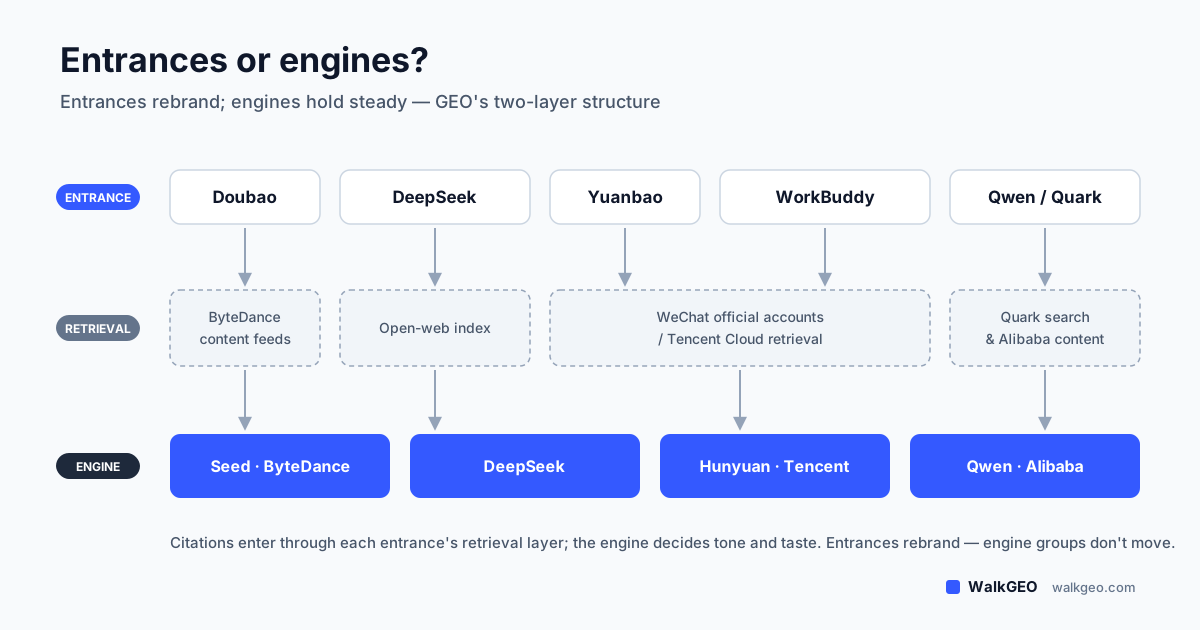
Tencent Yuanbao has not been renamed — it is still Yuanbao, and the app still ships updates. What changed is that Tencent has moved the weight of its AI investment to WorkBuddy, a new office-focused entrance. For anyone doing GEO, the news matters less than the question it exposes: the entrance you optimize for can be rebranded or sunset overnight, while the engine behind it stays comparatively stable. This article splits GEO into two layers — entrances, where citations actually happen, and engines, which decide how answers sound. The conclusion up front: monitor at the entrance layer, organize your work by engine — so the next rebrand next door never forces you to rebuild anything.
The facts first: Yuanbao isn't renamed, but Tencent is switching boats
Verify the facts before drawing strategy. As of October 2026, Yuanbao still exists under that name, with no renaming announcement. The shift happened one level up. According to a June 2026 report by 36Kr, Tencent is moving AI resources from its general-purpose chatbot Yuanbao toward WorkBuddy, an office-track entrance built to avoid going head-to-head with Doubao and Qwen. WorkBuddy came out of Tencent Cloud's CodeBuddy team, launched in March 2026 with an enterprise edition in June. It is a task-executing agent: it takes a natural-language instruction, decomposes the task, operates local files, and produces research reports with sources cited.
Traffic data tells the same story. Public reporting on QuestMobile data (Daily Economic News, April 2026) puts Doubao at roughly 380 million monthly active users, Qwen at about 170 million, and DeepSeek at about 130 million — while Yuanbao fell to around 40 million in Q1 2026, dropping out of the top three. Meanwhile WorkBuddy has been climbing fast and is now a flagship of Tencent's AI office lineup.
For GEO, those facts compress into one sentence: the "we cover Yuanbao" line in your copy may need rewriting next year; the WeChat-ecosystem content you built for Tencent this year keeps working. Entrance names and rankings change. What sits underneath them does not — or at least changes far more slowly. What exactly sits underneath? Read on.
Entrances vs engines: what's the difference?
Define the two terms first, because mixing them up costs money:
- Entrances are where users ask. Doubao, DeepSeek, Yuanbao, WorkBuddy, Qwen, Quark — all entrances. When your customer says "I asked Doubao," they name an entrance. Each entrance carries its own retrieval layer: the search index and content ecosystem its web lookup draws from. Citation candidates enter the answer through that layer.
- Engines are the models generating the answer. ByteDance Seed (behind Doubao), DeepSeek, Tencent Hunyuan (behind Yuanbao), Alibaba Qwen (behind Qwen and Quark). Engines decide tone, reasoning style, and their preference for material that is specific, consistent, and checkable.
| Dimension | Entrance layer | Engine layer |
|---|---|---|
| The question it answers | Where do users ask? | How do answers sound, and how is material picked? |
| Who decides citation sources | The entrance's retrieval layer — whose index it queries, which content ecosystems it favors | The engine's taste in candidates: specific, consistent, verifiable |
| Rate of change | Fast: renames, rebrands, new players, monthly or quarterly | Slow: a handful of heads, generational cycles measured in years |
| What GEO can move | Place content into the ecosystems each entrance favors | Write your site's material so it can be lifted verbatim |
| Risk of watching only this | New entrances go unmonitored; old ones get over-served | Citation-source mismatch — your optimization never enters the answer |
The most important row is "who decides citation sources." The common belief is that the engine picks its sources. That's only half true: the engine picks, but only among the candidates its retrieval layer hands it. If the retrieval layer never surfaces you, the engine never gets the chance to cite you. The retrieval layer is GEO's real battleground. The mechanics — the checks AI runs before quoting a source — are covered in our piece on how AI picks sources.
Here is the single most valuable judgment in this article: the same engine, behind a different entrance, cites a different set of sources. The Tencent family is a live demonstration. Yuanbao's retrieval is deeply tied to the WeChat ecosystem, where official account articles get outsized weight. WorkBuddy's web search runs on Tencent Cloud's retrieval service, with source attribution as a product feature. Same Hunyuan engine, two entrances, two different citation profiles. Studying "what Hunyuan likes" does not get you into Yuanbao's answers.
Why entrance-only GEO exhausts you
One premise first: monitoring has to sit at the entrance layer, because that's where users ask and where your brand gets mentioned or cited. Watching entrances is correct. The mistake is wiring every GEO action to one specific entrance — building a dedicated Yuanbao playbook, then a dedicated WorkBuddy playbook when it launches. Two failure modes follow.
First, exhaustion. You finally learned Yuanbao's temper in 2025; in 2026 it lost favor. WorkBuddy is rising today and may carry another name next year. Per-entrance playbooks mean costs scale linearly with entrance count, while which entrances survive is entirely out of your control. Betting budget on something you cannot control is the worst trade in operations.
Second, duplicated work. Look underneath the entrances and most of the Chinese market runs on four engines: ByteDance Seed, DeepSeek, Tencent Hunyuan, Alibaba Qwen. When a new entrance appears, ask which engine it sits on and whose retrieval it uses — the answer is usually "group it with what you have," not "build something new." WorkBuddy proves the point: it rides Tencent-family retrieval, so the official-account placement and site entity work you did for Yuanbao feeds it automatically. Building a fresh playbook for it means paying new costs to reproduce old coverage.
So the correct posture at the entrance layer: monitor per entrance — test wherever users ask; group actions by engine and content ecosystem — the entrance list changes freely, the action list barely moves. Entrances are volatile observation points, not volatile workload.
Why engine-only GEO falls short
The inverse mistake exists too: hearing "there are only four engines," concluding that polishing your site once makes you citable everywhere. The retrieval layer sinks that hope — each engine's entrance hands it different candidates. For the same company, the citation profile across four entrances can be four different lists:
- Doubao leans on ByteDance's ecosystem: articles, short video, Toutiao accounts — echo placement completely different from DeepSeek.
- Yuanbao carries the WeChat ecosystem, where official account articles sit in the first tier of citations.
- DeepSeek has no content ecosystem of its own; its retrieval base sits close to traditional search. Open web — your site, Zhihu, authoritative news — is the main battlefield.
- Qwen answers to Alibaba, and Quark's search ecosystem is another layout logic entirely.
One scope note: Quark is not currently on WalkGEO's monitoring list, so mentions of it here are placement advice, not a capability claim. What the monitoring list covers is defined by the site FAQ — that's a data red line we hold.
Your website's material is the shared foundation under every entrance; get it right once: definition sentences, parameters, FAQs, written so engines can lift whole sentences. Each entrance's content ecosystem is its own side dish — place echoes there separately. Fuse the two layers and you get the classic mystery: "our material is great, so why aren't we in the answer?" The four-gate audit in our visibility-gap piece walks the diagnosis in order.
Putting it to work: monitor by entrance, deploy by engine
Combine the two layers into one deployment table. Entrances on the monitoring side; actions grouped by engine and content ecosystem:
| Entrance group | Engine | Where citations come from | GEO actions |
|---|---|---|---|
| Doubao | ByteDance Seed | ByteDance ecosystem + website | Citable site material as the base; Toutiao-side echoes |
| DeepSeek | DeepSeek | Open web: site, Zhihu, news | Write for verbatim lifting; keep entity identical across sources |
| Yuanbao, WorkBuddy | Tencent Hunyuan | WeChat official accounts / Tencent Cloud retrieval | Mirror site definitions in official accounts, word for word |
| Qwen, Quark | Alibaba Qwen | Quark search and Alibaba content | Site base first; expand by customer volume |
Three disciplines to run with the table:
- For any new entrance, ask three questions before acting. Whose retrieval does it use? Does it have volume independent of its parent? Does existing coverage already absorb it? Usually it joins a group — the action list stays, the monitoring list gains a row.
- Rank the entrance list by volume; review the tail quarterly. Yuanbao's decline is not grounds for removal: ~40 million MAU is still a meaningful entrance, and its WeChat citation position is one nobody else offers. Downgrade priority; don't delete.
- Freeze the re-test protocol across entrances. Same prompt set, same schedule, engines logged separately — cross-entrance comparison only works on a frozen protocol. Our measurement piece defines the freeze.
First-hand: three changes we made to our own site this week
Method over. Here is what we did to walkgeo.com this week — small moves, each mapping to a judgment in this article, each verifiable on the live site.
- Re-ranked the engine list on our homepage and FAQ by MAU: Doubao, DeepSeek, Qwen, Yuanbao — Yuanbao last. The list reflects the market as it is; when a customer asks "isn't Yuanbao fading?", the ordering itself is half the answer.
- Added one sentence to our FAQ about entrance churn: "Entrances rise and fall with the market — WalkGEO connects at the underlying engine layer, so new entrances merge into the same monitoring automatically and coverage never shrinks." It answers two objections at once: the customer worried that Yuanbao's decline shrinks coverage, and the one who heard about WorkBuddy and wonders whether it costs extra.
- Grouped monitoring by engine: WorkBuddy joins the Tencent group rather than opening a new playbook. When its volume arrives, onboarding is a grouping action with near-zero marginal cost.
No citation-rate fireworks to show yet — the changes just landed, and by our own re-test discipline they wait for the next weekly window. That is itself part of discipline three: re-test weekly, treat daily noise as noise. This case study will be updated as the re-tests come in.
FAQ
Has Tencent Yuanbao been renamed to WorkBuddy? No. As of October 2026, Yuanbao still exists under that name with normal updates. What changed: Tencent shifted its AI resource weight to WorkBuddy, a new office-track entrance (36Kr, June 2026). For GEO, that means re-ranking your entrance list — not rebuilding your GEO.
Yuanbao's user base is shrinking. Should I still monitor it? Yes — lower the priority, don't remove it. At roughly 40 million MAU it remains a substantial entrance, and it is bound to the WeChat ecosystem, where official account articles are first-tier citation sources — a citation position no other entrance offers. Rank it after Doubao, DeepSeek, and Qwen; review quarterly.
WorkBuddy just launched. Do I need a separate GEO playbook for it? No. Ask whose retrieval it uses first: WorkBuddy rides Tencent-family retrieval, so it groups with Yuanbao — your official-account placement and site entity work carry over as-is. The standard move for a new entrance is grouping, not a new playbook; decide on dedicated placement once its independent volume is real.
Which AI engines should a China-focused GEO program actually monitor? Start by volume: Doubao, DeepSeek, Qwen, and Yuanbao — four entrances that together cover the four engines (ByteDance Seed, DeepSeek, Tencent Hunyuan, Alibaba Qwen). Add Baidu ERNIE or Kimi based on your customers' real usage. The point is a frozen list tested weekly, not a different engine every day.
If there are only four engines, does optimizing content once cover every entrance? The material layer is shared; the citation sources are not. Your site's citable material — definition sentences, parameters, FAQs — is the common foundation, right once. But each entrance's retrieval layer differs: Doubao leans ByteDance, Yuanbao leans WeChat official accounts, DeepSeek sits close to traditional search. Place echoes per entrance's ecosystem. Manage the two layers separately; no single piece of content wins everywhere.
Entrances have short half-lives; the engine layer is unusually stable. Put monitoring on the entrances and group your actions by engine and content ecosystem, and the industry's game of musical chairs stops being your risk. WalkGEO is built on exactly this structure: an entrance list that changes with the market, engine groups that hold steady. To see your brand's mentions, citations, and share of voice across the four entrances, start on the pricing page — or read what GEO is first for the foundations.
Done reading? Run the same audit on your own site
Sign up, then let the agent scan every page and hand you a prioritized fix list. Your first audit is free.
Run a free site audit