Beyond Mentions: How AI Describes Your Brand Matters
Being mentioned is not being described well. Category, peers, and reasons sit closer to conversion than mention rate. A sampling method for description consistency, plus our own record.
The most common move is to collapse AI visibility into one number: mention rate. Ask ten questions, count how often the brand appears, divide, drop it in the weekly report. The number is useful, but it answers "are you there", not "what are you". One engine calls you a solid entry-level choice for small teams; another says you are limited and fine for a trial. Both count as mentions, and they land on the user as opposite impressions. What actually decides whether someone clicks is the clause that says why you are recommended. What you are described as sits closer to conversion than whether you were described at all.
Three observation slots: category, peers, reason
A description is not a vague impression; it resolves into three observable slots. Read the sentences an answer gives about you and they will land in one of these three boxes.
| Slot | What to look at | Why it moves conversion |
|---|---|---|
| Category you were placed in | Entry-level, professional, alternative, or cautionary example | The category sets the budget and expectations the user brings to you |
| Who you are listed beside | Which brands share your sentence or paragraph | Those peers are the competitive set in the user's head |
| Reason given for recommending you | Price, function, reputation, or a vague "pretty good" | The reason becomes how users repeat you, and feeds the next answer |
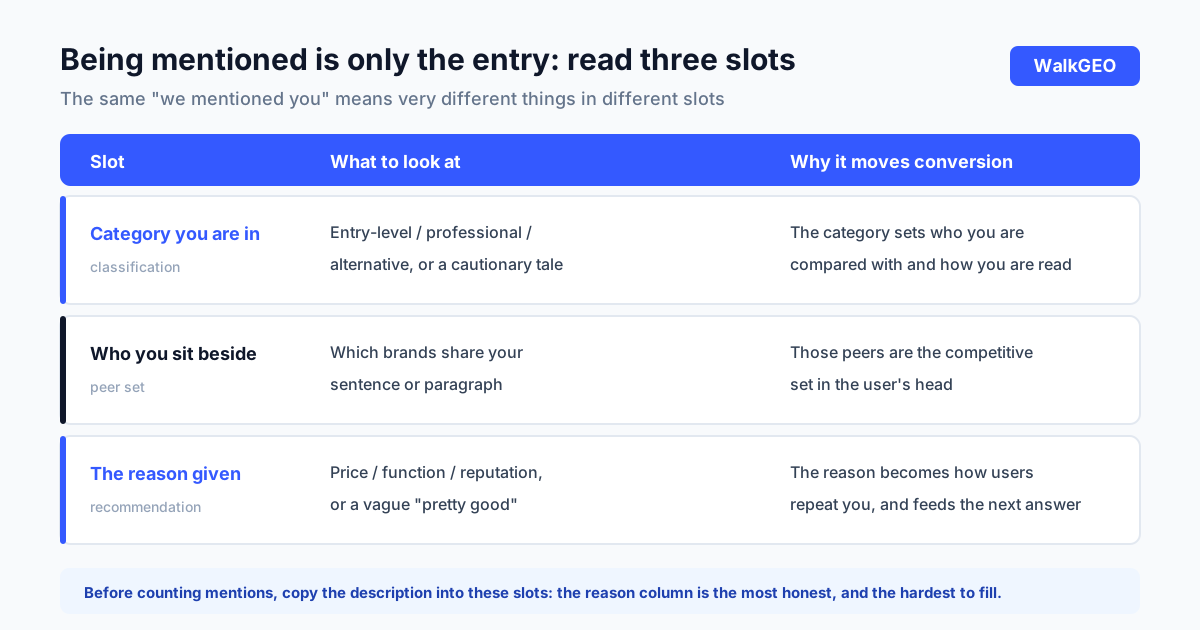
These three slots are worth more than mention rate because they map straight onto decisions. Being filed under "entry-level" means the user arrives with a low-budget expectation, and a pitch about professional depth lands on deaf ears. Being repeatedly listed beside one brand means that, in the engine's material, you are already two answers to the same question; you cannot opt out of that comparison. And when the reason is always a vague "good reputation", it means the engine has no concrete fact about you to draw on, so it fills the space with adjectives. What is missing is a repeatable fact, not another mention of your name.
There is a second-order effect worth noting: these slots reinforce themselves. Once an engine files you under a category for one question, later similar questions tend to reuse it; once you have been listed beside a brand, that is usually the brand you are listed beside again. Descriptions have inertia, so correcting one takes longer than lifting a mention. That is exactly why the first impression deserves care; fixing a formed one costs several times more. When we ran our own sampling, the first thing we noticed was not how often we appeared but what the reason column held. That column is harder to fill than the count column, and far more honest.
Measuring description consistency: same questions, several engines
The method is simple; the hard part is resisting the urge to score it. Fix a batch of questions, ask each across several engines, copy the sentences that describe you verbatim, and sort them into the three slots. Put descriptions for the same question from different engines side by side and see whether they point to the same facts. You want original wording, not your impression of it, and certainly not a subjective rating from one to ten. Scoring turns observation into judgment, and once a judgment is in the sheet, it becomes much harder to read the original sentences objectively next round.
We ran this on ourselves. The question set came from the frozen batch in prompt set design, engine coverage followed the portfolio in multi-engine monitoring, and each description went into a sheet with engine, question, verbatim sentence, and slot. The most useful finding was that the reason slot was the hardest to fill: plenty of answers were happy to mention us but could not produce a specific reason, offering only a broad assessment instead. That is not surprising. When a product is newly known, an engine usually has a name and a category, and no repeatable fact yet. We used that to rank our actions: build facts first, chase more mentions second. To place this method precisely, it is a structured observation, not an assessment tool, and it complements the verifiable metrics in measuring AI visibility rather than replacing them.
Mindshare and rank: sequence is not causation
Put description observation next to the metrics cluster and a tempting inference appears: get the rank and mentions up, and the description will follow. The inference is not wrong, but it gets part of the causality backwards. Rank and mentions are upstream inputs, and so is verifiable fact coverage; the description is the joint result of all three. When the fact layer is thin, mentions can rise while the engine still has nothing concrete to say, and your position in the reason column does not improve on its own.
That is why the point stressed in GEO metric definitions holds here: record what can be verified accurately, keep observation signals in a separate place, and never blend the two into one leaderboard. A description position is an observation signal, not a precise count; the same sentence can shift with the phrasing of the question. It belongs in a weekly report as a trend, not in a contract as "increase by X percent this quarter". We keep two columns: verifiable items that can be counted, and description excerpts with trend arrows. It looks less tidy, but it is honest, and it removes the temptation to tune questions for a prettier number. This is our own constraint on subjective metrics, not an industry standard, and I am saying it so you know how to read the sheet.
Which layer to change
Actions belong where you have control. You cannot edit an answer, but you can change the material it draws on. Each slot maps to one layer. An unclear category calls for a definition and boundaries, so the engine knows which class you belong to and which you do not. An unfavorable peer set calls for comparable facts: specs, use cases, and price ranges written as checkable pages so the comparison has something to stand on. A vague reason calls for a repeatable fact, one concrete practice that can be retold, worth more than ten lines of self-praise. All three land on your own fact layer, inside the area you actually control.
Back to our own sampling. The thin reason column pointed not to "publish more posts" but to the fact that our own fact pages were not yet easy to retell. What we did was reorganize key practices into pages with parameters, dates, and verification entry points, giving the engine something concrete to work with. There is no percentage to brag about; the observation window is not complete, and any improvement figure would be premature. What we can confirm is that the direction of the action matches the way descriptions are formed. What this means for you is specific: open a recent AI answer, copy the sentence that describes you, and look at the reason column. If it holds only adjectives, hold off on volume and go build one page with a fact someone can repeat. For how to write that page, see citable content; for keeping names consistent, see brand entity consistency.
Common questions
If AI mentions my brand, is our visibility work done?
A mention answers "are you there", not "what are you". One engine may call you a solid entry-level choice for small teams while another says you are limited and fine for a trial; both are mentions, and they land on the user as opposite impressions. What sits closest to conversion is what you are described as, who you are placed beside, and why you are recommended. Treating mention rate as the finish line misses all of that.
How do I actually measure description consistency?
Ask the same batch of questions across several engines, copy the sentences that describe you verbatim, and sort each into three slots: which category you were placed in, who you were listed beside, and what reason was given for recommending you. Put descriptions for the same question side by side and see whether they point to the same facts. This is a structured observation, not a score, and no engine needs a subjective rating.
Is an inconsistent description the engine's fault or ours?
Do not rush to attribute. If the same fact is worded differently across your own site, Zhihu, and your WeChat articles, the engine is faithfully reflecting that inconsistency and your content is what needs fixing. If your wording is consistent everywhere but answers still disagree, that is sampling variance or a difference in sourcing; keep retesting by window and do not conclude from a single run. Check your own fact layer before blaming the model.
Can we make mindshare metrics a hard KPI for the team?
I would not. A description position is an observation signal, not a precise count; the same sentence can change with the phrasing of the question. It belongs in a weekly report as a trend, not in a contract as a promised percentage. What can be a hard metric is verifiable fact coverage: whether key fact pages exist and whether specs have sources. Mindshare improves as a result of those actions; it is not a number you can commit to deliver.
Being mentioned makes you a name; being described correctly makes you an option. So here is the question: when someone asks an AI "which one suits me", is the you in its answer the you you want users to meet? That answer is not in the engine's hands; it is in the facts you have already made public. Today's move is to copy the description sentence out of your latest answer into a sheet and fill whichever slot is missing. Fold retesting into the weekly routine, read metric definitions for the full framework, and see products and pricing for where the tooling stops. WalkGEO's own description sheet still has blank reason cells; we intend to fill the fact pages first and worry about the counts later.
Done reading? Run the same audit on your own site
Sign up, then let the agent scan every page and hand you a prioritized fix list. Your first audit is free.
Run a free site audit